
You’ll typically spend between $1,500 and $2,500 to convert a standard inground pool to saltwater. Your salt chlorine generator represents the largest expense at $500 to $2,000, consuming 50-75% of your total budget. Professional installation adds $500 to $1,500, while initial salt costs run $10 to $40 per 40-pound bag. Budget-friendly DIY setups start around $500, but larger pools can reach $6,500 or more. Understanding hidden equipment upgrade costs below will help you plan accurately.
Total Saltwater Conversion Costs: $500 to $6,500 Breakdown
How much will converting your pool to saltwater actually cost? The total cost to convert pool to saltwater ranges from $500 for basic DIY setups to $6,500 for professional installations with premium equipment. In addition to the initial conversion cost, you may also want to invest in a saltwater conversion kit for pool maintenance to ensure optimal water quality. Many homeowners find that the long-term benefits, such as reduced chemical usage and lower maintenance costs, make this upgrade worthwhile. It’s essential to explore various brands and options to select the best kit that suits your specific pool requirements.
Your pool equipment costs break down into three main categories. The salt chlorinator price runs $600 to $2,000 depending on pool size and features. Professional installation adds $500 to $1,500 for electrical and plumbing work. Initial salt purchase costs $10 to $40 per 40-pound bag.
Budget-friendly conversions typically fall between $1,500 and $2,500. Standard inground pools average $1,700 to $2,500 plus salt. Larger or high-end pools requiring upgraded equipment and powerful chlorination systems can reach $6,500 to $10,000. Above-ground pools offer the most affordable option at $600 to $1,100. Keep in mind that you’ll need to budget for replacing the cell and control board every 3 to 7 years, which adds $1,200 to $2,000 to your long-term costs. Despite the upfront investment, saltwater systems typically save $300, $600 per year in chemical costs, helping the conversion pay for itself over time. Before converting, ensure your pool materials are compatible with saltwater, as certain surfaces and equipment may require upgrades to prevent corrosion or damage.
Salt Chlorine Generators: Your Biggest Expense ($500, $2,000)
The salt chlorine generator represents your largest single equipment investment, accounting for most of your conversion budget. When calculating your saltwater pool conversion cost, expect to spend $500 to $1,200 for above-ground pools and $1,000 to $3,200 for in-ground systems.
Your chlorine to salt water pool conversion cost depends heavily on proper sizing. Select a generator rated 1.5 to 2 times your pool’s volume, a 20,000-gallon pool needs a 30,000 to 40,000-gallon capacity unit. Your chlorine to salt water pool conversion cost depends heavily on proper sizing, which directly impacts long-term performance and efficiency as well as the saltwater pool benefits for homeowners. Select a generator rated 1.5 to 2 times your pool’s volume, a 20,000-gallon pool needs a 30,000 to 40,000-gallon capacity unit to maintain consistent chlorine production and reduce system strain.
Popular options include Hayward AquaRite and SwimPure systems ($850, $1,800) and Pentair IntelliChlor models (starting at $1,500). Each system includes a control box and salt cell that work together through electrolysis. The control board also allows fine-tuning of chlorine production and integration with pool automation systems. Budget for cell replacement every 3, 7 years at $700, $1,100.
Saltwater Conversion Costs by Pool Size
Everyone planning a saltwater conversion should understand that pool volume directly determines your total investment.
Small Pools (Under 10,000 Gallons)
You’ll spend $600 to $1,100 total. Generators start at $400, and you’ll need approximately 268 lbs of salt costing $80 to $100.
Medium Pools (10,000, 20,000 Gallons)
Expect $1,500 to $2,500 for complete conversion. Generators run $800 to $2,000, with salt requirements reaching 500, 600 lbs at $125 to $380.
Large Pools (20,000, 30,000 Gallons)
Budget $2,000 to $4,500 including installation. Equipment costs hit $1,000 to $3,200, plus $100 to $200 for initial salt. You may also need to replace existing pool parts with salt-resistant materials to prevent corrosion damage.
Extra-Large Pools (Over 30,000 Gallons)
Premium systems require $6,500 to $10,000. You’ll need generators costing $2,500 to $4,000, plus $500 to $1,500 for labor and potential equipment upgrades reaching $3,000.
In-Ground vs. Aboveground: Which Costs More to Convert?
Beyond pool volume, your pool’s construction type, in-ground or aboveground, significantly impacts conversion costs.
Aboveground Pool Conversions
You’ll find aboveground conversions more budget-friendly, typically starting around $500 for basic chlorinator systems. These setups require minimal site prep, no excavation, and often accommodate DIY installation kits. Pump and filter integration runs approximately $500, keeping your total investment at the lower end of the $500, $2,500 spectrum. However, keep in mind that aboveground pools typically last only 7-15 years, which may influence your decision to invest in a conversion.
In-Ground Pool Conversions
In-ground conversions demand more robust equipment, pushing costs toward $700, $1,000 for chlorinator systems that integrate with existing pumps and filters. Material compatibility matters here, concrete, vinyl, or fiberglass pools each present unique considerations that may require additional adjustments. Keep in mind that geographical influences such as regional labor rates and proximity to supply centers can further impact your total conversion costs.
The Bottom Line
While aboveground offers lower upfront costs, in-ground pools deliver decades of durability and stronger property value returns.
Equipment Upgrades That Inflate Your Saltwater Budget
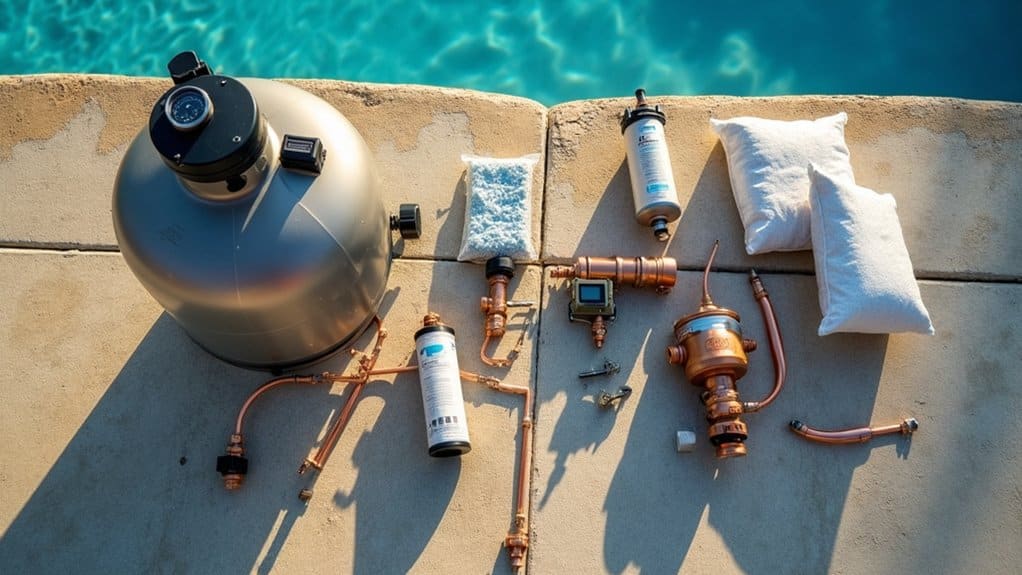
While the chlorinator itself represents your most visible expense, several supporting equipment upgrades can dramatically increase your total conversion budget.
The chlorinator is just the beginning, hidden equipment upgrades can significantly inflate your saltwater conversion costs.
Your existing pump may not be compatible with saltwater systems. Replacement pumps run $400 to $3,100, with variable-speed models recommended for ideal performance. Expect electricity costs to rise $35 to $50 monthly once your system’s operational.
Electrical upgrades often catch homeowners off guard. Dedicated circuits and wiring modifications cost $500 to $2,000, particularly for high-powered generators. Plumbing changes add another $300 to $1,000, while pool surface repairs for saltwater compatibility range from $500 to $2,000.
Don’t overlook filter replacements, which cost $250 to $2,000. Many conversions coincide with overdue filter upgrades, compounding expenses. If you’re also upgrading your pool cleaning equipment, robotic automatic pool cleaners like the Aquabot Pool Rover S2-40i start around $99.99. Budget $1,000 to $3,000 for combined equipment and plumbing modifications beyond your chlorinator purchase. You’ll also need to install a sacrificial anode to protect metal components from corrosion caused by the salt in your water.
Professional vs. DIY Saltwater Installation Costs
Once you’ve mapped out your equipment needs, the next decision, hiring a professional or tackling installation yourself, significantly impacts your final budget.
Professional Installation
Hiring a contractor costs $500 to $1,500 for labor alone. Total professional conversion runs $1,700 to $2,500 for inground pools, covering the salt chlorine generator, plumbing connections, and electrical work. You’ll pay more in urban areas where labor rates trend higher, but professional services certify proper handling.
DIY Installation
Most salt chlorinator systems include straightforward instructions for connecting to existing pools. You’ll spend $1,000 to $2,500 on equipment without service fees. However, you’re responsible for purchasing chemicals, tools, and any troubleshooting costs.
The Trade-Off
DIY saves $500 to $1,500 upfront but requires technical confidence. Professional installation guarantees proper setup and often includes warranties protecting your investment.
Monthly and Annual Costs After Your Saltwater Conversion
Once your saltwater conversion is complete, you’ll need to factor ongoing operational costs into your budget. Your salt chlorinator runs continuously, adding approximately $800 to $1,200 annually to electricity expenses, while monthly maintenance costs drop to around $45 for DIY upkeep or $80 to $95 for professional service visits. Annual chemical and salt expenses typically range from $70 to $100, significantly lower than the $300 to $800 you’d spend maintaining a traditional chlorine pool. Keep in mind that saltwater chlorine generators can cost about $330, with replacement cells ranging from $200 to $1,400 when they eventually need to be replaced.
Monthly Electricity Cost Increases
Converting to saltwater doesn’t dramatically spike your electricity bill, but you’ll notice a moderate increase from the chlorinator cell’s continuous operation. Saltwater chlorinators typically draw 200-500 watts while running, adding minimal load to your existing system.
Your pump type determines the bulk of electricity costs. Single-speed pumps run $75, $150 monthly, while variable-speed models cost just $10, $50. After conversion with an efficient variable-speed pump, expect monthly costs between $10, $31 for pump operation alone.
The overall monthly increase from saltwater conversion stays within $30, $100 when you’re running an efficient setup. Annual post-conversion electricity costs range from $360, $1,200, comparable to traditional chlorine pools. Your geographic location considerably impacts these figures, electricity rates vary from $0.164/kWh nationally to $0.43/kWh in Hawaii.
Annual Maintenance Expenses
Your saltwater pool’s annual maintenance expenses break down into predictable categories that you’ll manage differently than traditional chlorine systems.
You’ll spend $70 to $100 annually on salt and chemicals, significantly less than the $100 to $400 traditional chlorine pools require. This reduction eliminates manual chlorine tablet purchases, shock treatments, and algaecide costs.
Salt cell replacement adds $200 to $1,100 every 3 to 7 years, averaging out in your annual budget. You’ll clean the cell plates at least twice yearly, though hard water conditions may require descaling every 2 months.
Professional maintenance runs $80 to $95 monthly, while DIY approaches cost approximately $45 monthly. Factor in opening and closing costs of $300 to $650 annually. Total maintenance-only expenses typically fall between $960 to $1,800 per year.
Regional Price Variations for Saltwater Conversions
Five distinct U.S. regions show significant price variations for saltwater pool conversions, ranging from $600 to $3,000 depending on local labor rates, climate demands, and regulatory requirements. Five distinct U.S. regions show significant price variations for saltwater pool conversions, ranging from $600 to $3,000 depending on local labor rates, climate demands, and regulatory requirements, which often leads homeowners to ask can you convert your pool to salt water based on their specific location and setup.
| Region | In-Ground Range | Above-Ground Range |
|---|---|---|
| Northeast | $1,800, $2,500 | $700, $1,500 |
| Southeast | $1,100, $2,000 | $800, $1,800 |
| West Coast | $1,500, $3,000 | $1,000, $2,000 |
You’ll find the Southeast offers the lowest conversion costs due to high pool density and mild weather, with labor running $150, $250 per installation. The West Coast commands premium pricing from seismic considerations and stricter regulations. In the Midwest and Northeast, you’ll need to budget an additional $200, $500 for winterization requirements that protect your salt chlorinator during freeze cycles.
Ready to Transform Your Backyard?
Your dream pool is closer than you think. At Schiller Pools, our experienced team brings over 40 years of expertise to every project, delivering stunning fiberglass pool installations and custom pool construction that turn ordinary backyards into extraordinary outdoor retreats. With flexible financing options and lifetime warranty backing, there has never been a better time to get started. Call (561) 475-5997 today for your free estimate.
Frequently Asked Questions
How Long Does a Saltwater Pool Conversion Typically Take to Complete?
You can complete a saltwater pool conversion in 1-2 days total. If you’re tackling it yourself, expect 3-6 hours for the physical installation, followed by 24 hours of pump circulation to dissolve the salt. Professional installations typically wrap up in a single day. After adding salt, you’ll need another 24-48 hours to stabilize chlorine levels, adjusting your chlorinator output until you hit that 1-3 PPM sweet spot.
Can Saltwater Damage My Pool’s Existing Liner or Surface Materials?
Yes, saltwater can damage certain pool surfaces and liners. If you’ve got a concrete or plaster pool, salt accelerates wear up to five times faster than traditional chlorine. Vinyl liners themselves resist salt, but leaks let saltwater corrode metal wall panels behind them, especially galvanized steel. Fiberglass pools handle saltwater best with minimal surface impact. You’ll also need to protect metal components like ladders and heaters with sacrificial zinc anodes.
Is Saltwater Safe for Swimmers With Sensitive Skin or Allergies?
Saltwater pools generally suit sensitive skin better than traditional chlorine pools because they produce lower chlorine levels and fewer irritating chloramines. However, you can’t completely avoid chlorine exposure since saltwater systems still generate it for sanitization. If you have eczema or atopic dermatitis, you’ll want to apply emollients before swimming and shower immediately afterward. For ideal skin protection, consider mineral pool systems, which reduce chloramine production by approximately 40%.
How Often Do Salt Chlorinator Cells Need Replacement?
You’ll typically replace your salt chlorinator cell every 3-5 years, though proper maintenance can extend this to 7 years. Oversizing your cell by 1.5-2 times your pool’s capacity reduces its workload and prolongs lifespan. Clean the cell every 2-3 months, maintain salt levels between 2700-3900 ppm, and store it during off-season. Watch for declining chlorine output, persistent scale buildup, or erratic readings, these signal it’s time for replacement.
Will Converting to Saltwater Affect My Pool Warranty Coverage?
Converting to saltwater typically won’t void your overall pool warranty, but you’ll need to check the fine print carefully. Manufacturers may exclude coverage for corrosion or damage directly caused by salt exposure, particularly affecting heaters, metal fixtures, and automatic pool covers. Your pool’s surface materials and equipment compatibility matter critically. Before installing a salt chlorinator, contact your manufacturer to confirm coverage terms and identify any components that could lose warranty protection.