You’ll leverage fiberglass pool shells‘ fire resistance advantages through their silicon dioxide composition, which withstands temperatures exceeding 1,500°F before structural compromise. The glass fibers won’t burn, decompose, or release combustible gases, while fire-retardant resin formulations create protective char layers that slow flame spread. For ideal protection, you’ll want materials meeting ASTM E84 Class A ratings with a Flame Spread Index ≤25. Understanding installation requirements in high-risk zones further maximizes these advantages.
Why Glass Fibers and Resin Create Natural Fire Resistance
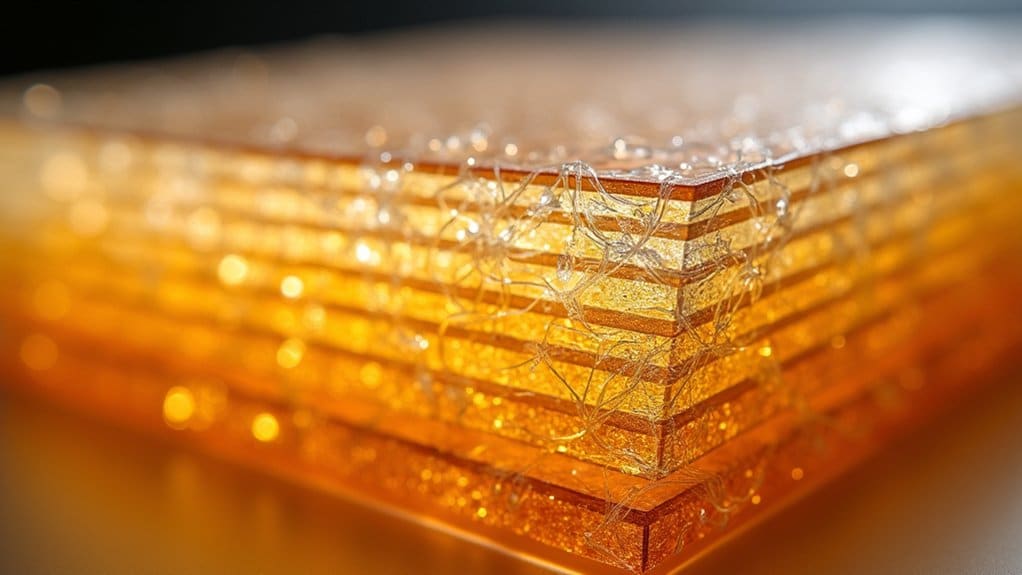
Glass fibers derive from silicon dioxide (SiO₂), giving them the same non-combustible properties as glass itself. You’ll find these fibers withstand temperatures exceeding 1000°C (1832°F) without burning, decomposing, or releasing combustible gases. The softening point ranges between 1300°F and 1400°F, with melting occurring between 1400°F and 1500°F.
When you examine the composite structure, binder resin degradation occurs at considerably lower temperatures, typically 400°F to 500°F. However, the glass fibers remain structurally intact even as resins burn. Fire-retardant resin formulations containing halogens or phosphorus compounds create protective char layers that slow flame spread. These advanced resin systems achieve self-extinguishing characteristics while the non-combustible fiber matrix provides the primary barrier against fire propagation throughout your pool shell structure. While the fiberglass reinforcements themselves do not burn, thermoset resins can generate heavy, dense smoke during combustion, which should be considered in enclosed applications. The fumes released from burning resin are toxic and unsafe to breathe, causing irritation, coughing, and wheezing if inhaled. This inherent fire resistance makes fiberglass ideal for high-risk environments including chemical plants, electrical enclosures, and transportation applications.
How Fiberglass Insulation Stops Heat From Spreading
When you examine how fiberglass insulation prevents heat transfer, you’ll find three distinct transport mechanisms at work: conduction through trapped air, conduction through the glass fiber matrix, and radiative exchange between fibers.
The fiber geometry properties create ideal thermal resistance through these mechanisms:
- Fiberglass air capture occurs when fine glass fibers create trapped air pockets that slow conductive heat transfer considerably.
- Glass fiber conduction follows the Fourier equation, with conductivity proportional to density (λ_glass = B·ρ).
- Radiative exchange decreases as density increases, since denser blankets enhance scattering effects.
You’ll achieve minimum effective thermal conductivity at 50-80 kg/m³ density, where fiber conduction and radiative transfer reach perfect balance. This configuration delivers maximum heat-stopping performance for fire resistance applications. The total heat transfer represents the sum of three distinct modes, which allows researchers to derive effective thermal conductivity as a function of density. The insulation material itself consists of molten glass spun into micro fibers, creating the structural matrix that enables these heat transfer properties. Research demonstrates that predicting thermal resistance variation from first principles remains challenging due to the complex heat transfer mechanisms involved in fiberglass insulation behavior.
Fiberglass vs. Concrete and Vinyl Pools in Fire Scenarios
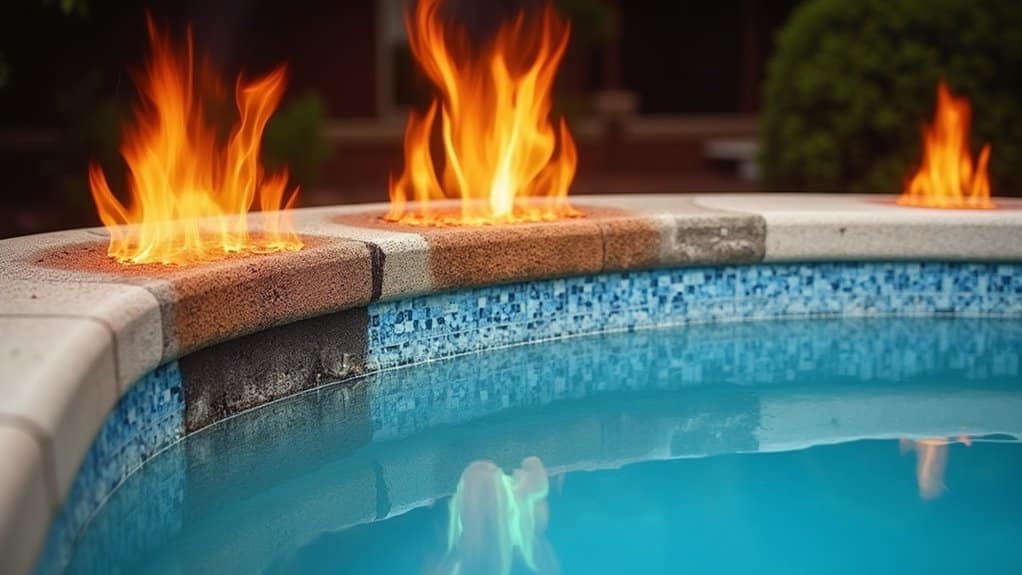
Understanding heat transfer mechanisms provides the foundation for comparing how different pool materials perform during actual fire exposure.
When you evaluate concrete pools, you’ll find they’re susceptible to cracking under extreme temperature fluctuations. These cracks compromise structural integrity during fire scenarios, and moisture trapped in concrete’s porous surface can create dangerous steam pockets. While concrete offers thermal mass advantages, its 2-4 week curing process introduces quality control variables.
Vinyl liner pools present greater fire risks. Their petroleum-based composition lacks inherent fire retardant properties, making them considerably more combustible than fiberglass shells. You’ll observe that vinyl melts and drips during thermal exposure, potentially spreading flames.
Fiberglass maintains superior performance, it won’t sustain independent combustion, produces minimal smoke, and retains structural integrity at temperatures exceeding 1,500°F. The glass fibers melt rather than burn, preventing flame spread from the pool shell itself. The high-performance vinyl ester resin used in fiberglass construction provides enhanced strength against environmental stresses, further contributing to its resilience during extreme thermal events. The material’s highly durable composition is naturally resistant to cracking, chipping, or leaking, which helps maintain protective barriers even under severe heat conditions.
Fire-Rated Fiberglass Pool Materials and Standards
How does fiberglass achieve its exceptional fire resistance? The silicon dioxide (SiO₂) core withstands temperatures exceeding 1000°C without decomposition. You’ll find these materials meet ASTM E84 Class A ratings, delivering both compressive strength requirements and thermal insulation properties essential for fire-resistant applications.
Key fire rating specifications you should verify:
- Flame Spread Index (FSI): Must achieve ≤25 for Class A classification
- Smoke Developed Index (SDI): Requires ≤50 to minimize smoke production
- Softening Point: Maintains structural integrity between 1300°F, 1400°F
Modern formulations incorporate flame-retardant resins that enhance protection beyond the inherent non-combustibility of glass fibers. While binder resins may degrade at lower temperatures, the fibers remain non-combustible throughout the product’s lifespan, requiring no additional treatments for fire resistance. The fiberglass fibers themselves are created by melting sand and recycled glass, then extruding the molten material into fine strands that naturally resist flame spread. When comparing insulation options, mineral fiber materials demonstrate substantially better ASTM E84 performance than rigid foam alternatives, with ratings of 10/0 versus 15/550 for flame spread and smoke development respectively. However, it’s important to note that while fiberglass reinforced polymer offers excellent fire resistance, it is not specifically classified as non-combustible under ASTM E136 standards, which define true non-combustibility according to NFPA guidelines.
Installing Fire-Resistant Fiberglass Pools in High-Risk Areas
When installing fire-resistant fiberglass pools in high-risk areas, you’ll need to conduct thorough site assessments using FEMA high-risk maps and geotechnical surveys to evaluate wildfire hazard zones, soil stability, and ember exposure risks. Strategic placement requires positioning your pool within defensible space zones, maintaining 30-100 feet of clearance from flammable vegetation while mapping proximity to structures for ideal firebreak integration. Proper placement, quality materials, and maintenance are key factors that boost property appeal while ensuring fire safety effectiveness. The fiberglass shell itself provides excellent protection since it can withstand temperatures exceeding 1000°C without burning or decomposing, making it an ideal non-combustible water reservoir during fire emergencies. These assessments guarantee your fiberglass shell’s anchoring stability and its effectiveness as a non-combustible barrier in fire-prone terrains. However, it’s important to understand that fiberglass composites have temperature limitations since the polymers begin to soften at their glass transition temperature, unlike metals that can withstand heat much better.
Site Assessment Essentials
Before you break ground on a fiberglass pool installation in a fire-prone zone, you’ll need to conduct a thorough site assessment that evaluates soil composition, drainage patterns, and proximity to vegetation fuel loads. Understanding soil stability requirements guarantees your pool shell maintains structural integrity during extreme heat exposure and ground moisture fluctuations common after wildfire events.
Your environmental impact analysis should address defensible space creation around the pool perimeter. Consider these critical assessment factors:
- Measure setback distances from combustible structures and vegetation per local fire codes
- Test soil compaction rates and bearing capacity at installation depth
- Map existing utility lines and emergency vehicle access routes
Document all findings before permitting applications. Your site data drives material specifications, excavation parameters, and fire-resistant landscaping requirements for compliant installation. Additionally, fiberglass pools can be installed in a fraction of the time of concrete pools, allowing you to establish fire-resistant water reserves more quickly in high-risk areas.
Strategic Placement Guidelines
Although fiberglass pool shells offer inherent fire-resistant properties, you’ll maximize their protective value by positioning them on a compacted gravel base that provides both structural stability and superior drainage during high-risk fire events. Your excavation techniques must account for precise shell alignment using stakes and strings that match zoning specifications.
| Specification | Requirement | Purpose |
|---|---|---|
| Vegetation Clearance | Minimum 10 feet | Reduces fire spread risk |
| Structure Spacing | Per local code | Prevents radiant heat damage |
| Base Material | Compacted gravel | Guarantees drainage/stability |
| Edge Protection | Gypsum sandwich | Adds fire resistance |
| Elevation Tolerance | ±0.25 inches | Optimizes drainage flow |
Maintain backfill consistency by gradually adding crushed stone with water integration to balance hydrostatic pressure. You’ll prevent settling in fire-prone soils through even compaction methods.
Gel Coats and Surface Treatments That Block Fire Damage
Because fiberglass pool shells already possess inherent fire resistance, with glass fibers withstanding temperatures exceeding 1000°C (1832°F), the gelcoat layer serves as your first line of defense against surface-level fire damage. Understanding gel coat chemistry helps you select appropriate formulations, while proper spraying techniques at minimum 77°F guarantee maximum cross-linking for durability.
Consider these fire-retardant options based on your thermal requirements:
- Intumescent gelcoat: Inflates under flame exposure, forming protective bladders that shield the substrate
- Silicone-coated variants: Withstand continuous temperatures up to 500°F (260°C)
- Ceramic-reinforced formulations: Handle 2000°F (1093°C) continuously for extreme heat applications
Crystic Fireguard 72PA delivers low-smoke fire retardancy with 55 MPa tensile strength. You’ll also benefit from vinyl ester resin integration, which prevents water intrusion while maintaining chemical barriers that preserve your fire-resistant surface treatments.
Maintenance Routines That Preserve Fire-Resistant Integrity
While your fiberglass pool shell‘s fire-resistant properties stem from inherent material characteristics, maintaining that protective integrity requires systematic monitoring protocols. Test sanitizer, pH, and total alkalinity levels at 18 inches below the surface to prevent corrosive conditions that compromise surface coatings.
Chemical additive precautions are critical, always dilute and pre-mix chemicals before introduction to minimize concentrated contact with gel coat surfaces. The non-porous fiberglass structure resists damage from properly diluted additives better than vinyl alternatives.
Equipment inspection frequency should increase post-fire events. Clean filters regularly since ash containing potassium and calcium oxides can cement filtration systems. Conduct thorough checks on gas lines and electrical components serving fire features. Use nylon-bristled brushes exclusively to preserve the UV-resistant topcoat without scratching protective surface treatments.
Fire-Safe Landscaping and Decking for Fiberglass Pools
Your pool shell’s fire-resistant properties extend only as far as its surrounding materials allow. Fiberglass decking with ASTM E84 Class A ratings delivers flame spread indices of 0-25, matching your pool’s non-combustible shell. The fiber density impact on fire performance remains critical, high glass fiber reinforcements retain structural integrity at heightened temperatures while UV retardant effectiveness sustains protection beyond 5,000 hours of exposure.
Select decking specifications that complement your fiberglass pool:
- Fire-retardant resin systems with oxygen index ≥32 and self-extinguishing compliance per ASTM D-635
- Anti-slip surfaces featuring NFSI Certified High Traction and 35% cooler temperatures than composites
- Moisture resistance under 0.5% water absorption preventing warping in poolside environments
This integration creates defensible space while maintaining 50 PSF live load capacity per ICC-ES standards.
Warranties and Certifications for Fire-Resistant Pools
When you’re selecting a fire-resistant fiberglass pool shell, you’ll want to validate both structural lifetime warranty coverage and compliance with fire safety certification standards like ASTM E84 Class A ratings and ASTM E119 fire endurance testing. Manufacturers differ considerably in their guarantee comparisons, with some offering two-year warranties specifically on fire ratings while others bundle fire resistance under broader structural coverage. You should prioritize suppliers holding ICC-ES AC274 certification for pool shells alongside ISO 9001 quality management credentials to safeguard consistent manufacturing standards.
Structural Lifetime Warranty Coverage
When evaluating lifetime warranty transferability, consider these key specifications:
- SwimUSA offers a transferable 50-year structural warranty, providing flexibility for property changes.
- Genesis Pools requires sales contract documentation and property sale records for warranty transfer, reserving inspection rights.
- Latham restricts coverage exclusively to the original retail buyer who maintains pool ownership.
You should verify whether your selected manufacturer covers structural failure from faulty workmanship, as this directly impacts long-term fire-resistant pool shell integrity and investment protection.
Fire Safety Certification Standards
Fire safety certification standards establish measurable performance benchmarks that distinguish genuinely fire-resistant pool components from standard equipment. You’ll find ISO 9001 certification requires third party audits to verify consistent material quality, product standards, and manufacturing processes, a credential no other U.S. fiberglass pool company currently holds.
When evaluating fire-resistant pool shells, you should examine compliance documentation that references applicable standards. UL1709 testing confirms materials withstand 1093°C pool fire conditions for 30 minutes, while EN1869 validates continuous exposure ratings of 500-550°C. These specifications matter for installations near fire-prone zones.
Classification society certifications provide authoritative third-party verification since real-condition fire testing isn’t practical. You’ll want documentation showing structural steel jet fire or actuator enclosure system certification, depending on your specific installation requirements and risk assessment calculations.
Manufacturer Guarantee Comparisons
Although fire safety certifications verify material performance under extreme heat conditions, manufacturer guarantees determine your long-term protection against structural failures and surface degradation. When evaluating fiberglass pool shells, you’ll encounter significant warranty variations across manufacturers.
Leading manufacturers provide these core coverage specifications:
- Structural warranties: 25-year minimum to lifetime coverage protecting against cracking, delamination, and osmosis, River Pools, Imagine Pools, and Thursday Pools offer lifetime options.
- Surface warranties: 7-15 years covering blistering, fading, UV damage, and chemical degradation.
- Transferable warranties: Both structural and surface coverage transfers to new owners, enabling property value enhancement during resale.
You’ll want transferable warranties since they maintain protection regardless of ownership changes. Unlike concrete pools offering builder-only warranties, fiberglass provides dual manufacturer-backed guarantees with dedicated repair support teams.
Frequently Asked Questions
Can Fiberglass Pools Be Used as Emergency Water Sources During Wildfires?
Yes, you can use fiberglass pools as emergency water sources during wildfires. Your pool’s water storage capacity of 10,000-15,000 gallons provides a reliable firefighting water supply when hydrants fail. You’ll connect portable pumps that extract water at 150 gpm, dispersing contents within two hours. Firefighters and homeowners have successfully tapped pools in Los Angeles County during pressure drops, spraying water 40+ feet to protect properties.
How Does Chlorinated Pool Water Affect Fiberglass Fire Resistance Properties?
Chlorinated pool water doesn’t compromise your fiberglass shell’s fire resistance properties. Quality vinyl ester resin creates a chemically inert barrier that prevents chemical composition changes in the structural matrix. The fire retardant additives embedded during manufacturing remain stable because the gel coat blocks chlorine penetration at the molecular level. You’ll maintain full fire resistance ratings even with long-term chlorine exposure, provided you’ve invested in shells exceeding 3/8-inch thickness with proper gel coat application.
Do Fiberglass Pools Release Toxic Fumes When Exposed to Nearby Flames?
No, fiberglass pools don’t release toxic fumes when exposed to nearby flames. Available data shows no documented reports of fiberglass shells emitting harmful gases during fire exposure scenarios. Your pool surface integrity remains protected by the gelcoat layer, which seals the underlying material. The fiberglass insulation properties create a barrier that doesn’t combust or off-gas under typical residential fire conditions. You’ll primarily need to address ash contamination rather than material toxicity concerns.
What Insurance Discounts Exist for Homes With Fire-Resistant Fiberglass Pools?
You won’t find insurance policy discounts specifically for fiberglass pools, as carriers don’t classify them as fire-resistant home features. Discounts apply to roofing, siding, sprinkler systems, and defensible space measures, not pool materials. However, pools can serve as emergency water sources during fire safety inspections, potentially supporting your overall risk assessment. To maximize savings, focus on Class A roofing and fire-rated vents, which deliver documented premium reductions of 10-20%.
How Long Can Fiberglass Withstand Direct Ember Exposure Without Damage?
Your fiberglass pool shell can withstand direct ember exposure for extended periods due to its heat-resistant Kevlar integration and basalt fiber reinforcement, which offers tensile strength 17 times greater than concrete. The gelcoat surface provides radiant heat protection, while the vinyl ester resin layer contributes flame retardant properties. You’ll find these materials resist thermal degradation through significant temperature fluctuations, though specific ember exposure duration depends on your installation quality and maintenance practices.