Fiberglass pools resist freeze-thaw cycles because their composite structure can flex up to 12 inches per 100 feet without failure, absorbing the roughly 9% expansion that occurs when water freezes. Unlike concrete, which develops micro-cracks as ice crystals form within its porous surface, fiberglass features a non-porous gelcoat that prevents water absorption entirely. Fiberglass pools also retain tensile strength that can exceed steel wire performance, even in subzero temperatures. Understanding these thermal performance characteristics explains why fiberglass pools are commonly chosen in cold climates such as Canada.
What Freeze-Thaw Cycles Do to Pool Materials
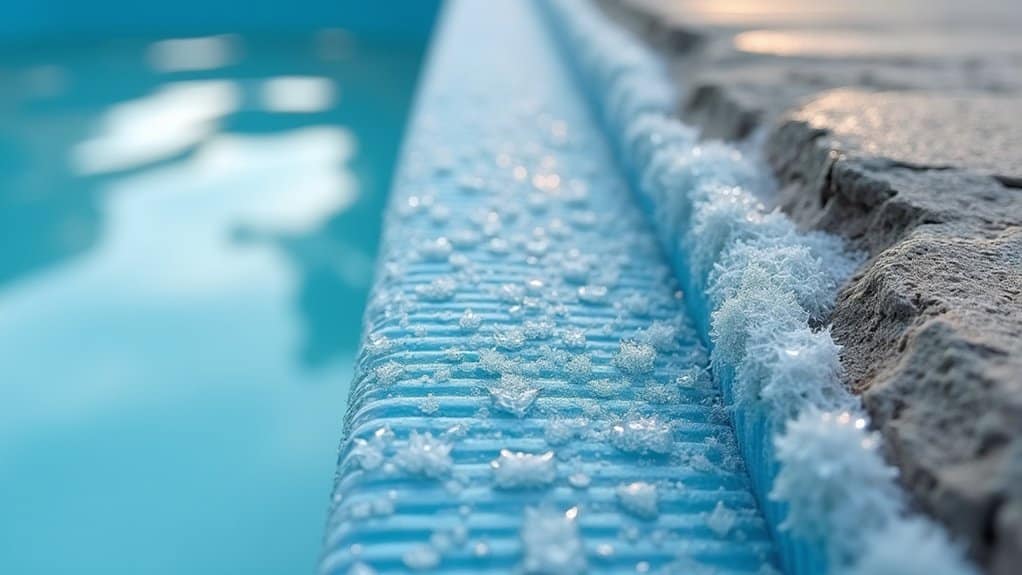
Freeze-thaw cycles create measurable stress on pool materials when temperatures fluctuate between 30°F and 50°F. Water penetrates concrete pores and cracks, then expands approximately 9% upon freezing. This expansion rate differences between water and rigid materials like concrete and plaster cause crystalline structure damage at the molecular level.
You’ll observe micro cracks forming in gunite and concrete pools after repeated cycles. Plaster surfaces deteriorate as ice forms and melts, loosening grout and popping tiles from coping edges. Vinyl liners become brittle, developing tears that lead to leaks. Northern pools require finishes that won’t become brittle and crack under these demanding conditions. In contrast, fiberglass pools feature multiple flexible layers that absorb expansion forces without fracturing.
Your equipment faces similar risks. PVC pipes crack when trapped water freezes, while pumps, filters, and heaters sustain damage from ice pressure. A single freezing night can compromise your entire equipment system, requiring costly professional repairs. Clay-rich soils compound problems through frost heave, pushing against buried structures.
Why Fiberglass Flexes Instead of Cracks in Winter
When temperatures plummet, you’ll find that fiberglass’s composite structure allows it to flex under freeze-thaw stresses rather than crack like rigid materials. The engineered matrix of glass fibers and resin absorbs deformation without structural failure, giving your pool shell the ability to move with shifting, frozen ground. This natural material flexibility means your fiberglass pool endures seasonal soil expansion and contraction that would fracture concrete or damage vinyl liners. Unlike metals, fiberglass is less prone to thermal expansion and contraction, making it even more reliable when temperatures fluctuate dramatically throughout winter months. During manufacturing and repairs, maintaining room temperature conditions ensures optimal epoxy resin application for the strongest possible bond in the fiberglass composite. Any repair work should be performed when temperatures remain above 55 degrees to prevent curing problems that could compromise the structural integrity of the fiberglass.
Natural Material Flexibility
Unlike rigid materials that crack under thermal stress, fiberglass pools flex with temperature fluctuations, a critical advantage in winter climates. The composite structure’s natural give allows expansion and contraction during freeze-thaw cycles without compromising structural integrity. You’ll find that fiberglass’s low moisture absorption rate prevents ice formation within the material itself, eliminating internal stress fractures common in porous alternatives.
| Property | Fiberglass | Concrete |
|---|---|---|
| Flexibility Rating | High | Low |
| Moisture Absorption | Minimal | Significant |
| Crack Resistance | Superior | Poor |
Your pool’s thermal regulation benefits from fiberglass’s composite nature, which provides natural insulation against extreme temperature swings. The material absorbs expansions from freezing water without sustaining damage, maintaining its shape through repeated cycles. This resilience guarantees decades of stability in harsh winter environments. The smooth, non-porous gelcoat surface is also less prone to damage from ice, salt, and winter exposure compared to other pool materials. Fiberglass pools are specifically designed to withstand shifting soil and freezing temperatures, making them ideal for regions with severe seasonal changes. In contrast, concrete pools require meticulous sealing and ongoing maintenance to prevent freeze-thaw damage that can compromise their structural integrity over time.
Absorbing Ground Movement
Ground movement poses the ultimate stress test for any pool shell, and fiberglass demonstrates measurable superiority in this arena. When frost heave expands clay-rich soils, your fiberglass shell flexes up to 12 inches per 100 feet without structural failure. This frost pressure resistance allows the material to absorb shifting forces that would crack rigid concrete. The single molded shell design eliminates vulnerable seams or joints where cracks typically originate under pressure.
Your installation’s hydrostat control system works alongside proper gravel backfill to manage groundwater during thaw cycles. Crushed stone bases minimize heave potential while perimeter drainage directs moisture away from the shell. Unlike sand, gravel backfill accommodates soil expansion without transferring destructive pressure to the pool walls. The non-porous gel coat surface prevents water absorption that could otherwise lead to cracking when trapped moisture freezes.
The shell’s natural give handles freeze-thaw cycling throughout Pennsylvania winters, maintaining structural integrity where concrete would fracture under identical conditions. Fiberglass pools have proven their resilience in brutally cold Canadian climates, demonstrating that proper winterization allows them to transition seamlessly through extreme temperature changes.
How Fiberglass Strength Holds Up at Forty Below
Because fiberglass insulation maintains reliable performance down to -50°C (-58°F), it easily handles the demands of forty-below environments without losing structural integrity. You’ll find this thermal stability critical for cryogenic applications where temperature fluctuations would compromise lesser materials.
At -40°F, fiberglass delivers these measurable performance characteristics:
- Tensile strength retention exceeding steel wire at equivalent weights
- Elongation under load limited to 3% or less
- Zero deformation or thermal resistance loss at subzero temperatures
- Low coefficient of linear expansion ensuring dimensional stability
- Consistent insulation properties across seasonal thermal cycles
You’re working with a material that doesn’t become brittle or weak when temperatures plummet. Glass fibers resist breakdown through repeated cold cycles, while the woven structure maintains air-trapping capability for sustained insulation effectiveness. The material’s high dimensional stability and abrasion resistance further ensure that extreme cold cycling does not compromise the fiberglass structure over time. This durability stems from fiberglass being a fiberglass-reinforced plastic composed of silica sand and fine glass fibers that create an inherently stable composite structure. The spun glass fibers are noncombustible and do not melt or deform easily, providing an additional safety margin in extreme temperature environments.
Why Water Can’t Seep Into Fiberglass and Freeze
When you’re dealing with harsh winter conditions, gelcoat finish creates a critical moisture barrier that prevents water from penetrating your fiberglass surfaces and causing freeze-related damage. This non-porous surface eliminates the water seepage pathways that typically lead to structural degradation, mold growth, and compromised insulation performance. The reinforced glass and plastic resins combine to create impeccable strength that withstands the expansion and contraction cycles common in freezing temperatures. You’ll find that properly applied gelcoat works alongside vinyl ester resin barriers to deliver up to 30 years of protection against moisture infiltration in fluctuating winter temperatures.
Gelcoat’s Protective Barrier
Although gelcoat creates a glossy, durable exterior finish on fiberglass hulls, it doesn’t function as a true waterproof barrier. Understanding gelcoat performance limitations helps you protect your vessel during winter storage.
Water molecules migrate through gelcoat over time, with permeation rates increasing at higher temperatures. You’ll find that standard gelcoat thickness between 20-30 mils provides excellent coverage, but even properly applied coatings permit eventual moisture penetration.
Key factors affecting gelcoat permeation barriers include:
- Thickness below 20 mils fails to block water adequately
- Thickness exceeding 30 mils increases cracking susceptibility
- Temperature fluctuations create microfractures allowing moisture entry
- Impact damage and abrasions compromise protective integrity
- Manufacturing voids at the gelcoat-laminate interface promote blister formation
You’ll need supplemental epoxy barrier coats like Interprotect to greatly slow water migration and enhance freeze-thaw protection.
Non-Porous Surface Benefits
Fiberglass composites derive their non-porous characteristics from the polymer resin matrix that binds glass fibers into a unified, impermeable structure. You’ll find this sealed surface prevents water molecules from penetrating the material’s core, eliminating the moisture absorption that damages porous alternatives like concrete and wood.
When temperatures drop below freezing, trapped water in porous materials expands by approximately 9%, creating internal stresses that cause cracking and structural failure. Fiberglass exhibits negligible expansion under these conditions because water can’t infiltrate the resin barrier. Your installation maintains smooth aesthetics throughout repeated freeze-thaw cycles without surface degradation.
The polymer matrix’s flexibility allows the composite to accommodate thermal fluctuations while preserving dimensional stability. This performance advantage translates to reduced maintenance requirements and extended service life in harsh winter environments where moisture-related damage typically accelerates material deterioration.
Fiberglass vs. Concrete, Vinyl, and Metal in Winter
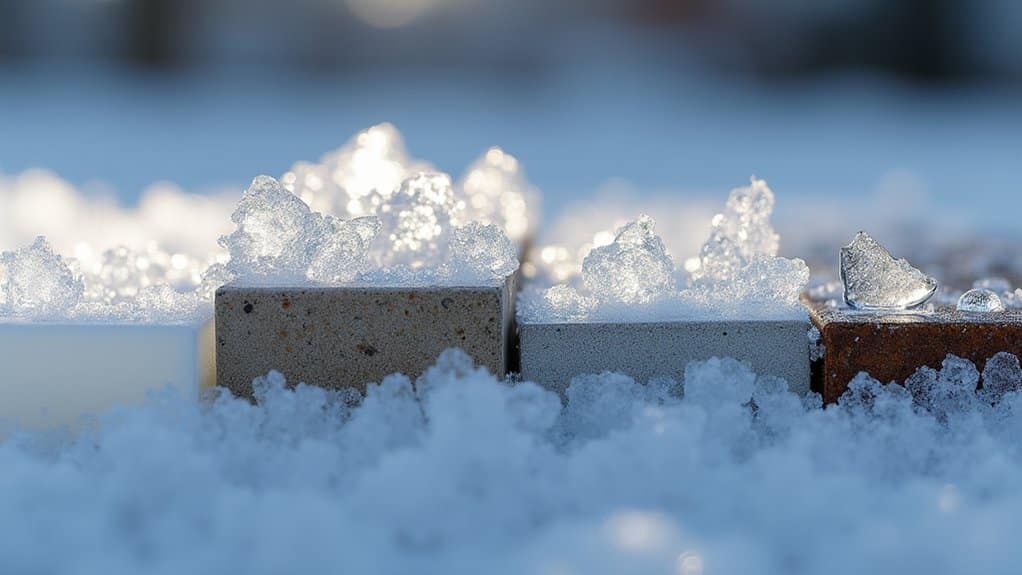
Harsh winter climates put pool materials to the ultimate test, and the data reveals clear performance differences between fiberglass, concrete, vinyl, and metal options.
Winter weather separates pool materials that survive from those that fail, and the performance gap is dramatic.
When you’re evaluating freeze thaw effects and insulation efficiency, consider these performance metrics:
- Fiberglass flexes with ground movement, maintaining structural integrity through repeated cycles
- Concrete cracks under soil shifts and requires 30% more heating energy
- Vinyl liners lack durability, demanding regular replacement in harsh conditions
- Metal components corrode faster in salty winter environments
- Fiberglass thermal conductivity measures 0.04 W/mK versus concrete’s 1.0-1.8 W/mK
You’ll find fiberglass maintains temperatures 2-4°F warmer than concrete under identical conditions. This translates to 15-20% lower heating costs and extended swimming seasons during shoulder months.
Proven Fiberglass Performance in Cold Climates
When temperatures plunge below freezing, fiberglass composites demonstrate measurable advantages over conventional materials that become brittle or warp under thermal stress.
Field studies tracking glass fiber core vacuum insulation panels in subarctic Yukon conditions reveal exceptional freeze thaw environment resilience. Over eight years of continuous monitoring, these panels showed less than 0.9% annual change in thermal performance, even with average winter humidity reaching 75%.
You’ll find long term durability trends equally compelling. Thermal conductivity increased from 0.0034 to 0.00429 W/m·K across 14 years in extreme cold, representing predictable, linear degradation. Unlike steel that corrodes from snow and road salt exposure, fiberglass maintains structural integrity without moisture-related deterioration.
These validated field results confirm accelerated aging test predictions, giving you reliable performance data for cold climate applications.
Why Fiberglass Cuts Heating Costs in Winter
Beyond thermal stability, fiberglass pools deliver measurable heating cost reductions through superior insulation properties. You’ll benefit from a thermal conductivity rating of 0.04 W/mK compared to concrete’s 1.0-1.8 W/mK, translating directly to year round reliability in temperature maintenance.
Your fiberglass pool’s performance advantages include:
- 15-20% lower heating costs versus concrete alternatives
- 2-3 fewer daily heating hours to reach target temperatures
- 30% reduced energy consumption during spring and fall
- 4-6 hour pump operation versus extended runtimes for other types
- 2-4°F warmer water retention under identical conditions
The low cost installation combined with high-density foam backing and non-porous gel coat creates an efficient thermal barrier. You’ll experience reduced monthly utility bills while maintaining consistent water temperatures throughout colder months.
Simple Winterization Steps for Fiberglass Pools
Protecting your fiberglass pool from freeze damage requires a systematic five-step winterization process that you’ll complete in approximately 2-4 hours.
Begin by balancing pH levels to 7.2-7.8, then apply shock treatment according to product specifications. Maintaining water circulation at high pump speed for 1-2 hours guarantees proper chlorine distribution and chemical integration throughout the pool.
Next, drain equipment lines using your filter system’s suction mode. Remove pump thumb screws and cartridge filter drain caps for complete water extraction. Use a blower attachment to force remaining water from return lines, air bubbles from the main drain confirm successful removal.
Install threaded return caps with Teflon tape for secure seals. Add approximately one gallon of antifreeze to both skimmer and return lines. Place a punctured floating chlorinator for continuous winter chlorination.
Fiberglass Lifespan: What to Expect After 25 Winters
Completing these winterization steps each season directly impacts how long your fiberglass pool will serve you, and the data shows impressive durability. With professional maintenance practices, your pool can operate 30-40 years in cold climates, with some 1980s installations still functioning after 40+ winters.
Here’s what the performance data reveals:
- Less than 1% cracking incidence after 25 years with proper installation
- Fiberglass gelcoat durability eliminates surface replacement needs that vinyl requires every 7-12 years
- Structural shells maintain 35-year to lifetime integrity post-25 years
- Annual maintenance costs average $500-1,000, half of concrete’s expenses
- Newer gelcoat formulations extend lifespan by 10-20% over older versions
Your fiberglass pool’s flexibility handles freeze-thaw ground movement better than rigid concrete, preventing the frequent resurfacing concrete demands every 10-15 years.
Frequently Asked Questions
Can I Install a Fiberglass Pool in Late Fall Before Winter?
Yes, you can install a fiberglass pool in late fall. Pool installation timing during this season offers ideal conditions, mild temperatures and stable weather allow for proper excavation and concrete curing before ground freeze. You’ll benefit from off-season discounts while ensuring your pool’s ready by spring. Seasonal preparation requirements include completing backfill with high-quality gravel, lowering water levels, balancing chemistry, and securing covers before freezing temperatures arrive to protect your investment.
Does Fiberglass Pool Color Fade After Multiple Harsh Winters?
Fiberglass pool color doesn’t fade from freezing alone. Cold climates show no reported acceleration of color loss due to freeze thaw protection features inherent in flexible gelcoat materials. However, you’ll notice fading after 5-9 years from UV exposure, improper water chemistry, or neglected winterization, not temperature cycles. Effective pool color maintenance includes balanced pH levels, UV-resistant coatings, and proper winter closing procedures to prevent calcium buildup and scaling that causes discoloration.
Will Heavy Snow Loads on Pool Covers Damage Fiberglass Shells?
Heavy snow loads won’t damage your fiberglass shell when you implement proper snow weight management. Your pool’s monolithic construction flexes up to 12 inches per 100 feet, distributing pressure evenly without stress concentration. Mesh covers allow snowmelt drainage, preventing excessive accumulation. The shell’s insulation performance maintains stability during freeze-thaw cycles, while the honeycomb core reinforcement absorbs impact. You’ll achieve ideal protection by ensuring covers include drainage systems that prevent water pooling.
How Soon After Spring Thaw Can I Reopen My Fiberglass Pool?
You can reopen your fiberglass pool as soon as the ice melts and the risk of hard freezes passes, typically early to late spring depending on your climate zone. If you’ve followed proper winterization procedures, your shell should be ready for immediate startup. Don’t delay, as warm untreated water promotes algae growth. Schedule your annual maintenance checks during reopening to inspect equipment, test water chemistry, and guarantee exemplary filtration performance.
Does Homeowner’s Insurance Cover Freeze-Thaw Damage to Fiberglass Pools?
Standard homeowners insurance typically excludes freeze-thaw damage to fiberglass pools. Your policy likely denies claims for freezing, thawing, or ice pressure, meaning you’ll absorb repair costs without supplemental coverage. Even if you secure specialized protection, you’ll face deductibles for freeze thaw claims that reduce payouts substantially. Coverage limits for pool repairs often cap at 10% of your dwelling amount for other structures, so verify your specific limits before winter arrives.