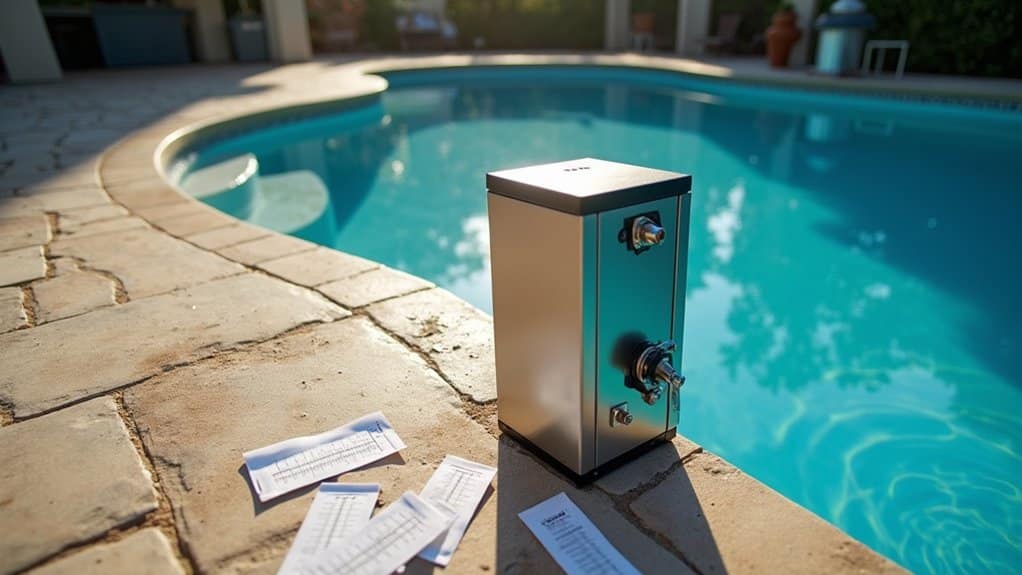
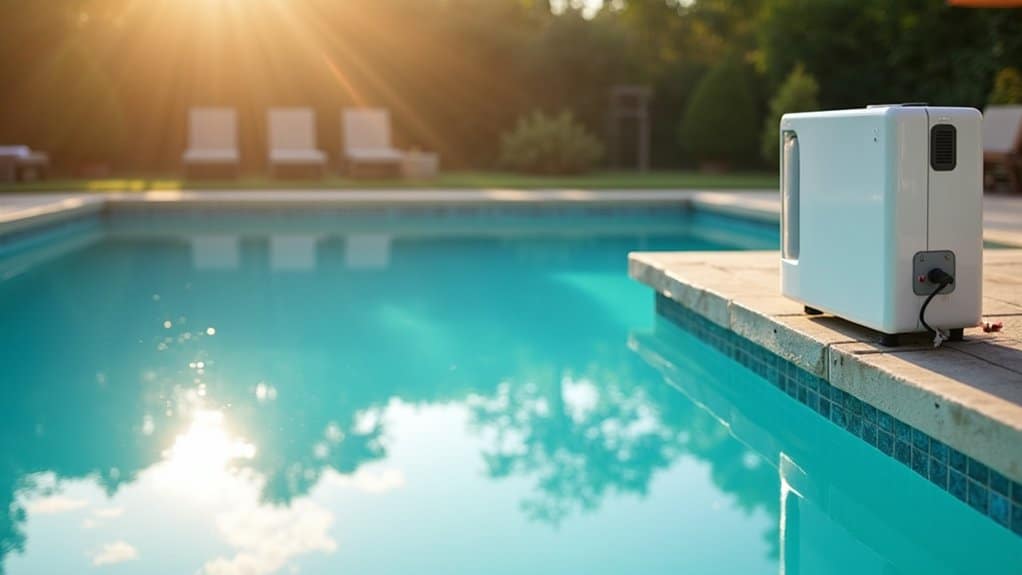
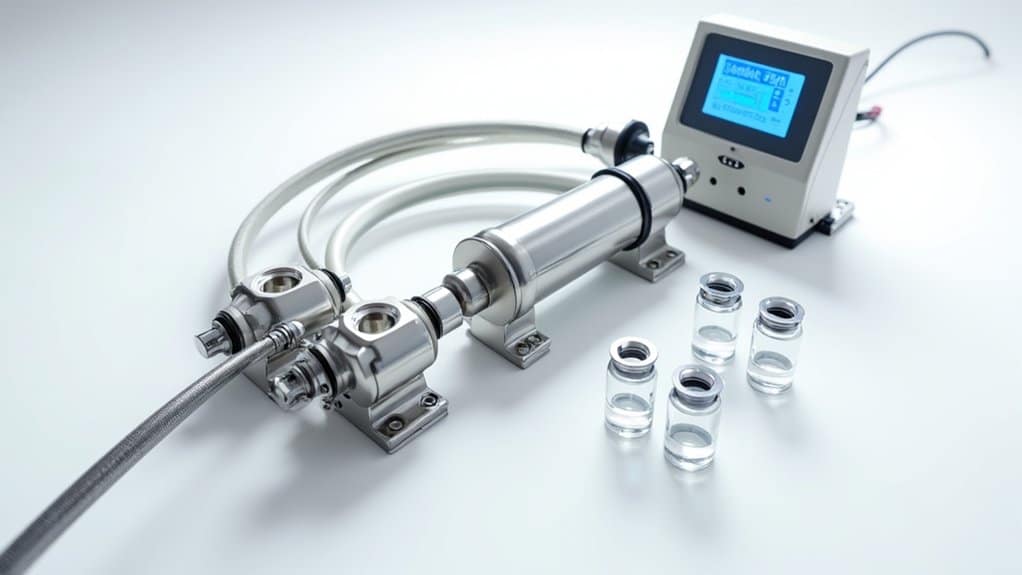
To convert your chlorine pool to saltwater, you’ll first balance your water chemistry and verify your pump’s compatibility with a salt system. Next, install a salt chlorine generator sized for double your pool’s volume, positioning the cell as the final component on the return line. Add pool-grade salt to reach 3200 ppm, then calibrate the system. Following the detailed steps below will help you complete this saltwater pool conversion successfully.
Prep Your Pool Before the Saltwater Conversion
Before you install a saltwater chlorine generator, you’ll need to balance your pool’s water chemistry to guarantee the system operates efficiently. Test and adjust these levels: pH between 7.2, 7.8, total alkalinity at 80, 120 ppm, cyanuric acid at 50, 75 ppm, and calcium hardness between 150, 400 ppm. Maintain free chlorine at 1.0, 3.0 ppm before activating your pool salt chlorinator.
Next, clean your pool thoroughly. Remove debris, brush all surfaces to eliminate buildup, and verify your filtration system runs properly. Don’t drain your pool unless you’re replacing the liner. Clear the equipment pad area where you’ll mount the electrolysis pool system components. Confirm your pump is compatible with a saltwater pool system, replace it if necessary to prevent corrosion damage. You should also test your current water to establish a baseline salt reading, since you’ll need to reach a target range of 3,000-3,500 PPM once you add salt to the pool. Checking compatibility with your automation panel is essential before purchasing a saltwater chlorinator to ensure seamless integration with your existing pool system.
Pick the Right Salt Chlorine Generator Size
Once your pool’s water chemistry is balanced and equipment area cleared, you’ll need to calculate your pool’s exact volume to select the correct salt chlorine generator. For rectangular pools, multiply length × width × average depth × 7.5. Oval pools use length × width × average depth × 6.7. For kidney-shaped pools, use length × average width × average depth × 7.0 as your multiplier.
When you convert chlorine pool to saltwater, always oversize your generator. A cell operating at partial capacity lasts longer than one running at maximum output. For a 20,000-gallon pool, choose a 40,000-gallon rated unit like the Pentair IC40 or Hayward T-Cell-15. The generator uses electrolysis to produce free chlorine, which then sanitizes your pool water by killing harmful bacteria. Look for models with automatic salt level detection to ensure you maintain the proper concentration for optimal chlorine production.
Understanding chlorine vs saltwater pool maintenance helps explain this: your saltwater pool conversion still produces chlorine through electrolysis. Oversizing guarantees consistent 1-3 ppm chlorine levels while extending cell life beyond the typical 3-5 years.
Install the Cell, Control Box, and Wiring
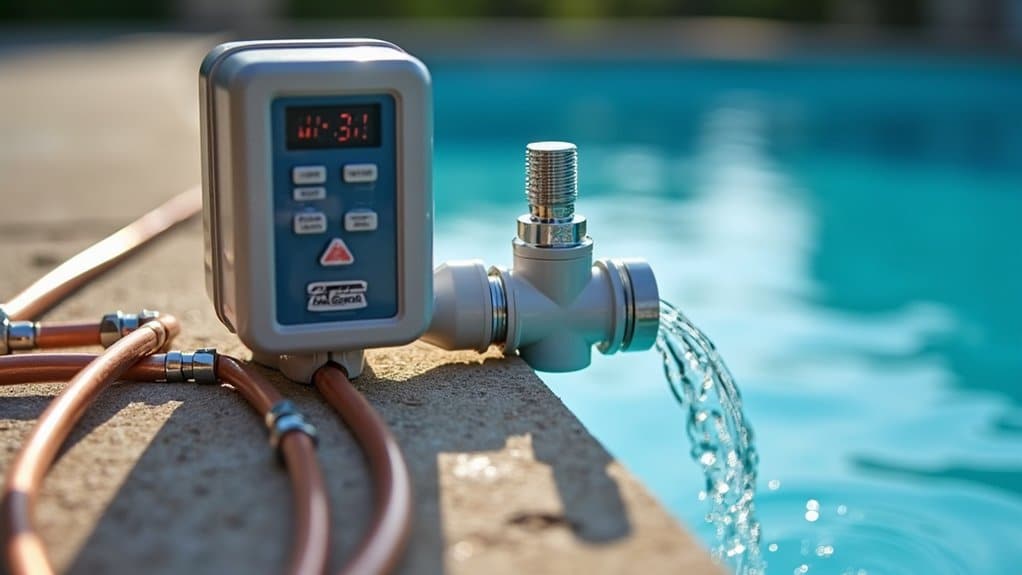
Because your salt chlorine generator relies on precise water flow detection, you’ll install the cell and flow switch as the final components on your return line, positioned downstream of the pump, filter, and heater. Maintain 12 inches of straight pipe before the flow switch, and verify the arrow matches your water flow direction.
Mount the control box in a ventilated area. Connect the tri-sensor cord and cell cord to their designated ports inside the cabinet, you’ve got 12 feet of cable length to work with. Run power wires through ½-inch nonmetallic flexible conduit to your time clock or controller relay, connecting to terminals 1 and 4.
Before powering up, attach #8 bare wire from the bonding lug to your pool’s bonding system. Reattach the dead front after completing all connections. Keep in mind that improper water chemistry can void your equipment warranty, so ensure proper installation supports balanced chemical levels from the start.
Add Pool Salt and Hit Your Target Salinity
With your salt chlorine generator fully installed and wired, you’re ready to add pool-grade salt and dial in your target salinity.
Calculate your salt needs using this formula: 8.375 x salinity increase ÷ 100 = pounds per 10,000 gallons. For a 10,000-gallon pool starting from zero, you’ll need approximately 267 pounds (six to seven 40-pound bags) to reach the ideal 3200 ppm.
Pour pure pool-grade NaCl directly into the water while your filtration system runs. Distribute salt evenly around the pool’s perimeter to speed dissolution. Allow complete circulation before testing, typically 24 hours.
Test salinity at the return jet using a digital salt meter. Your target range spans 2700-3400 ppm, with 3200 ppm being perfect. Readings below 2700 ppm reduce chlorine production; levels exceeding 4000 ppm risk equipment damage. For ongoing monitoring, conductivity sensors measure the water’s ability to conduct electricity, which directly correlates to your pool’s salinity level. Be sure to clean the salt cell regularly to prevent calcium buildup that can reduce chlorine production efficiency.
Power Up and Calibrate Your Saltwater System
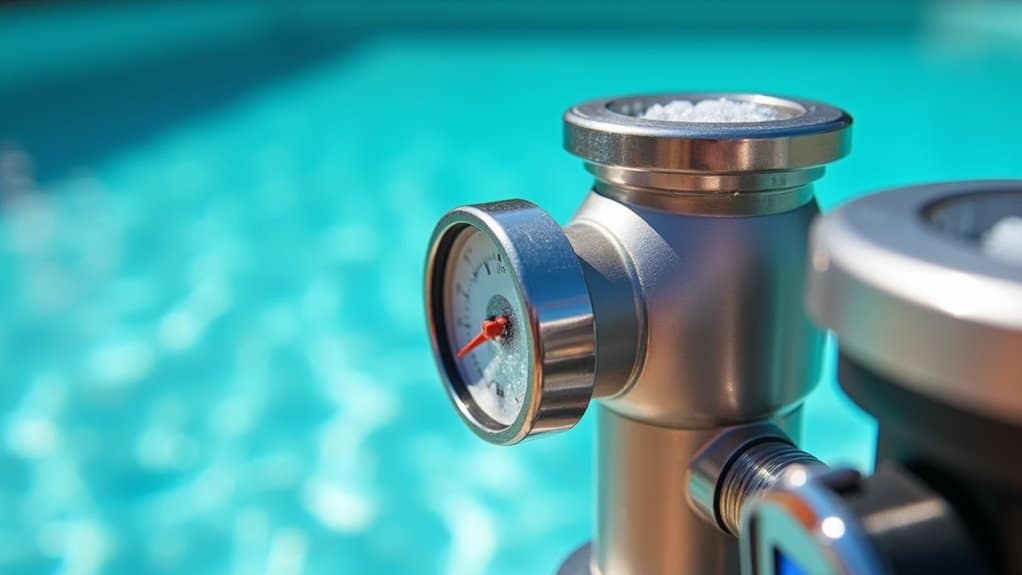
Your salt chlorine generator won’t produce chlorine accurately until you’ve calibrated its salt display to match actual pool water conditions. Run your pump for several minutes before starting calibration, then test your water using reliable salt strips or a digital meter. Electronic salt meters provide more precise measurements than strips when properly calibrated.
For Hayward Aqua Rite systems, move the main switch from Auto to Off, then back to Auto. Wait ten seconds for the internal click, then press the Diagnostics button five times. Scroll the display until it matches your test strip reading, then toggle from Auto to Super Chlorinate and back.
For Pool Pilot Professional models, press Menu/Enter, navigate to “Calibrate Salt,” adjust in 100 ppm increments using the arrows, and press Menu/Enter to lock your setting. Verify readings match within 24 hours after full circulation. Your target salt level should fall between 2,700 and 3,400 ppm to enable efficient chlorine generation. For Pool Pilot Digital models, press Menu, navigate to Maintenance Menu, then select Calibrate Salt and adjust the salt display to match your test kit reading before pressing Select to complete the process.
Maintain Your Saltwater Pool Week to Week
Once your saltwater system is running, you’ll need to establish a consistent maintenance schedule to keep water chemistry balanced and equipment functioning properly. Test your pH and free chlorine levels weekly, aiming for a pH between 7.2 and 7.8 and chlorine around 3 PPM, while checking salt concentration monthly to guarantee adequate chlorine generation. You should also brush walls and steps weekly to prevent algae buildup on pool surfaces. Every three months, inspect your salt cell for calcium buildup and clean it as needed to maintain efficient electrolysis. For stubborn calcium deposits, use a diluted muriatic acid solution to dissolve buildup without damaging the cell.
Weekly Chemical Testing Routine
Although saltwater pools generate chlorine automatically, you still need to test water chemistry weekly to keep levels balanced and equipment running efficiently.
Free Chlorine
Test free chlorine levels weekly, maintaining 1-4 ppm. Adjust your generator’s output if readings fall below range to prevent bacteria growth.
pH Levels
Check pH weekly, targeting 7.4-7.6. Imbalanced pH causes skin irritation and corrodes equipment.
Total Alkalinity
Test TA weekly to maintain 80-120 ppm. Stable alkalinity buffers pH and prevents rapid fluctuations.
Calcium Hardness
Monitor calcium weekly at 200-400 ppm. Low levels corrode equipment; high levels create scaling on salt cells.
Cyanuric Acid
Test stabilizer levels weekly, keeping 30-50 ppm. This protects chlorine from UV degradation outdoors.
Increase testing to 2-3 times weekly during heavy use, after rain, or following chemical additions.
Monthly Salt Level Checks
While weekly chemical testing keeps your chlorine and pH balanced, salt concentration requires less frequent monitoring, typically once per month during pool season. During summer, increase testing to every fortnight. Always test after heavy rain, pool parties, or adding fresh water, since these events dilute salt levels.
Your saltwater generator operates best between 2700-3400 ppm, with 3200 ppm being the sweet spot. Most chlorinators are calibrated for around 4000 ppm maximum.
To test accurately, use digital salinity testers or electronic pens like Apera models. Salt test strips work for quick checks, but verify readings against your generator’s display monthly. Sample water from multiple pool areas to confirm consistent distribution.
Low salt reduces chlorine production and damages cell plates. High salt above 5000 ppm corrodes equipment. Dilute with fresh water or add pool salt accordingly.
Quarterly Cell Cleaning
Follow these steps to clean your cell:
- Turn off power and remove the cell according to manufacturer instructions.
- Soak the cell in a muriatic acid mixture inside a 5-gallon bucket until foaming stops.
- Rinse thoroughly with fresh water and repeat if deposits remain.
- Reinstall the cell, restore power, and verify operation on the control panel.
Wear gloves and eye protection when handling acid. Avoid over-cleaning to prevent plate damage.
Ready to Transform Your Backyard?
Your dream pool is closer than you think. At Schiller Pools, our experienced team brings over 40 years of expertise to every project, delivering stunning fiberglass pool installations and custom pool construction that turn ordinary backyards into extraordinary outdoor retreats. With flexible financing options and lifetime warranty backing, there has never been a better time to get started. Call (561) 475-5997 today for your free estimate.
Frequently Asked Questions
How Much Does a Complete Saltwater Pool Conversion Typically Cost?
You’ll typically spend between $600 and $2,500 for a complete saltwater pool conversion, depending on your pool type. Above-ground pools cost $600 to $1,200, while inground pools run $1,500 to $2,500 for standard setups. Factor in the salt chlorine generator ($500 to $2,500), pool-grade salt ($10 to $40 per bag), and installation labor ($500 to $1,500). Premium systems with compatibility upgrades can push your total to $4,000 to $6,500.
Will Saltwater Damage My Pool Liner or Concrete Surfaces?
Saltwater won’t directly damage your vinyl liner, but improper chemistry will. Low pH causes fading and wrinkles, while high chlorine breaks down the material. Keep pH between 7.2-7.8 and chlorine below 3 ppm to protect your liner.
Concrete surfaces face more risk. Salt water wears plaster finishes up to five times faster than traditional chlorine water. You’ll need resurfacing sooner, especially with standard plaster over aggregate finishes.
Can I Switch Back to Traditional Chlorine if I Change My Mind?
Yes, you can switch back to traditional chlorine. You’ll need to drain about 50% of your pool water to lower cyanuric acid from 80-90 ppm to around 40 ppm. Replace your salt cell with a bypass fitting or install an in-line chlorinator like Intellichlor or AquaRite. After refilling with fresh water, you’ll resume manual chlorine dosing and maintain standard CYA levels without needing bulk stabilizer additions.
How Long Do Salt Chlorine Generator Cells Typically Last Before Replacement?
Salt chlorine generator cells typically last 3-7 years, with most averaging 3-5 years under normal conditions. You’ll extend your cell’s lifespan by maintaining proper water chemistry, keeping salt levels between 2,700-3,900 ppm, and cleaning monthly rather than waiting for warning lights. Oversizing your system for your pool’s volume also reduces wear. When replacement time comes, expect to spend $700-$1,100 for a new cell.
Is Saltwater Safe for Pets That Drink From the Pool?
Saltwater pools pose minimal risk to pets in small amounts, but you shouldn’t let them drink freely. Your pool contains about one-tenth the salt concentration of seawater, yet excessive ingestion can cause dehydration, vomiting, and muscle tremors. Pets with heart or kidney conditions face heightened dangers. You’ll want to provide fresh water immediately after swimming, supervise pool access closely, and rinse your pet afterward to remove residual chemicals from their coat.