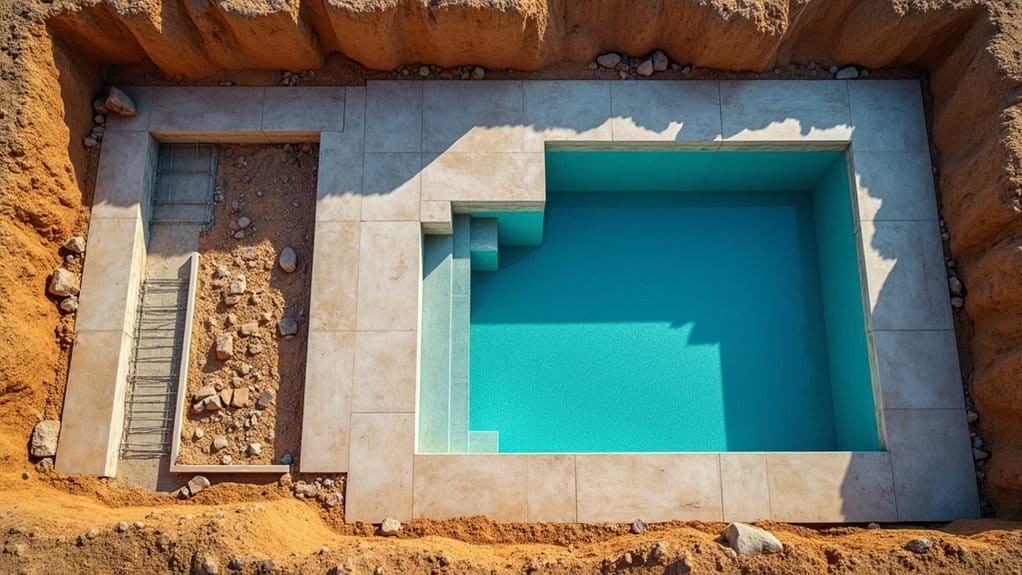
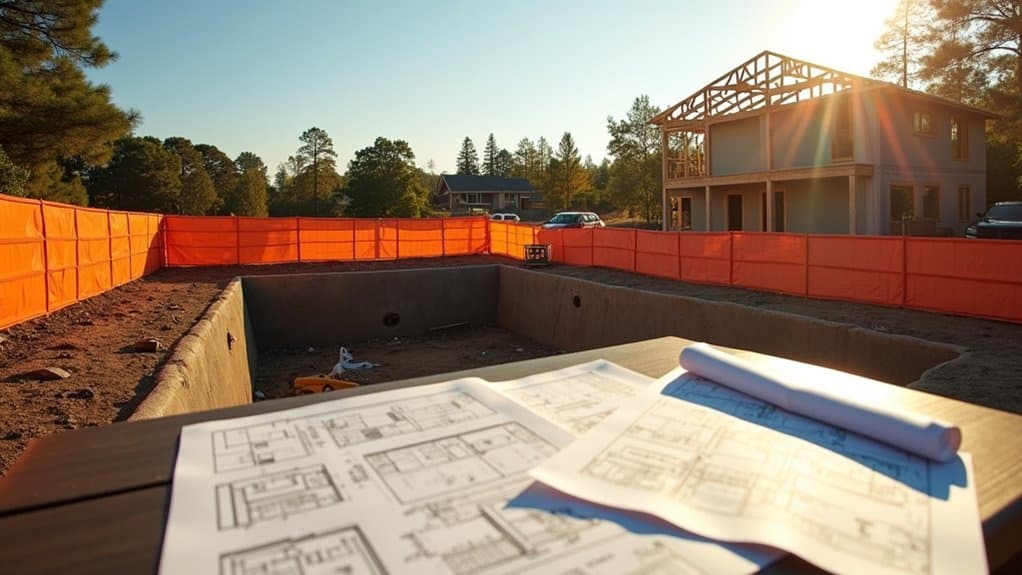
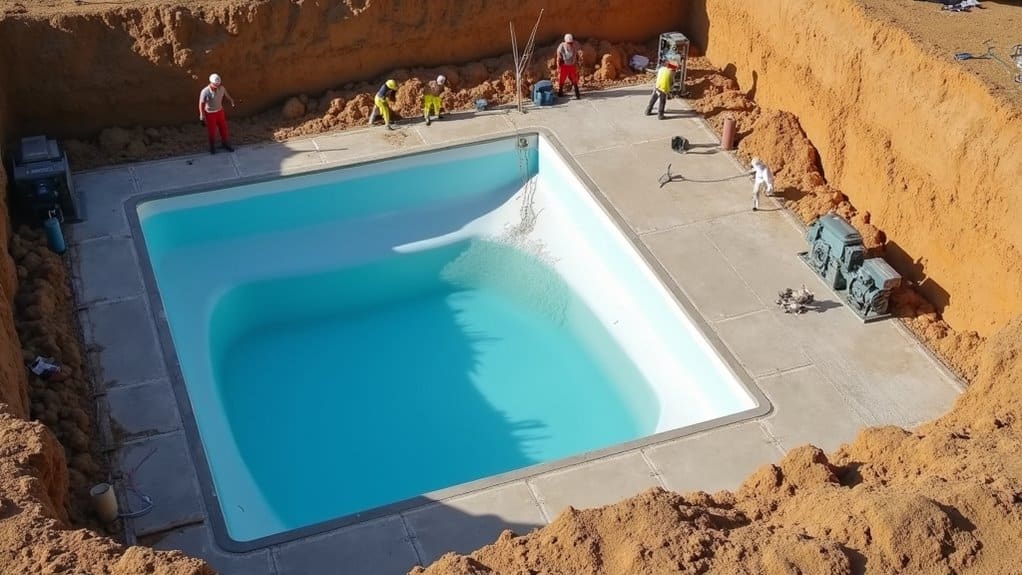
Key structural details in pool construction start with proper soil analysis and foundation requirements, including 1:1 depth ratios and thorough stability testing. You’ll need strategic rebar placement in a 12″ grid pattern, with #3 bars at 6″ OC in depth shift zones. Your basin material choice impacts durability options include shotcrete, fiberglass, or vinyl with steel frames. The success of your pool project depends on how these critical engineering elements come together.
Foundation Requirements and Soil Analysis

Before beginning any pool construction project, a thorough analysis of foundation requirements and soil conditions must be carried out to guarantee structural integrity and long-term stability. Your foundation design must account for a 1:1 depth ratio extending to a maximum of 5′-0″, with shift occurrences taking place at water depths of 33 inches or greater. Two sets of drawings must be submitted showing all structural specifications and dimensions for review. Engineering calculations are required if the pool depth exceeds 5 feet from the nearest foundation.
A comprehensive soil stability analysis should evaluate buoyancy forces from groundwater table assessment, expansive soil characteristics, and potential ground movement risks. You’ll need to make certain proper load capacity of 250 lbs/sqft and implement adequate drainage systems. Consider the impact of nearby trees on soil conditions and maintain appropriate toe extensions beyond pool walls. Consultation with both structural and geotechnical engineers is pivotal for determining acceptable movement levels and foundation specifications that match your site’s unique conditions.
Basin Material Selection and Durability
With a solid foundation established, your next major decision centers on selecting the appropriate basin material for your pool. Each material’s durability directly correlates with its porosity and resistance to freeze-thaw impact. Concrete pools offer 50-year lifespans but require periodic resurfacing due to their porous nature. Fiberglass presents a non-porous alternative lasting 25-30 years with minimal maintenance, while stainless steel delivers exceptional durability in harsh conditions. Fiberglass pools can be installed in just two to three days.
You’ll find vinyl liners are cost-effective initially but demand replacement every 5-9 years, making them less durable long-term. Material porosity considerably affects maintenance requirements: concrete’s porous surface needs frequent chemical treatment and brushing, whereas fiberglass and stainless steel resist algae growth through their non-porous composition. Consider freeze-thaw impact when choosing concrete and fiberglass demonstrate superior weather resistance compared to vinyl. Natural stone pools provide exceptional weather durability but require specialized expertise during installation.
Structural Support Systems and Reinforcement

Your pool’s structural integrity depends on proper foundation load distribution through strategically placed support systems. You’ll need to incorporate concrete piers, steel frames, or helical piles to effectively spread the weight across stable soil conditions. The careful placement of steel rebar reinforcement throughout the walls and deck creates a unified structure that resists both vertical loads and lateral pressures. Regular inspection of the support components helps identify early signs of wear and ensures long-term stability. The advanced powder coating fusion at 400 degrees provides exceptional protection by completely sealing the steel against rust and corrosion.
Foundation Load Distribution
Proper foundation load distribution plays a critical role in pool structural integrity, requiring careful consideration of both static and dynamic forces. You’ll need reinforced concrete slabs at least 25 cm thick to effectively redistribute hydrostatic loads across your pool structure. Contact pressure analysis helps predict settlement patterns under loaded regions, guaranteeing your foundation can handle varying load intensities. Expansive soils require special foundation considerations to prevent structural damage from shrink-swell cycles.
Your pool’s walls, floor, and decking areas experience different load distributions based on pool dimensions and water levels. To manage these forces, you’ll need helical piles capable of supporting both vertical and uplift loads up to tens of tons. Modern helical pile systems can be installed rapidly without large equipment mobilization costs. Dynamic loads from water movement require reinforced connections between structural components. When combined with proper material specifications and installation techniques, this thorough approach to load distribution assures long-term structural stability and performance.
Rebar Placement Techniques
Successful pool construction hinges on precise rebar placement techniques that form the backbone of structural integrity. You’ll need to verify proper steel grade quality through certified testing procedures before installation begins. The placement process requires meticulous attention to specifications and structural engineering requirements. Tensile strength reinforcement provides essential support to prevent concrete failure under pressure. Deputy inspectors must monitor and approve all rebar installations before shotcrete application.
- Position rebar in a grid pattern at 12″ center-to-center spacing, maintaining 3″ clearance from soil and 2-3″ from edge surfaces
- Install #3 bars at 6″ OC in changeover zones between shallow and deep ends
- Create wire-tied junctions at critical connections, with proper overlap at corners and curves
- Place vertical rebar at 12″ centers in CMU blocks, ensuring continuous horizontal reinforcement in wall cavities
All rebar must meet ASTM standards and undergo supervised quality checks before concrete pouring begins, with laser-measured layouts ensuring accurate positioning.
Water Circulation and Filtration Design
To maintain safe and hygienic pool conditions, a well-engineered water circulation and filtration system must efficiently process the entire pool volume multiple times daily. You’ll need core components working in harmony: a pump creating suction, a filter removing contaminants, skimmers capturing surface debris, and strategically placed return jets. Modern systems integrate chemical treatment integration and prioritize energy efficiency optimization.
Your system must achieve four complete turnovers within 24 hours, meeting regulatory standards for public pools. Post-2010 requirements specify that skimmer and main drain piping must handle 100% of the design flow rate. You’ll need to position return inlets at the pool bottom for uniform circulation, while ensuring all plumbing connections use durable PVC materials and follow permit-approved layouts by registered professionals.
Shell Construction and Waterproofing Methods

Building a sturdy pool shell starts with selecting the most suitable construction method for your project requirements. You’ll need to evaluate membrane strength and seam integrity across different construction options while considering your budget and design complexity. Additionally, it’s essential to understand the differences between structural pools vs shell pools, as each type has its own advantages and challenges. Assessing the location and environmental factors will also influence your choice, ensuring longevity and durability in your pool design.
- For custom designs, you’ll find concrete shells using shotcrete or gunite offer maximum flexibility, though they require precise rebar placement and 28-day curing periods.
- Pre-manufactured fiberglass shells provide faster installation and reliable waterproofing but limit you to standard shapes.
- Vinyl liner systems with steel frames offer cost-efficient solutions, though they’ll need more frequent replacement.
- Block wall construction works well for basic shapes, but you’ll need additional waterproofing measures at joints.
Your choice affects long-term durability, so consider material properties, installation complexity, and maintenance requirements when deciding.
Essential Safety Features and Barriers
You’ll need to install regulatory-compliant pool fencing that maintains a minimum 48-inch height, prevents 4-inch sphere passage through openings, and includes self-closing, self-latching gates that open away from the pool area. A certified pool cover system provides an additional safety layer while meeting local building codes for emergency access points and barrier requirements. Your vertical barrier members must be spaced no more than 1.75 inches apart, with any mesh or chain-link material limited to 1.25-inch openings unless fitted with privacy slats.
Regulatory Fence Requirements
Swimming pool barriers must adhere to four primary safety requirements: minimum height specifications, precise spacing measurements, gate mechanisms, and material standards. Your fence installation needs to integrate seamlessly with your residential landscape while maintaining strict gate compliance with local regulations.
- Install fences at least 4 feet high (preferably 5 feet) with vertical clearance ≤4 inches from pool structures
- Guarantee spacing between vertical members is less than 1.75 inches, with no openings larger than a 4-inch sphere
- Mount self-closing, self-latching gates that open outward, equipped with locking mechanisms meeting ASTM-F1908 standards
- Choose barrier materials based on specifications: chain-link fences require 1.25-inch maximum mesh, lattice openings must be ≤1.75 inches, and all materials must resist corrosion in wet conditions
You’ll need to verify additional requirements specific to your location, as standards vary by jurisdiction.
Pool Cover Systems
Three primary types of pool cover systems serve as critical safety barriers while offering distinct functional benefits for pool owners. Mesh covers support over 5,000 pounds and require periodic water management, making them well-suited for year-round use. Solid vinyl covers block all debris and sunlight, though they’ll need automatic pumps to prevent water accumulation. Automatic covers provide the most convenience through motorized operation but demand significant upfront investment and regular track maintenance.
For the best seasonal readiness, you’ll need to examine your specific requirements. Mesh systems utilize deck-mounted anchors with spring tensioners, ensuring consistent coverage. Solid covers require proper thickness to handle snow loads, while automatic covers need compatible track systems. Each type demands professional installation, with custom fitting adding approximately 20-30% to material costs.
Emergency Access Points
While pool safety encompasses many aspects, emergency access points serve as critical lifelines during urgent situations. You’ll need to guarantee your facility meets strict requirements for emergency communication devices and accessibility features. These elements work together to create an in-depth safety system that enables quick response during emergencies.
- Install permanent emergency phones within 200 feet of the pool, connected directly to 911 with backup power sources
- Mount weather-resistant signage displaying your facility’s physical address and emergency contact numbers near communication devices
- Implement ADA-compliant access methods based on pool size: lifts or sloped entries for pools under 300 feet, dual methods for larger pools
- Position transfer walls between 24-48 inches in height, guaranteeing proper spacing for wheelchair access and maintaining clear pathways to emergency communication devices
Drainage Systems and Hydraulic Balance
Pool drainage systems depend on a carefully engineered network of components working in sync with hydraulic principles. You’ll need to guarantee proper drainage slope in all suction piping, while preserving adequate subsurface drainage below the frost line. The system’s core relies on strategically placed main drains at the pool’s deepest point, complemented by deck drains and overflow gutters.
To achieve perfect hydraulic balance, you must match flow rates between drainage capacity and pump output. This includes installing parallel drain connections and expansion joints to accommodate temperature fluctuations. Your overflow gutters should handle 125% of the recirculation rate, while main drains must be spaced at least 3 feet apart to prevent pressure drops. Bear in mind that all materials must resist chemical corrosion and meet safety standards for entrapment prevention.
Equipment Placement and Integration
When planning your pool’s equipment layout, you’ll need to position the pump room strategically to optimize hydraulic efficiency while maintaining required safety distances of at least 4 feet from the pool wall. Your skimmer zones must provide complete surface coverage with proper spacing between units, typically requiring one skimmer per 400-500 square feet of pool surface. You’ll want to configure return jet placement to create effective circulation patterns that guarantee proper water distribution and chemical dispersion throughout the pool.
Strategic Pump Room Location
Strategic placement of pump room equipment forms the cornerstone of efficient pool operations, where proper location directly impacts performance, maintenance, and long-term operational costs. When positioning your pump room, you’ll need to balance proximity requirements with practical considerations for both function and aesthetics.
- Position equipment within 5 meters of the pool to minimize hydraulic losses while incorporating ambient noise dampening features through soundproof panels or enclosures
- Allow minimum clearance of 1m around equipment for maintenance access, with dedicated service pathways for future upgrades
- Install vandalism deterrence measures through secure, weather-resistant enclosures that match your property’s architectural style
- Integrate proper ventilation and drainage systems to prevent moisture accumulation and chemical fume buildup, ensuring equipment longevity and safety compliance
Skimmer Zones and Coverage
Effective skimmer placement forms the foundation of proper pool circulation and debris management. You’ll need one skimmer per 800 square feet for residential pools, while public pools require stricter coverage at one per 500 square feet. For ideal water level maintenance, align the water with the middle of the skimmer opening, typically 4-6 inches below the deck edge.
Position your skimmers strategically to prevent short-circuiting and dead zones, ensuring they work with return jet patterns for balanced circulation. You must maintain regular skimmer basket cleaning to sustain the required 30 GPM minimum flow rate. Install VGB-compliant equalizer lines and secure skimmer lids during operation. For larger pools, implement multiple skimmers to boost surface debris capture while keeping them away from primary swim zones.
Return Jet Flow Patterns
Proper return jet placement complements your skimmer system to create ideal pool circulation patterns. When installing return jets, you’ll need to focus on jet angle adjustment and flow rate optimization to maintain efficient water movement throughout your pool.
- Position your jets slightly downward and in a unified direction (clockwise or counterclockwise) to generate a circular flow pattern that pushes debris towards the pool floor
- Install at least two return jets per skimmer, ensuring they’re not pointing directly at skimmer openings to prevent circulation disruption
- Maintain flow rates of 6-8 m³/h for 50mm pipes and 8-10 m³/h for 63mm pipes, while keeping velocities below 0.6 m/s
- Integrate jets near Roman steps to protect liner integrity and bolster cleaning effectiveness in stepped areas, while ensuring proper vertical mixing throughout the pool
Surface Finishing and Sealing Techniques
The surface finishing and sealing phase represents a critical milestone in pool construction, encompassing diverse material choices and application methods that determine both aesthetics and longevity. You’ll find options ranging from traditional plaster to sophisticated glass bead finishes, each offering unique aesthetic appeal and customized design flexibility.
Your finish selection will impact your pool’s durability and maintenance requirements. Plaster provides cost-effective simplicity, while pebble finishes create erosion-resistant surfaces through exposed aggregates. Glass beads and quartz deliver smooth, non-porous textures that resist etching when properly maintained. You’ll need to examine water chemistry management, as balanced pH levels protect calcium-based finishes from deterioration. The application technique matters too – from hand-troweling for even aggregate distribution to acid washing for darker finishes, each method requires precise timing and expert execution.
Mechanical System Configuration
Mechanical systems form the circulatory backbone of your pool, comprising interconnected components that work in concert to filter, heat, and distribute water throughout the structure. You’ll need to understand the configuration’s core elements for ideal performance and maintenance.
A pool’s mechanical systems create an integrated network, working together like a well-orchestrated symphony to maintain clean, flowing water.
- Circulation Components: Your system starts with skimmers and main drains that collect water through suction lines, feeding into a pump that’s matched to your pool’s volume requirements.
- Filtration Chain: Water moves through filters (cartridge, sand, or DE) with proper control valve positioning to maintain flow rates.
- Return Configuration: Filtered water distributes through return lines and adjustable jets, with check valves preventing backflow.
- Safety Integration: Modern systems require dual main drains and VGB-compliant covers, plus accessible drain valves for winterization protocol implementation.
Frequently Asked Questions
How Do Temperature Fluctuations Affect Different Pool Materials Over Time?
You’ll notice that different pool materials react distinctly to temperature changes. Fiberglass shells maintain stability with minimal thermal expansion rates, while concrete pools experience more significant structural stress due to higher moisture absorption effects and expansion/contraction cycles. Vinyl liners are most vulnerable, as they’ll contract in cold weather and expand in heat, potentially leading to wrinkles or tears. These thermal responses directly impact your pool’s long-term durability and maintenance needs.
What Impact Does Groundwater Pressure Have on Pool Structure Stability?
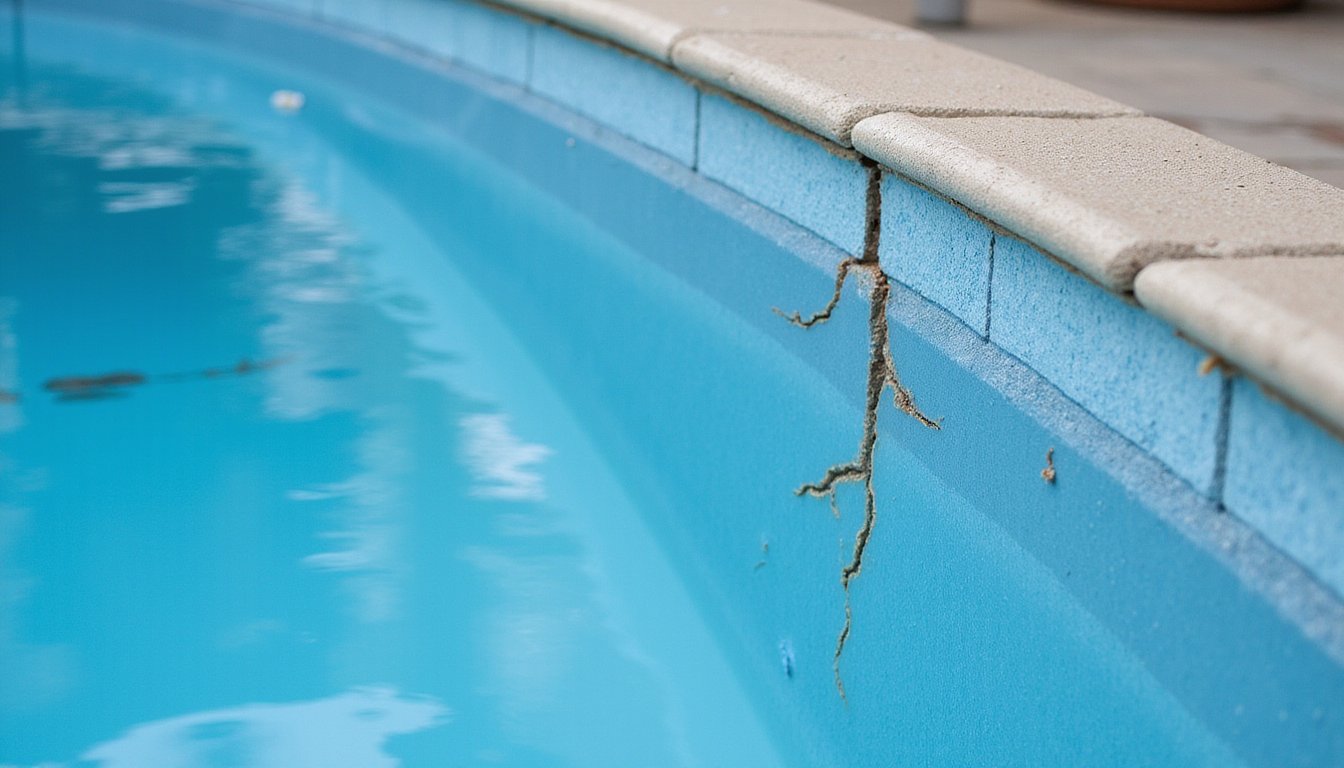
Groundwater pressure greatly impacts your pool’s structural stability through upward forces that can cause lifting or cracking. You’ll need to ponder your soil composition, as loose or permeable soils allow more water movement and pressure buildup beneath the structure. Implementing an effective drainage system is vital to manage hydrostatic pressure and prevent flotation. You should guarantee your pool shell’s weight and anchoring system sufficiently counteract these upward forces to maintain stability.
Can Existing Underground Utilities Affect Where Support Structures Should Be Placed?
You’ll need to carefully plan support structure placement around existing utilities, as their locations directly influence where you can safely install pool supports. Utility placement affects both the vertical and horizontal positioning of structural elements. You’ll want to maintain safe clearances from utility lines while ensuring your support structures rest on stable soil conditions. Consider using alternative support configurations or relocated footings when utilities interfere with ideal structural placement.
How Do Different Climates Influence the Choice of Structural Reinforcement Methods?
You’ll need to adapt your reinforcement methods based on your local climate and soil composition requirements. In cold regions, you’ll want frost-protected footings and air-entrained concrete to prevent freeze-thaw damage. For coastal areas, you’ll require epoxy-coated rebar and stainless steel anchors to combat salt corrosion. Don’t forget to ponder water table depth factors, as high groundwater levels necessitate supplementary structural support and specialized drainage systems.
What Role Does Pool Shape Play in Determining Structural Stress Points?
Your pool’s shape directly influences stress concentration points through complex load distributions. You’ll notice that curved designs distribute forces more evenly, while angular shapes create distinct stress points requiring added reinforcement. When performing pool dimension calculations, you must account for how water flow patterns interact with geometric changes. Sharp corners typically demand more structural support, as they concentrate stress loads that would otherwise disperse along curved surfaces.