
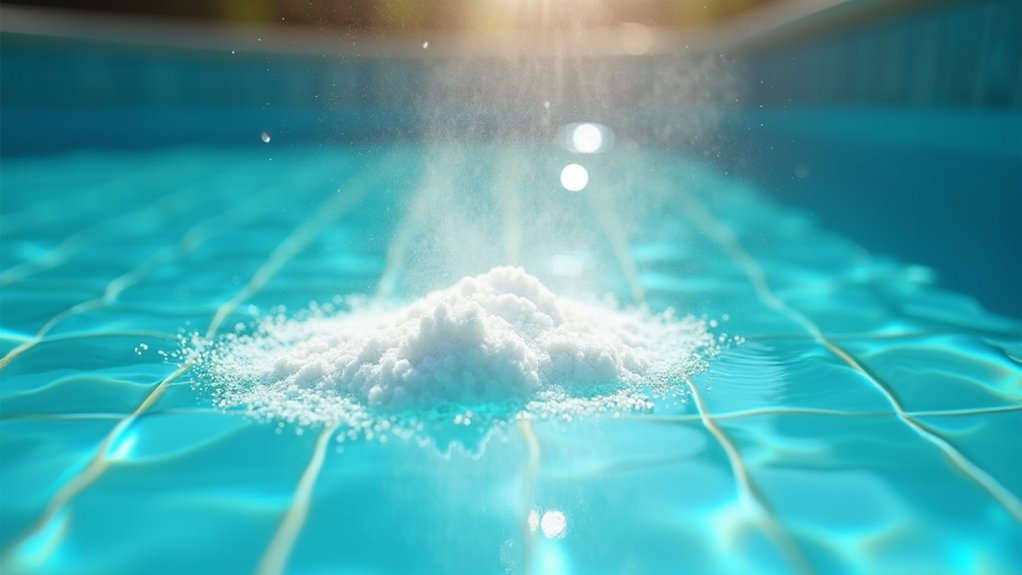

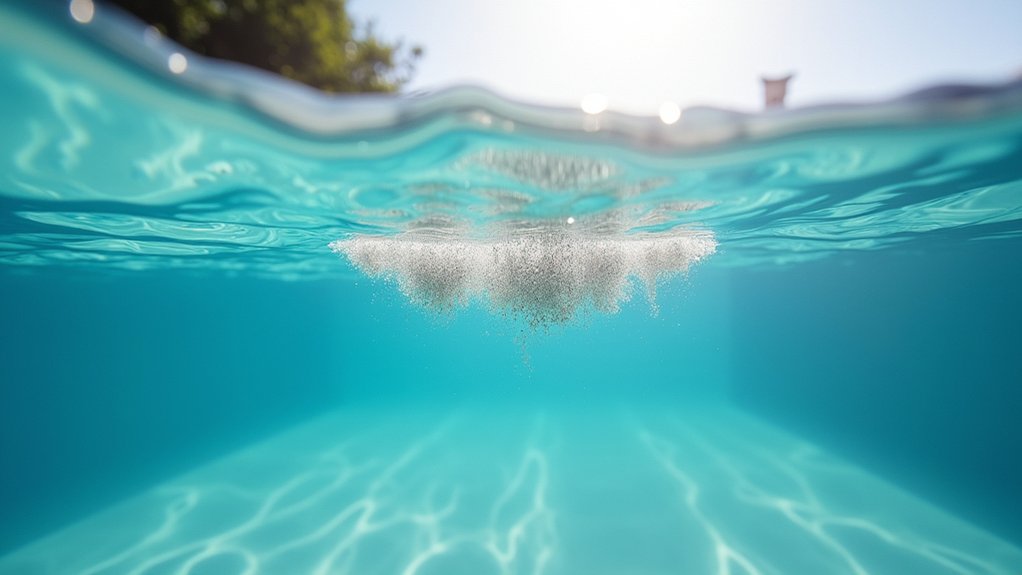
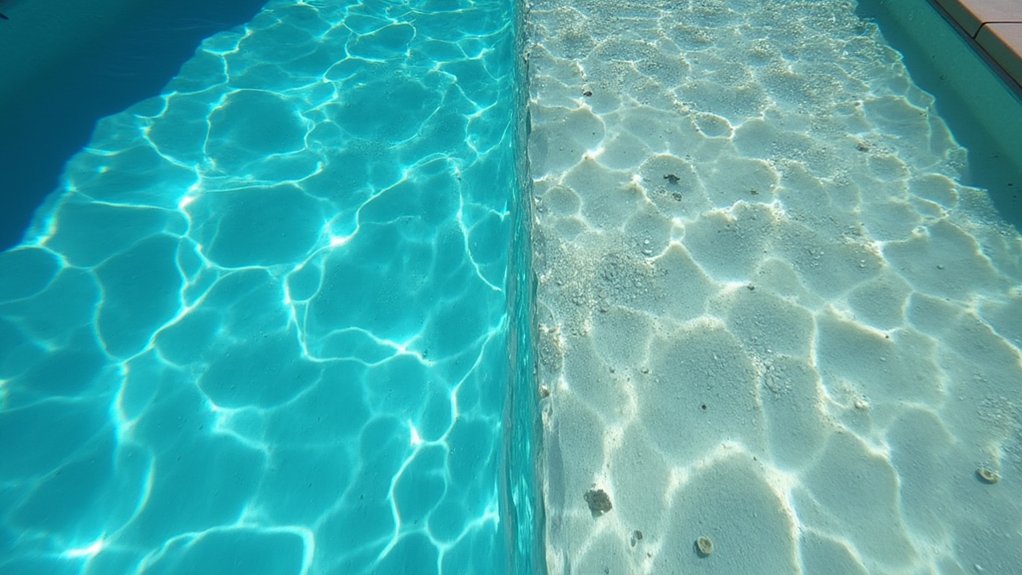
For standard powder or granular flocculant, you’ll add 1-2 pounds per 10,000 gallons of pool water. Liquid flocculant requires 100-200 ml per 10 cubic meters for cloudy conditions. Alum-based products work differently, use 2-4 ounces per 5,000 gallons for mild cloudiness or 4-8 ounces for heavier turbidity. Your exact dosage depends on your pool’s volume, current water clarity, and the specific product formulation you’re using.
The Standard Pool Flocculant Dose
The standard flocculant dose for most residential pools falls between 1-2 pounds per 10,000 gallons of water. Your pool volume calculation determines the exact floc amount you’ll need for effective treatment.
For mild cloudiness, start with the lower end of the flocculant dosage range. If you’re dealing with severely cloudy water, you’ll want to use the full 2 pounds per 10,000 gallons. Popular products like Baquacil and Poolife recommend 1.5 pounds per 10,000 gallons as their standard rate. Baquacil Flocculant uses an aluminum sulfate formula that works effectively with chlorine, bromine, and biguanide sanitizing systems.
When determining how much flocculant to add to pool water, always check your specific product’s label first. If you don’t see improvement after 24 hours, add half your initial dose. Accurate measurement prevents residue buildup and filtration problems while ensuring particles settle properly. Flocculant is available in liquid or powder form, so be sure to follow the measuring instructions specific to the product type you’re using. For optimal flocculant performance, ensure your pool maintains ideal pH levels (7.2-7.6) before application.
Calculate Your Pool Volume First
Before you can determine the correct flocculant dosage, you’ll need to calculate your pool’s exact volume in gallons. Use these formulas based on your pool’s shape:
Rectangular pools: Length x Width x Average Depth x 7.5
Round pools: 3.14 x Radius x Radius x Average Depth x 7.5
Oval pools: 3.14 x Length x Width x 0.25 x Average Depth x 7.5
Kidney-shaped pools: (Width A + Width B) x Length x 0.45 x Average Depth x 7.5
Irregular/free-form pools: Longest Length x Widest Width x Average Depth x 5.9
Calculate your average depth by adding the shallow and deep end measurements, then dividing by two. Take multiple depth readings for irregular pools to improve accuracy. Pools with steep drop-offs between the shallow and deep ends require more depth measurements to calculate an accurate average. Record your final volume, you’ll reference this number when measuring your flocculant dose.
Dosage by Type: Alum, Liquid, and Cartridge
Different flocculant types require specific dosing calculations based on your pool’s volume and water conditions. For alum, you’ll typically use 1-2 pounds per 10,000 gallons, while liquid flocculants need 10 ml per cubic meter for recovery treatments or 0.5 ml per cubic meter for routine maintenance dosing. Cartridge flocculants follow a simpler schedule, replace them every 15 days in your skimmer or buffer tank based on the manufacturer’s specifications. Liquid flocculant is designed for sand filters only and should not be used with cartridge filtration systems. Under-dosing leads to incomplete flocculation and poor sedimentation, leaving your pool water cloudy despite treatment efforts. Using the incorrect amount can negatively impact water quality, so always follow manufacturer instructions to ensure proper water balance.
Alum Dosage Guidelines
Several factors determine the correct alum dosage for your pool, including water volume, cloudiness severity, and the specific product form you’re using.
For granular alum, apply 2-4 ounces per 5,000 gallons for mild cloudiness. Moderate to heavy conditions require 4-8 ounces per 5,000 gallons. The standard average sits at 4 pounds per 10,000 gallons, with a working range of 2-8 pounds per 10,000 gallons depending on suspended solids concentration.
If you’re targeting CYA removal, increase your dosage to 8.3 pounds per 10,000 gallons. For sand filter applications, add 6 ounces per 100 pounds of filter media directly into the skimmer after backwashing. Be careful to avoid over-dosing, as excessive alum can cause pH imbalances and scaling issues in your pool.
Metric users should calculate 10 grams per cubic meter. Always pre-dissolve granular alum in a bucket of water before distribution around the pool perimeter. This dissolution step is essential because alum works through coagulation and flocculation, binding tiny suspended particles together into larger clumps that sink to the pool floor for easy vacuuming. After application, allow impurities to settle for at least 2 hours before removing them with a pool hoover.
Liquid Flocculant Amounts
Most liquid flocculants require 100-200 ml per 10 m³ of water for treating substantially cloudy conditions, though you’ll want to start at the lower end and adjust based on results.
For shock treatment of severely turbid water, increase to 200 ml per 10 m³. Dilute your measured dose in 10 liters of water before spreading it evenly across the pool surface in a thin stream.
If cloudiness persists after 24 hours, add a half-dose increment rather than repeating the full application. This prevents chemical overload without improving clarity. Note that overdosing may cause temporary cloudiness that typically dissipates within 1-3 days.
For weekly maintenance, reduce your dosage considerably to 50 ml per 10 m³ to prevent particle stabilization. Regular preventative applications at 5 ml per 10 m³ eliminate the need for emergency shock treatments during peak turbidity periods. The flocculant’s cationic nature interacts with colloidal particles, forming voluminous flocs that sink to the bottom for easy vacuuming.
Cartridge Replacement Schedule
When you’re using cartridge-type flocculant products, you’ll need to replace them based on usage hours and pressure differential rather than a fixed calendar schedule.
Monitor your filter’s pressure gauge closely. Replace the cartridge when pressure rises 8-10 psi above the clean baseline reading. After flocculant treatment, vacuum settled debris to waste the following day to prevent clogging.
| Indicator | Threshold | Action Required |
|---|---|---|
| Pressure Rise | 8-10 psi above baseline | Replace cartridge |
| Post-Treatment | 12-24 hours settling | Vacuum to waste |
| Persistent Cloudiness | After initial treatment | Repeat process |
If cloudiness persists after the first application, repeat the treatment cycle. Always rebalance your water chemistry after completing the flocculant process, as the treatment can affect pH and alkalinity levels. Be aware that entering certain inputs like SQL commands or malformed data into pool chemical calculator websites may trigger security blocks that prevent you from accessing dosage information. When using alum-based flocculants, the positively charged aluminum species attract negatively charged particulate matter, causing particles to combine into heavier floc that settles to the bottom.
Adjusting Your Dose for Cloudiness Level
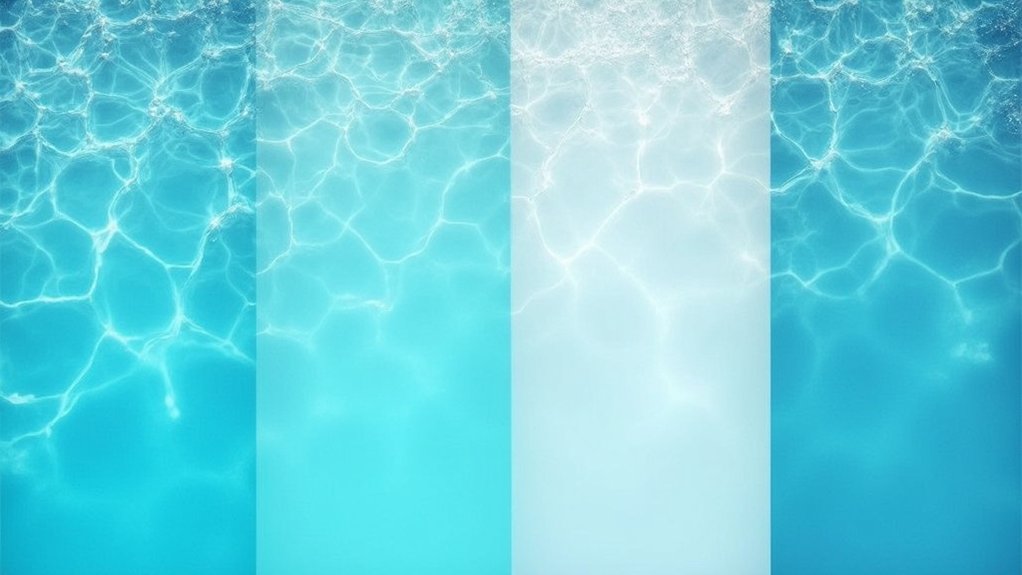
Your cloudiness level directly determines how much flocculant you’ll need, so you should assess water clarity before measuring your dose. For mild haze where you can still see a dark object at four feet, start with half the manufacturer’s recommended amount since extended filtration or a clarifier often handles light cloudiness without flocculant. Reserve full or increased doses for severe, pea-soup conditions where visibility drops dramatically, and if you don’t see improvement after 24 hours, add half your initial dose rather than doubling up immediately.
Mild Versus Severe Cloudiness
Not all cloudy pools require the same flocculant dose, matching your application rate to the severity of cloudiness prevents both undertreatment and chemical overload.
Mild Cloudiness
If you can see a dark object at four feet deep, you’re dealing with mild haze. Start with 1 pound per 10,000 gallons or consider using a clarifier instead for gradual improvement over 2-3 days. Extend your filtration time before adding flocculant, light haze often clears without chemical intervention.
Severe Cloudiness
When visibility fails at four feet or your water resembles pea soup, increase your dose to 2 pounds per 10,000 gallons. Follow manufacturer guidelines, typically 4-8 oz per 10,000 gallons for concentrated formulas. This strength drops stubborn particles clarifiers can’t handle. Always balance pH to 7.2-7.6 before treating either condition.
Starting With Lower Doses
Although you might feel tempted to use maximum flocculant strength immediately, beginning with the minimum recommended dose protects your pool from chemical overload and prevents costly damage to your filtration system. Lower doses for mild cloudiness often prove sufficient, eliminating unnecessary chemical expense while allowing you to assess your water’s response before adding more product.
Starting conservatively prevents overdosing consequences such as filter clogs, pump damage, and reversed particle charges that can worsen cloudiness. A measured approach with gradual increases delivers better results than maximum dosing from the start.
If you don’t see visible improvement after 24 hours, add a half-dose increment rather than doubling your initial amount. This calculated method lets you find the ideal quantity for your specific water conditions without wasting product or risking equipment damage.
When to Add More
When your pool’s cloudiness persists after the initial flocculant application, you’ll need to assess whether a dosage adjustment is necessary. Allow 8-12 hours of settling time before evaluating results. If visibility hasn’t improved, wait a full 24 hours, then add half your original dose.
Before adding more flocculant, retest your water chemistry. Balanced pH (7.2-7.6) and alkalinity (80-120 ppm) directly impact floc effectiveness.
Key indicators for dosage adjustment:
- No visible particle settling after 8-12 hours of pump-off time
- Pea-soup murkiness remains unchanged after 24 hours
- Visibility test still fails at four feet depth
- Sediment layer hasn’t formed on pool floor
Don’t exceed maximum limits, overdosing reverses particle charges and worsens cloudiness. Vacuum any settled sediment before reassessing clarity.
Check pH Before Adding Flocculant
Before you add flocculant to your pool, you’ll need to test and adjust your pH level to guarantee ideal particle binding. The perfect range falls between 7.2 and 7.8 for most flocculants to work effectively. Chlorine pools perform best at 7.0 to 7.4, while salt water and bromine systems require 7.2 to 7.6.
Low pH reduces your flocculant’s ability to clump particles by altering its charge. High pH causes certain flocculants to break down, diminishing aggregation efficiency. If you’re dealing with heavy soil or mud contamination, raise your pH to 7.8 or higher.
Test your water first, then adjust using acid or base to reach the target range. Starting at approximately 7.0 preserves sanitizer function while supporting flocculation. Always verify pH after treatment completion.
How to Add Flocculant Step by Step
How precisely should you measure flocculant for your specific pool size? Start by calculating your pool’s volume, then apply the standard dosage of 1 L per 100,000 L of water. For small pools (15,000, 20,000 L), you’ll need 100, 150 mL. Medium pools (20,000, 40,000 L) require 150, 300 mL, while large pools (40,000, 60,000 L) need 300, 450 mL.
Proper flocculant dosing depends on pool volume, use 1 L per 100,000 L of water for crystal-clear results.
Follow these steps for proper application:
- Dilute the flocculant in a 5-gallon bucket with water according to label instructions
- Set your filter valve to recirculate to prevent clogging
- Pour the diluted solution evenly around the pool’s perimeter in a thin stream
- Add flocculant in the evening for ideal overnight settling
Run your pump 2, 4 hours for mixing, then turn it off for 8, 12 hours.
When the First Dose Doesn’t Work
Even with precise measurement and proper application, your first flocculant dose may not produce the expected results. Living algae resists flocculation entirely, you must shock your pool first to kill algae cells before they’ll clump together. Guarantee chlorine levels exceed 1 ppm and allow 8-12 hours of undisturbed settling time after circulating water for 2 hours.
Check your water chemistry before re-dosing. Balance pH to 7.2-7.6, since high alkalinity and calcium cause turbidity that flocculant can’t address. For heavily cloudy pools, increase your initial dose above the standard 1 L per 100,000 L ratio.
Before adding more flocculant, vacuum settled particles to waste and scoop surface residue with a dip net. Clogged filters compromise results regardless of dosage accuracy.
Dosing Mistakes That Ruin Results
While accurate measurement forms the foundation of effective flocculation, several application errors can undermine even perfectly calculated doses. Understanding these pitfalls helps you maximize your flocculant’s effectiveness.
Even perfect measurements can’t save your pool if you make these common flocculant application mistakes.
Common Dosing Mistakes:
- Overdosing, Adding excess product causes particles to bond beyond contaminants, actually worsening cloudiness and clogging filters
- Ignoring pH levels, Flocculant requires pH between 7.2-7.6 to function properly; unbalanced water renders your dose ineffective
- Running the pump continuously, After circulating for 2 hours, you must stop the pump for 8-12 hours to allow settling
- Poor distribution, Dumping product in one spot reduces dispersal; walk the pool’s edge spreading evenly across the surface
You’ll also want to avoid adding flocculant within 24 hours of shocking, as heightened chlorine levels interfere with the flocculation process.
Frequently Asked Questions
Can I Swim Immediately After Adding Flocculant to My Pool?
No, you can’t swim immediately after adding flocculant to your pool. You must keep the water completely still for the flocculant to work properly, it needs to bind particles into clumps that sink to the bottom. Any movement disrupts this process. You’ll need to wait until the floc fully settles, then vacuum the residue to waste before swimming. Test your water chemistry afterward to verify safe conditions.
How Long Does Flocculant Take to Fully Settle Debris to the Bottom?
Flocculant takes 8-24 hours to fully settle debris to the bottom of your pool. You’ll see particles begin binding within 8-16 hours, but complete sedimentation requires 24-48 hours for best results. Keep your pump off during this entire period, any water movement resuspends particles and restarts the process. You’ll know settling’s complete when you see a visible debris layer on the pool floor, ready for vacuuming to waste.
Will Flocculant Damage My Pool Liner or Vinyl Surface?
Flocculant won’t damage your vinyl liner when you apply it correctly. The product coagulates particles without attacking flexible PVC surfaces. Your bigger concern should be chlorine levels, don’t shock above 15 ppm, as excessive chlorine causes bleaching and dimensional changes to vinyl within 6, 24 hours. Follow proper dosing measurements, turn off your pump for 8, 16 hours during treatment, and vacuum settled debris to waste to protect your liner’s integrity.
Can I Use Flocculant in a Saltwater Pool System?
Yes, you can use flocculant in a saltwater pool, but you’ll need to follow specific steps. Turn off your salt chlorine generator before adding the product, and guarantee your flocculant is labeled for saltwater compatibility. Sand filters work best, avoid diatomaceous earth filters, which will clog. Balance your pH to 7.4, 7.6, allow 8, 24 hours for settling, then vacuum to waste. Restore salt levels afterward.
How Often Can I Safely Use Flocculant in My Pool?
You can safely use flocculant every 1-2 weeks maximum, but only when specific conditions require it. Don’t treat on a schedule, instead, reserve flocculant for storm debris, algae blooms, or persistent cloudiness that clarifiers can’t handle. Before each application, test your water chemistry: pH must read 7.2-7.6, and free chlorine should measure 1-4 ppm. Always allow full water recovery between treatments to prevent cumulative filter damage.