
Pool flocculant uses positively charged polymers to neutralize the negative electrical charges on microscopic contaminants that slip through your filter. Once neutralized, these tiny particles lose their repulsion and begin clustering together through polymer bridging. Van der Waals forces strengthen these bonds as particles collide, forming dense 2-5mm flocs heavy enough to sink to your pool floor. You’ll then vacuum up the settled debris, restoring crystal-clear water within hours, and the application process is simpler than you’d expect.
Why Your Pool Stays Cloudy Despite Filtration
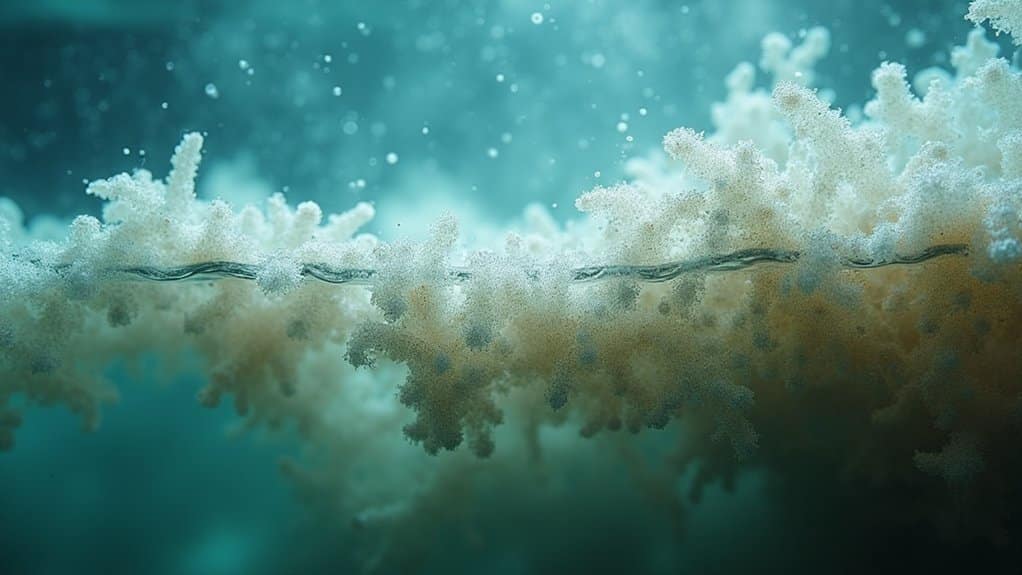
Several factors cause persistent cloudiness that your filter simply can’t resolve on its own. High pH levels above 8.0 trigger limescale precipitation, creating microscopic particles that pass through standard filtration media. When your chlorine-to-CYA ratio falls out of balance, bacteria and algae proliferate faster than your system removes them. Inadequate filtration combined with improper chemical balance creates conditions where contaminants accumulate faster than they’re removed. Elevated phosphate levels can also contribute to cloudy or green pool water by providing additional food sources for algae growth.
Understanding what does flocculant do helps explain why filtration alone fails. Dead algae after shocking remains suspended, evading capture. Your filter can’t trap particles smaller than its micron rating. Poor water circulation creates dead zones where fine particles collect and settle, further contributing to persistent cloudiness.
This is where learning how flocculants work becomes essential. These chemicals enable particle clumping by neutralizing electrical charges, making debris heavy enough to sink. For effective algae removal, flocculant bypasses your overwhelmed filter entirely, settling contaminants to the pool floor for vacuuming.
How Flocculant Neutralizes Invisible Charged Particles
When you add flocculant to cloudy pool water, the chemistry targets particles you can’t see with the naked eye. These microscopic contaminants carry negative electrical charges that cause them to repel each other, keeping them suspended indefinitely. Your filter can’t capture what won’t settle.
Cationic flocculants carry positive charges that directly neutralize these negative surface charges through electrostatic attraction. Once the charges balance out, particles lose their repelling force and can finally make contact with each other. This process is known as coagulation, which specifically involves neutralizing the electronic surface charges of particles, fibres, and colloidal material in the water. The effectiveness of this process can be measured by monitoring the zeta potential, which decreases as charges are neutralized.
This destabilization process creates ionic and hydrogen bonds between the polymer chain and particles. The high molecular weight of flocculant polymers allows them to capture multiple destabilized particles simultaneously along their chain length. These larger and denser flocs settle more quickly to the pool floor, allowing efficient separation from the water. Without this charge neutralization step, particles remain in stable suspension, and no amount of circulation will clear your water.
How Flocculant Bridges Particles Into Larger Clumps
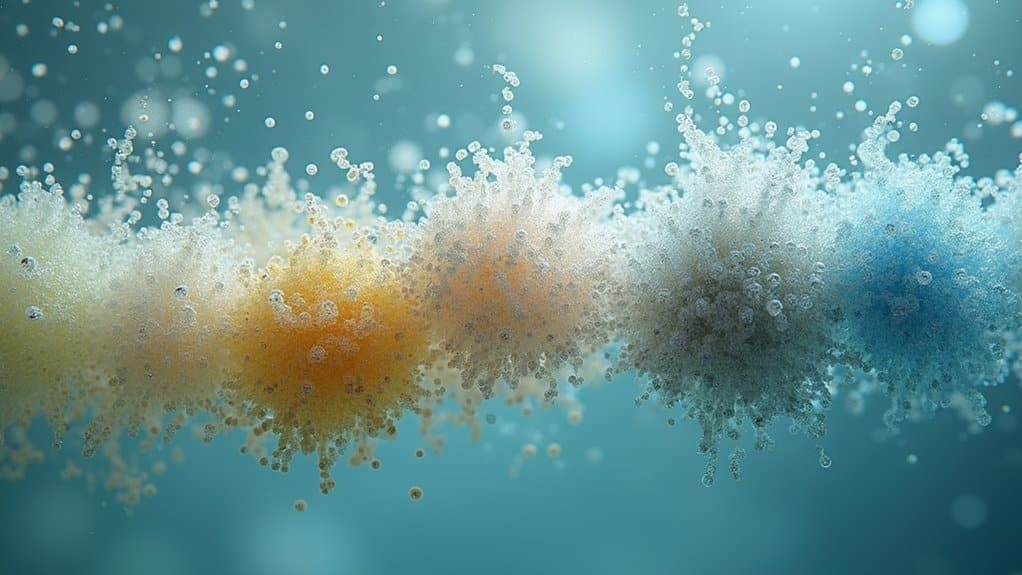
Once charge neutralization destabilizes suspended particles, polymer bridging takes over to build visible, settleable flocs. High-molecular-weight polymers extend their long molecular chains through the water, simultaneously adsorbing onto multiple particle surfaces. This creates three-dimensional networks that trap and bind particles together.
The bridging mechanism works through these key processes:
- Adsorption binding, Polymer chains attach to particle surfaces at multiple contact points, interconnecting destabilized particles into larger aggregates
- Van der Waals enhancement, Attractive forces work synergistically with polymer bridging to strengthen particle bonds
- Collision-driven growth, Gentle water movement encourages particles to collide and combine, allowing microflocs to develop into dense clumps measuring 2-5 millimeters
You’ll notice flocs forming within minutes as polymer bridging transforms microscopic particles into heavy aggregates that sink to your pool floor. The size and density of these flocs directly determine how quickly and effectively they settle, making proper floc formation essential for clearing your pool. As flocs grow larger, they become more fragile, so avoiding excessive water agitation helps preserve their structure and ensures optimal settling. This gentle, diffusion-driven aggregation process allows particles to naturally encounter each other and bond without disrupting the delicate floc structures.
From Microscopic Specks to Visible Flocs in Minutes
Once you add flocculant to your pool, the microfloc formation timeline begins immediately as positively charged polymers attract and bind negatively charged particles like dust, oils, and algae. You’ll notice particle size growth occurring rapidly as these microscopic specks, previously too small for your filter to capture, combine into increasingly larger aggregates. Within hours, these growing flocs become heavy enough to sink, transforming invisible suspended debris into visible clumps on your pool floor. This process is particularly effective after pool parties or storms when high bather loads introduce excessive contaminants that cause cloudy, dull-looking water. Unlike clarifiers that work gradually through your filtration system, flocculants deliver near-immediate results when you need fast water clarity restoration. Before adding flocculant, you should switch your pump to recirculate mode to bypass the filter system and allow proper distribution throughout the water.
Microfloc Formation Timeline
Microfloc formation occurs in three distinct phases, each requiring specific conditions to transform invisible particles into settleable clumps.
During the initial phase, you’ll notice rapid mixing disperses the flocculant throughout your pool water within 1-3 minutes. Flash mixing creates violent agitation that neutralizes particle charges almost instantly. The flocculant works by neutralizing the electrical charge on suspended particles, enabling them to aggregate together. Once destabilized, colloids begin forming microfloc clusters.
The second phase involves gentle agitation that promotes particle collisions:
- Microfloc collisions build pinflocs over 15-30 minutes
- Higher collision rates accelerate floc growth
- Polymers strengthen bonds between particles
In the final phase, pinflocs cluster into visible macroflocs reaching 0.1-3 mm in size. You’ll observe snowflake-like particles appearing within 30-45 minutes. Maintaining gentle, uniform water movement prevents fragile flocs from breaking apart during this critical growth period. This size range is ideal because larger flocs are more subject to breakup from excessive water movement, while smaller ones may fail to settle properly. Be careful when dosing, as using too much flocculant can actually make your pool water cloudier instead of clearer.
Particle Size Growth
The transformation from microscopic colloids to visible, settleable flocs hinges on two primary mechanisms: charge neutralization and polymer bridging. You’ll first see flocculant ions reduce zeta potential below ±5mV, eliminating electrostatic repulsion between particles. High-molecular-weight polymers like PAM then extend chains measuring 10-15 million Daltons, physically linking destabilized particles through hydrogen and ionic bonds.
| Growth Stage | Particle Size | Mechanism |
|---|---|---|
| Initial destabilization | <1 micrometer | Charge neutralization |
| Pin floc formation | 100-500 micrometers | Gentle collision aggregation |
| Macro floc maturation | 2-5 millimeters | Polymer bridging networks |
You’ll achieve ideal growth with gentle mixing at G-values of 20-70 s⁻¹ for 15-30 minutes. This controlled agitation maximizes particle collisions while preventing shear-induced floc breakup. Excessive shear during mixing can tear apart the delicate floc structures, reducing settling efficiency and requiring additional chemical treatment.
How to Apply Flocculant Step by Step
Before adding flocculant to your pool, you’ll need to complete several critical preparation steps that directly impact treatment effectiveness. Start by raising your water level to its highest point, balancing pH between 7.0-7.6, and switching your filter valve to the recirculate setting. For dosage, follow manufacturer directions precisely, typically 8 ounces per 20,000 gallons for moderate cloudiness, and always dilute the product in a 5-gallon bucket before pouring it around your pool’s edges.
Pre-Treatment Water Preparation
Several critical steps must occur before you add flocculant to your pool. First, you’ll need to raise your water level by placing a running hose in the skimmer box. This compensates for water loss during the vacuum-to-waste process that follows treatment.
Several critical steps must occur before you add flocculant to your pool. For effective pool flocking, preparation is essential to ensure the chemical can bind suspended particles properly. First, you’ll need to raise your water level by placing a running hose in the skimmer box. This compensates for water loss during the vacuum-to-waste process that follows treatment.
Next, balance your pH to 7.4-7.6 for ideal floc performance. Use pH buffer or soda ash to make adjustments, then verify your levels before proceeding.
Before adding chemicals, prepare your pool surface:
- Rake heavy debris from the pool floor and walls
- Brush all surfaces thoroughly to loosen adhered particles
- Remove visible organics like pollen, dust, or mulch
Finally, super-chlorinate with 20-40 litres of liquid chlorine or 2-4 kg granular chlorine. Spread chemicals evenly across the water surface for uniform distribution.
Dosage and Application Methods
Correct dosage determines whether flocculant clears your pool effectively or creates additional problems. Standard treatment requires 1 liter per 100,000 liters of pool water, though brand-specific formulations range from 4, 8 ounces per 10,000 gallons. For mild cloudiness, start with 1, 2 pounds per 10,000 gallons and adjust based on results.
Calculate your pool’s volume using length, width, and depth measurements before application. Small pools (15,000, 20,000 liters) need 100, 150 milliliters, while large pools (40,000, 60,000 liters) require 300, 450 milliliters.
Dilute the flocculant in a 5-gallon bucket filled with pool water according to product instructions. Pour the mixture evenly around your pool’s perimeter, never directly into the skimmer. For sand filter systems, broadcast alum across the water’s surface. Apply during evening hours to maximize overnight settling time.
Liquid vs. Tablet Flocculant: Which One Fits Your Pool?
When you’re ready to treat cloudy pool water, choosing between liquid and tablet flocculant depends on your specific situation and pool characteristics.
Liquid flocculant disperses rapidly, making it ideal for urgent clearing needs. You’ll get immediate action without waiting for dissolution. For quick-shock scenarios or commercial pools with heavy use, liquid delivers fast results. For those looking for solid alternatives, a reliable option to consider is pool flocculant home depot. These products are often stocked in local hardware stores, providing convenient access for pool maintenance. Pairing a quality flocculant with regular cleaning practices can significantly enhance your pool’s clarity and overall appearance.
Liquid flocculant acts fast, perfect when you need crystal-clear water without the wait.
Tablet flocculant offers consistent release and minimal handling. Pre-dosed tablets eliminate measuring and dissolve steadily through dispensers similar to chlorine systems.
Consider these selection factors:
- Pool volume: Liquid suits high-volume pools; tablets work well for pools under 5,000 gallons
- Urgency level: Liquid provides immediate treatment; tablets maintain ongoing clarity
- Maintenance preference: Tablets require less labor; liquid demands precise application
Match your choice to your pool’s demands for ideal clearing performance.
The pH and Dosing Sweet Spot for Flocculant
Getting your pH dialed in before adding flocculant determines whether you’ll achieve crystal-clear results or waste product on ineffective treatment. Target a pH range of 7.2 to 7.6 for ideal particle bonding. Starting around 7.0 accounts for flocculant-induced changes during treatment. Chlorine pools perform best between 7.0 and 7.4, while saltwater and bromine systems require 7.2 to 7.6.
Before treatment, verify your total alkalinity sits between 80 and 120 ppm to buffer pH fluctuations. Use sodium carbonate to raise low pH or sodium bisulfate to lower it.
For dosing, apply 32 oz per 10,000 gallons, distributed evenly across the surface. Dilute your flocculant in a five-gallon bucket following label directions. Measure precisely, overdosing increases cloudiness rather than improving clarity.
Flocculant Mistakes That Keep Your Pool Cloudy
Even though flocculant offers a powerful solution for cloudy water, common application errors often sabotage results and leave pools looking worse than before treatment.
Critical mistakes to avoid:
- Overdosing flocculant, Excess product sticks to itself rather than particles, creating floating cloudiness that’s harder to remove than the original problem.
- Skipping pre-treatment shock, Flocculant can’t clump live algae. You must kill algae first with shock, then floc the dead cells for vacuum removal.
- Insufficient settling time, Premature vacuuming stirs up unset floc, worsening turbidity. Allow 8-48 hours of settling with the pump off.
Additionally, using incorrect filter settings undermines the entire process. Set your valve to “recirculate” during mixing, then switch to “waste” when vacuuming to bypass your filter completely.
Frequently Asked Questions
Can I Swim in My Pool While Flocculant Is Working?
No, you shouldn’t swim while flocculant is working. You’ll stir up the settled particles and ruin the treatment, forcing you to start over. Turn off your pump and let the water sit undisturbed for 8, 12 hours while debris sinks to the bottom. Once you’ve vacuumed the settled material to waste and tested your water chemistry, you can safely resume swimming.
How Do I Remove the Settled Debris After Flocculant Treatment?
You’ll remove settled debris by vacuuming to waste after the 8-16 hour settling period. Set your filter valve to the “waste” position, then manually vacuum the bottom, targeting the sediment layer. Don’t run debris through your normal filter cycle, you’ll cause damage. Alternatively, use a fine-mesh pool rake to scoop clumped particles. Afterward, backwash your filter, replace lost water, and rebalance chemicals before resuming standard filtration.
Will Flocculant Damage My Pool Liner or Equipment?
Flocculant won’t damage your vinyl liner or equipment when you use it correctly. You’ll need to maintain balanced water chemistry (pH 7.2-7.8) and calcium hardness above 150 ppm to protect surfaces. Never add flocculant directly to your skimmer or filter, this causes equipment damage. You must have a sand or DE filter with a waste setting, since cartridge filters can’t handle floc debris removal without clogging.
How Often Can I Safely Use Flocculant in My Pool?
You should limit flocculant use to occasional treatments, spacing applications at least 24-48 hours apart with full pump cycles between uses. Don’t rely on it regularly, constant need signals underlying issues like unbalanced chemistry or dirty filters that you’ll need to address first. Overuse causes re-clouding, filter clogging, and water loss from repeated vacuum-to-waste cycles. Balance your pH, clean filters, and run maintenance routines before considering another application.
Can I Use Flocculant With a Cartridge Filter System?
You can use flocculant with a cartridge filter system, but you’ll need to modify your approach. Remove your cartridge elements before adding the flocculant to prevent clogging. Run circulation without the cartridges installed, let particles settle, then vacuum directly to waste, not through your filter. Reinstall cartridges only after vacuuming is complete. Alternatively, consider using clarifier products or cartridge-compatible flocculants specifically formulated for your system.