
Your pool equipment enclosure requires strategic construction using durable materials like galvanized steel or aluminum frames combined with sound-dampening components. You’ll need to meet minimum safety standards, including 4-foot barrier heights and self-latching gates positioned 54 inches from the bottom. Incorporate proper ventilation while achieving up to 90% noise reduction through specialized acoustic materials and anti-vibration mounts. This thorough guide examines the essential elements for maximizing equipment protection and longevity.
Essential Components of Pool Equipment Enclosures
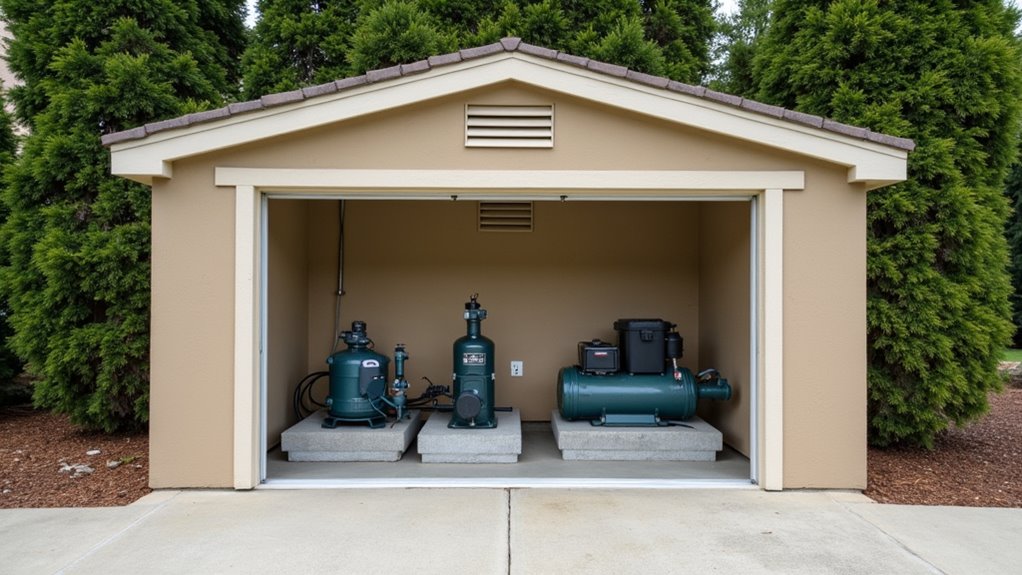
Pool equipment enclosures require specific essential components to guarantee proper functionality, safety, and equipment protection. You’ll need a sturdy structural framework, typically constructed from galvanized steel or weather-resistant wood, to form the foundation. Proper ventilation requirements must be integrated through strategic airflow design and placement of vents to prevent equipment overheating. The Pool Pump Cover offers 80% noise reduction while maintaining essential ventilation and protection. For comprehensive protection, custom constructions can be tailored to exact specifications and unique site requirements. Building a small roof enclosure can effectively shield equipment from rain and snow, except when housing gas heaters.
Access doors are critical elements that need careful consideration in your enclosure design. They should be positioned to allow easy maintenance while maintaining security. The protective covering must include weather-resistant materials that shield against environmental elements while supporting necessary ventilation. Your configuration should incorporate adequate clearance around equipment, typically adding 2-3 feet for maintenance access. Consider installing reinforced concrete pads with proper drainage to create a stable base that protects your equipment long-term.
Material Selection and Durability Factors
Three key material categories dominate the terrain of equipment enclosure construction: metals, synthetics, and glass composites. Each offers distinct advantages in structural integrity and longevity for your pool equipment protection needs.
Aluminum and steel frames lead the metal category, with aluminum providing excellent corrosion resistance for coastal environments and steel delivering superior strength when properly coated. Low maintenance aluminum frames require only occasional cleaning to maintain their pristine condition. These materials are designed to withstand harsh weather and provide lasting protection year after year. You’ll find synthetic options like vinyl and PVC offering flexibility and UV resistance at lower material costs, though they typically require replacement sooner than metal alternatives. Quality materials and construction from reputable brands consistently deliver superior durability and performance.
Glass composites, particularly tempered varieties, combine modern aesthetics with lasting durability, often exceeding 20-year lifespans. When evaluating your options, consider the weather conditions you’ll face, coastal areas demand corrosion-resistant materials, while high-impact zones benefit from polycarbonate’s durability and UV protection capabilities.
Safety Standards and Compliance Requirements
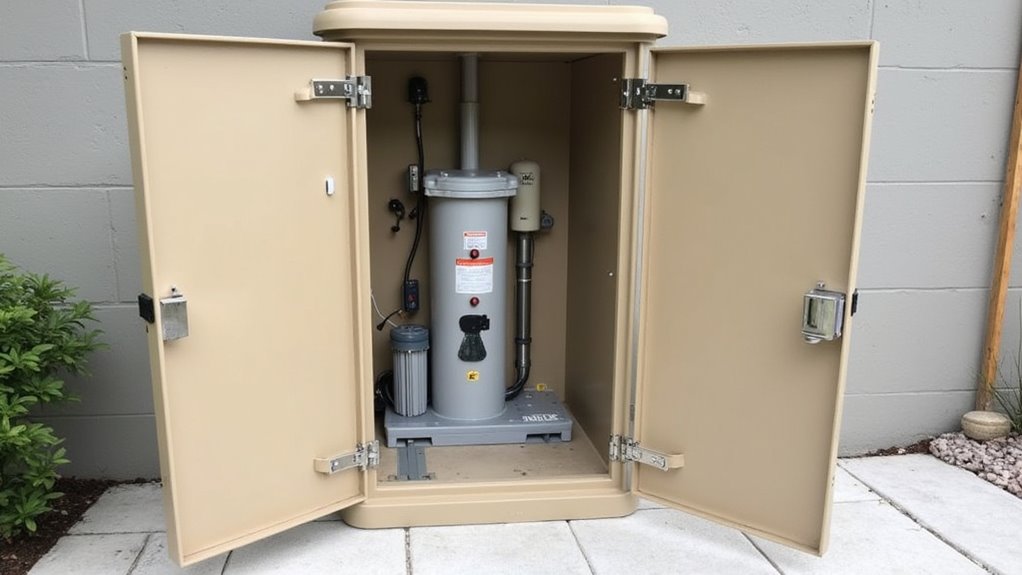
Beyond material selection, rigorous safety standards govern every aspect of pool equipment enclosure construction. You’ll need to guarantee your barrier construction techniques meet specific height and mesh requirements while preserving proper code compliance documentation. Ensuring all equipment adheres to local building codes is essential for maintaining safety and legal operation.
| Requirement | Standard | Verification |
|---|---|---|
| Barrier Height | 4 feet minimum | Local inspection |
| Mesh Openings | 1¼” max square | Engineer review |
| Gate Hardware | Self-latching | Safety test |
| Release Mechanism | 54″ from bottom | Field measure |
| Safety Covers | ASTM F1346-91 | Certification |
Your enclosure must include self-closing gates with properly positioned release mechanisms and meet strict opening size limitations. You’ll need final inspection approval before operation, including professional engineer evaluation of all mechanical systems. Keep in mind that temporary barriers are mandatory during construction phases, and you must maintain thorough documentation of all safety aspects.
Noise Reduction and Sound Control Features
Modern pool equipment enclosures integrate specialized soundproofing materials like water-resistant acoustic panels and BlocknZorbe™ that can reduce pump noise by up to 90% when properly installed. You’ll achieve ideal noise reduction through strategic barrier design combining dense plywood construction, sealed corners with GREENchoice adhesive, and vibration isolation methods like rubber pads that prevent sound transmission. Testing confirms these extensive sound control features can lower typical pump noise levels from 95.4 dB to 78.5 dB while maintaining proper ventilation and equipment access. Installing the pump on an anti-vibration mat has been proven to significantly decrease mechanical resonance throughout the enclosure structure. The versatile enclosure design ensures easy pump access through a removable lid that facilitates regular inspection and maintenance requirements. Surrounding the enclosure with dense vegetation can provide additional noise absorption benefits for both high and low frequencies.
Soundproofing Technology And Materials
Multiple soundproofing technologies and materials work together to create an effective noise control system for pool mechanics enclosures. You’ll find innovative soundproofing methods like mass loaded vinyl barriers and PrivacyShield® ABSC-25 blankets that block sound transmission through enclosure walls. These specialized insulation techniques combine with acoustic foam panels and Quiet Board™ materials to absorb up to 50% of airborne noise. Building a proper enclosure with dense plywood materials helps contain equipment noise while protecting components from the elements. A well-designed enclosure should include baffle silencers to maintain proper ventilation while minimizing noise escape. Closed-cell foam panels provide excellent sound insulation while resisting moisture and humidity.
To control vibrations, you’ll need anti-vibration pads and rubber isolation mats beneath your pool pump, reducing noise levels by 20-30%. Multi-layer systems like Quiet Barrier® Composites integrate soundproofing membranes with polyurethane foam for maximum effectiveness. Weather-resistant options, including Quiet Board™ Water Resistant Panels, guarantee your soundproofing maintains performance in aquatic environments while withstanding moisture, heat, and physical impact.
Strategic Sound Barrier Design
While designing an effective pool mechanics enclosure, strategic sound barrier implementation requires careful attention to both configuration and material selection. You’ll find that modular design configurations offer the flexibility to create custom-fitted solutions that optimize noise reduction while maintaining equipment accessibility. Incorporating self-adhesive rear face materials significantly streamlines the installation process and ensures secure attachment to enclosure surfaces. The advanced engineering delivers up to 80% noise reduction for a quieter poolside environment.
Your enclosure’s effectiveness depends on integrating innovative ventilation approaches that balance cooling requirements with acoustic performance. Through strategic placement of ventilation openings and acoustic barriers, you’ll prevent sound leakage while guaranteeing proper airflow. For ideal results, incorporate vibration isolation measures using anti-vibration pads and elastic base materials to prevent structure-borne noise transmission.
Consider tool-free assembly systems that allow quick installation and maintenance access. Weather-resistant, galvanized steel construction with powder coating guarantees long-term durability while maintaining sound-blocking capabilities in outdoor environments.
Acoustic Performance Test Results
Recent acoustic performance testing demonstrates compelling noise reduction capabilities across professional and DIY pool equipment enclosures. You’ll find that professional installations achieve up to 80% noise reduction, while properly constructed DIY solutions deliver approximately 17-18 dB(A) reduction, bringing typical pump noise from 68 dB(A) down to 50 dB(A).
Frequency response analysis reveals excellent performance in mid-range frequencies, with reductions of 20-22 dB at 1-2kHz. While low frequencies show minimal reduction (-6 dB at 63Hz), high-frequency attenuation maintains consistent 18 dB reduction at 8kHz. Reverberation time control testing confirms these enclosures’ effectiveness, reducing echo times from 3 seconds to under 1.5 seconds. Professional systems, though costlier at $1,800, guarantee council-approved performance with specialized sound-dampening insulation and rapid tool-free installation.
Weather Protection and Equipment Longevity
Pool equipment enclosures provide critical protection against harsh environmental elements that can dramatically reduce the lifespan of your pool’s mechanical systems. You’ll guarantee year-round operation while maintaining improved aesthetic appeal through high-quality galvanized steel construction and UV-resistant materials.
| Protection Feature | Equipment Benefit |
|---|---|
| UV Ray Barrier | Prevents material degradation |
| Rain Shield | Eliminates corrosion risk |
| Temperature Control | Reduces thermal stress |
| Wind Protection | Maintains operational stability |
| Debris Barrier | Prevents mechanical wear |
Your equipment enclosure’s weatherproof design delivers thorough protection through tensioned fabric structures that exceed international building codes. The system’s ability to regulate temperature and block harmful UV rays greatly extends component lifespans while reducing maintenance costs. With 80% noise reduction and superior contamination prevention, you’ll sustain optimal equipment performance in all weather conditions.
Size Options and Configuration Choices
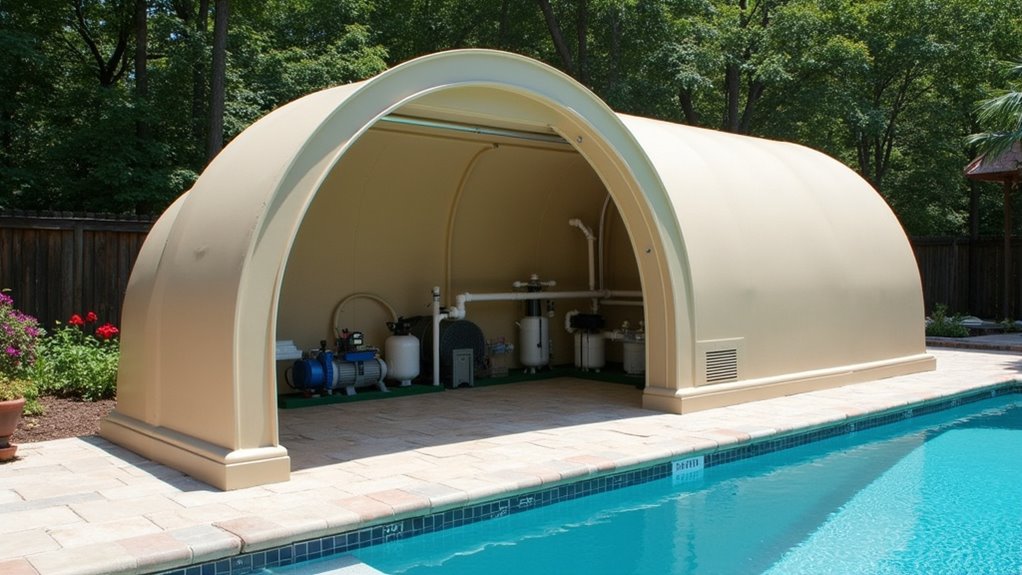
Professional enclosure systems offer six standardized width configurations ranging from 660mm to 1788mm, with adaptable depth and height options to accommodate diverse equipment layouts. You’ll find depth flexibility through wall-mounted options of 900-1200mm or freestanding choices of 1040mm and 1240mm, guaranteeing proper equipment spacing and maintenance access.
Height variation includes standard 1285mm and 1485mm configurations, with custom sizes available for specialized requirements. When planning your installation, account for internal dimensions being 50mm less than external measurements due to wall thickness, plus an additional 10-20mm concrete slab allowance. Consider the 50mm lid clearance requirement for proper operation. These precise measurements ensure ideal protection while maintaining accessibility for your pool equipment.
Installation Guidelines and Assembly Steps
Successful installation of mechanics enclosures requires systematic planning and precise execution to guarantee efficient equipment protection and functionality. You’ll need to confirm proper equipment spacing requirements while maintaining the critical minimum straight run of five times the pipe diameter for ideal plumbing pipe alignment.
| Phase | Critical Tasks | Safety Checks |
|---|---|---|
| Planning | Site preparation | Ground stability |
| Foundation | Concrete pad layout | Level verification |
| Framing | Post installation | Structure integrity |
| Equipment | Pump positioning | Access clearance |
| Completion | Pipe connections | Seal inspection |
When installing your enclosure, start with a level foundation and maintain proper clearances between components. Position your pump with adequate straight pipe run on the suction side, and confirm all equipment remains accessible for future maintenance. Remember to weatherproof all connections and verify structural integrity before final assembly completion.
Maintenance and Access Considerations
While maintaining a pool mechanics enclosure demands consistent attention, implementing a structured maintenance program guarantees long-term equipment protection and operational efficiency. You’ll need to establish regular visual inspection protocols focusing on structural components, screening materials, and hardware integrity.
- Conduct monthly inspections of beams, purlins, and fasteners to identify early signs of wear or corrosion
- Schedule seasonal deep maintenance during spring and fall, including thorough cleaning with soap-and-water mixtures and soft-bristled brushes
- Maintain one-foot clearance between vegetation and enclosure structures while preserving proper ventilation management
Remember to use appropriate cleaning agents for your enclosure’s surfaces, particularly on polycarbonate or acrylic panels. Don’t forget to check moving parts like doors and hinges, applying silicone-based lubricants to prevent rust formation and uphold smooth operation.
Frequently Asked Questions
How Much Ventilation Space Is Needed Between Equipment and Enclosure Walls?
You’ll need to maintain at least 24 inches of clearance between your equipment and enclosure walls to guarantee proper air circulation. Don’t compromise this spacing, as it’s critical for both maintenance access and adequate insulation. For heaters and heat pumps, you must allow a minimum 2-foot overhead clearance with unobstructed venting to the sky. Remember to position combustion air vents 12 inches above floor level to sustain safe and efficient equipment operation.
Can Multiple Equipment Enclosures Be Connected Together for Larger Setups?
Yes, you can connect multiple equipment enclosures for larger pool systems through proper multiple component integration. You’ll need to guarantee each connected enclosure maintains required ventilation clearances and structural integrity. When joining units, use weatherproof seals and compatible fastening systems between sections. Create customizable enclosure layouts that allow easy access for maintenance while following local building codes. Always maintain proper electrical isolation and grounding between connected compartments.
Are Permits Required Before Installing Pool Equipment Enclosures?
Yes, you’ll need permits before installing pool equipment enclosures. Your local code requirements typically mandate building permits for any pool equipment structures, especially those housing mechanical and electrical components. You must submit detailed plans showing proper installation procedures, including equipment locations and setbacks (minimum 5 feet from property lines). Don’t skip this step, failure to obtain required permits can result in fines and mandatory equipment removal.
What’s the Average Lifespan of Different Enclosure Materials in Coastal Environments?
In coastal environments, you’ll find significant variations in enclosure lifespans based on moisture resistance and coastal climate impact. Standard fiberglass screens typically last 5-8 years, while builder-grade artisan mesh only survives 3-5 years. You’ll get better durability from premium materials like Phifer Super Screen, lasting 10-15 years. For ideal longevity, you’ll need marine-grade hardware and stainless steel fasteners, which resist salt air corrosion and extend your enclosure’s structural integrity.
How Do Enclosures Affect Equipment Warranty Coverage From Manufacturers?
You’ll need to check your specific manufacturer’s warranty terms, as enclosure use can impact coverage differently. Proper equipment accessibility is indispensable; if your enclosure restricts service access or creates maintenance barriers, it might void the warranty. Furthermore, enclosure climate control plays a critical role; inadequate ventilation or moisture control could invalidate coverage due to environmental damage. It’s best to document your enclosure setup and get written confirmation from manufacturers about warranty compliance.