
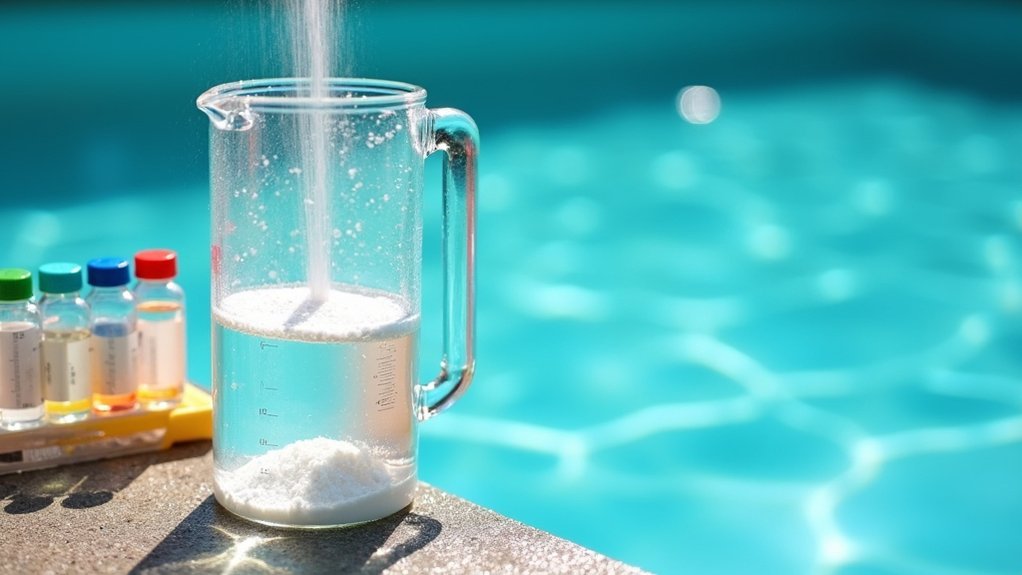
Prepping your pool chemicals for each season involves three key steps. First, identify each season’s specific demands, summer requires more chlorine due to UV exposure and heavy use, while fall focuses on winterizing treatments. Second, test your water at elbow depth using DPD liquid kits for accurate readings before adding anything. Third, follow a structured treatment schedule that adjusts for temperature and bather loads. Each season’s unique requirements are outlined below.
Know Which Pool Chemicals Each Season Requires

When seasonal changes affect your pool, the chemical demands shift noticeably, yet certain fundamentals remain constant throughout the year. You’ll maintain chlorine at 1-3 ppm regardless of season, though maximum chlorine levels required during summer increase due to UV exposure and heavier bather loads.
Your pH target stays at 7.2-7.6 year-round, but minimizing pH level adjustments depends on proper alkalinity management. Keep total alkalinity at 80-120 ppm to buffer against seasonal fluctuations from rain and debris. For every 10,000 gallons, 1.5 pounds of baking soda raises alkalinity by 10 ppm when levels drop below your target range.
Cyanuric acid protection at 30-50 ppm becomes critical during high-sun months, preventing chlorine degradation. Calcium hardness requires attention during winter to prevent equipment corrosion. For saltwater pool owners, remember that pH tends to rise over time, requiring more frequent monitoring and adjustment than traditional chlorine pools. Stock sodium bisulfate for pH reduction, sodium bicarbonate for alkalinity increases, and both stabilized tablets and liquid chlorine for flexible sanitization control. Having these essential products on hand prevents emergency repairs and wasted pool chemicals when seasonal demands spike unexpectedly.
Test Your Water Before Adding Any Chemicals
Although you might feel tempted to add chemicals based on visual cues or a maintenance schedule, accurate water testing must precede any chemical addition to your pool. Using proper sample collection techniques guarantees reliable results, collect samples with the kit’s provided collector at elbow depth, away from return jets. Sampling at this depth is important because higher chemical concentrations tend to accumulate near the water’s surface.
| Testing Method | Best Application |
|---|---|
| DPD Liquid Kits | Professional-grade accuracy (±0.2 ppm) |
| Photometric Devices | Automated controller calibration |
The importance of calibration can’t be overstated when using electronic meters. Without regular probe cleaning and calibration, your readings become unreliable. For liquid reagent tests, hold bottles vertically to maintain uniform drop sizes. Even facilities with automated testing systems require periodic manual testing to verify that equipment remains properly calibrated. Test free chlorine (1.0, 4.0 ppm), pH (7.4, 7.6), total alkalinity (80, 120 ppm), and calcium hardness (200, 400 ppm) before proceeding.
Follow This Seasonal Schedule for Chemical Treatments
Because pool chemistry demands shift dramatically throughout the year, you’ll need to adjust your chemical treatment protocol to match each season’s unique challenges.
Spring: Shock your pool to eliminate bacteria, then balance pH (7.2-7.6) and alkalinity (80-120 ppm). Reconnect equipment and add algaecide post-cleaning.
Summer: Maintain chlorine at 1-3 ppm with weekly applications. Optimize chemical ratios by testing 2-3 times weekly. Shock after heavy rain or usage during cooler hours. Run your circulation system 4-6 hours daily during periods of high pool usage to ensure proper chemical distribution. Pay special attention to chlorine levels since heat and sun cause them to dissipate quickly.
Fall: Reduce treatment frequency while maintaining weekly testing. Apply winter algaecide and shock before closing. Adding a clarifier with your algaecide helps keep water clear throughout the dormant months.
Winter: Add winterizing chemicals, lower water below the skimmer, and apply metal chelation products.
Throughout every season, monitor equipment operation consistently. Run filters 2-4 hours daily during algae treatments and backwash as needed.
Frequently Asked Questions
How Should I Store Pool Chemicals During the Off-Season?
Store your pool chemicals in a cool, dry, well-ventilated area away from temperature extremes and moisture. You’ll want secure chemical storage by locking them away from children and pets while keeping containers upright with tight lids. Never mix different chemicals, separate acids from chlorine products on distinct shelves. Check for clumping, discoloration, or damaged containers before each season. For degraded products, follow proper disposal methods through local guidelines or your pool retailer.
How Long Should I Run My Filter After Adding Chemicals?
You should run your filter for a minimum of 3 hours after adding chemicals to guarantee complete circulation throughout your system. This filter runtime after chemical addition allows proper mixing and distribution. For ideal chemical application timing, add treatments during your normal pump schedule rather than starting a separate cycle. Run your pump at standard or high speed, and extend runtime after heavy rain to remove pollutants effectively.
What Is the Correct Order for Adjusting Pool Water Chemistry?
You should adjust your pool chemistry in this specific order: Start with total alkalinity first, as proper alkalinity levels (80-120 ppm) stabilize your water and prevent pH fluctuations. Next, balance your pH to achieve the ideal pH range of 7.4-7.6. Then adjust your chlorine or sanitizer levels, followed by cyanuric acid. Finally, address calcium hardness. Always run your pump and wait 30 minutes between adjustments before retesting.
Can I Add Algaecide Immediately After Shocking My Pool?
No, you shouldn’t add algaecide immediately after shocking your pool. High chlorine levels above 5 ppm will degrade the algaecide’s effectiveness. Wait 8-24 hours until free chlorine drops below 5 ppm and pH reaches 7.6 or lower. When treating algae growth, shock first to kill existing algae, then add algaecide once chlorine normalizes. For preventing algae formation, this timing guarantees your algaecide works as an effective preventive backup.
How Much Chlorine Do I Need for an Entire Swimming Season?
Your seasonal chlorine needs depend on pool size, usage, and conditions. For a chlorine dosage calculation, estimate 15-20g per 10,000L to raise levels 1-2 ppm. With proper chlorine replenishment frequency, weekly in moderate weather, twice weekly during peak summer heat, a 50,000L pool typically requires 2-4 kg of chlorine monthly. Plan for 10-20 kg total for a 4-5 month season, adjusting for heavy use, storms, or heat waves.