
Structural pools are engineered shells you build from reinforced concrete, masonry, or stainless steel that anchor permanently into the ground. They’re designed to withstand hydrostatic pressures and resist soil forces through steel rebar frameworks installed both horizontally and vertically. You’ll apply shotcrete or gunite onto these reinforced structures, creating a rigid foundation that supports custom shapes and water features. Understanding the specific construction methods and engineering standards below will help you plan your build safely.
Defining Structural Pools and Their Core Characteristics
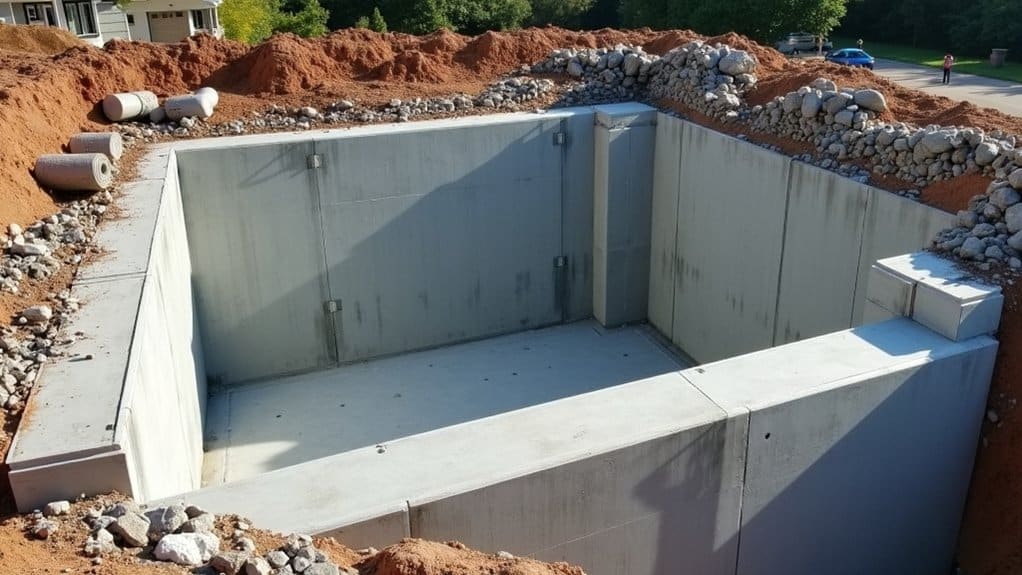
A structural pool is a man-made basin constructed from reinforced concrete, masonry, or similar materials designed to hold water permanently in-ground. This engineered shell forms the structural base that supports tile, coping, fittings, and integrated plumbing systems.
You’ll find these pools typically excavated and built using shotcrete or gunite, allowing custom shapes without traditional forming requirements. The shell must withstand significant hydrostatic pressures from groundwater while resisting soil forces modeled as equivalent fluid pressure. Engineers review Geotechnical Report findings to determine the appropriate structural design that accounts for soil texture, proximity to buildings, and seismic zone considerations.
Your pool integrates essential components including skimmers, drains, and circulation systems directly into the structure. The pool pump serves as the heart of this filtration system, ensuring continuous water movement throughout the basin. Concrete admixtures enhance the mix’s performance characteristics, while steel reinforcement provides critical tensile strength since concrete offers high compressive strength but low tensile capacity. This permanent fixture becomes tailored specifically to your backyard’s conditions, accommodating water features and site-specific engineering demands.
The Five Main Shell Types for In-Ground Pool Construction
When you’re selecting a shell type for your in-ground pool, you’ll need to evaluate five primary construction methods: concrete (including gunite and shotcrete variants), fiberglass, vinyl liner, and stainless steel options. Each shell type carries distinct load-bearing characteristics, installation requirements, and long-term structural performance factors that directly impact safety and durability. Understanding these differences helps you match the right construction method to your site conditions, design goals, and maintenance capabilities. Additionally, soil types and climate conditions at your specific location can significantly influence which shell material will perform best over time. Concrete pools offer endless design possibilities but require a longer construction timeline compared to other shell types. Fiberglass pools require a crane to lower the pre-formed vessel into the excavated hole, making access to your property an important consideration during planning.
Concrete Shell Construction
Concrete shell construction forms the structural backbone of in-ground pools, with five distinct methods available to meet varying load requirements, site conditions, and design specifications. Your choice among these concrete delivery methods directly impacts structural integrity and longevity.
Gunite and shotcrete pools spray concrete onto reinforced steel frameworks, differing only in mixing location. Gunite combines dry materials with water at the nozzle, while shotcrete arrives pre-mixed. Both create flexible pool foundation designs suitable for complex shapes.
Cast pools pour concrete between front and back forms, following BS EN 1992 standards for water retention. Block construction stacks precast units with rebar-reinforced cavities filled with concrete, offering cost-effective stability. Poured concrete pools use reinforced formwork, delivering maximum customization and decades of service when you maintain them properly. Because concrete pool shells are monolithic structures that can hold water independently, they provide absolute water tightness essential for pools constructed over or near habitable areas. Regardless of which concrete method you select, plan for resurfacing every 10-15 years to maintain structural integrity and aesthetic appeal.
Stainless Steel Options
Stainless steel shells deliver exceptional strength-to-weight ratios, weighing up to ten times less than concrete while achieving 50-year service lives when you select the correct grade for your water chemistry.
Your alloy selection factors depend directly on chlorine levels and environmental exposure. For freshwater pools under 5 ppm chloride, 304L provides adequate corrosion resistance. However, metallurgy considerations favor 316L for saltwater or high-chlorine applications due to its molybdenum content. Higher-performance options like 904L and Duplex 2205 resist stress corrosion cracking in humid pool buildings.
Construction uses 2.5 mm side walls and 1.5 mm bottoms with anti-slip bases. Welded panels create self-supporting structures handling water depths to 2 meters. Deeper installations require heavier panels or secondary support frames. Prefabricated sections enable rapid assembly, you’ll fill your pool hours after installation. The ductility of stainless steel gives designers and architects broad options for creativity, allowing pool basins to take virtually any shape. The non-porous surface creates an ultra-hygienic environment that resists algae growth and bacterial buildup, significantly reducing chemical treatment requirements compared to porous pool materials.
Liner and Modular Types
Beyond premium metal shells, most residential pools rely on five proven construction methods, each balancing cost, durability, and design flexibility differently.
Vinyl liner pools offer exceptional liner design flexibility, accommodating rectangular, kidney, and freeform shapes within a $35,000, $65,000 budget. You’ll choose between steel walls for maximum customization or polymer systems delivering superior polymer wall corrosion resistance, critical for saltwater installations and freeze-thaw climates. Expect liner replacement every 10, 12 years. Because vinyl pools depend on the liner rather than a rigid shell, they rely on surrounding wall structures for their shape and stability.
Modular fiberglass shells arrive factory-built, limiting width to 16 feet but ensuring installation within 3, 5 weeks. The non-porous gel coat resists algae and flexes with ground movement, providing 25, 30 years of low-maintenance service. These pools also require 30% less chlorine than other pool types, reducing ongoing chemical costs. The smooth, comfortable surface eliminates the need for water shoes, making it gentle on bare feet for swimmers of all ages.
Gunite concrete demands 3, 6 months construction time but delivers unmatched structural permanence, up to 50 years, with unlimited custom configurations for integrated features.
Step-by-Step Construction Process for Structural Pools
Building a structural pool requires you to follow a precise sequence of construction phases, starting with excavation and steel reinforcement before moving to concrete application. You’ll need to excavate according to your approved design specifications, then install Grade 60 #3 rebar both horizontally and vertically to create a reinforced framework that handles hydraulic pressure and soil loads. Once inspectors verify your steel placement meets code requirements, you can proceed with shotcrete or gunite application to form the pool’s structural shell. Before excavation begins, a Line Locate is called to mark any underground utilities and prevent damage during the dig. After the shell cures, contractors complete the tile, coping, and decking installation to finish the pool’s aesthetic and functional surfaces.
Excavation and Steel Reinforcement
Once you’ve confirmed property boundaries and obtained necessary permits, the excavation phase transforms your pool design from blueprint to physical reality. You’ll face excavation challenges including unstable soils requiring shoring and precise depth control for proper water displacement calculations. Excavate 2 inches deeper than finished depth to accommodate base materials, and compact the subgrade thoroughly for structural stability.
| Phase | Action | Safety Requirement |
|---|---|---|
| Earth Removal | Dig shelf on undisturbed soil | Verify sidewall angles |
| Soil Management | Over-dig hopper 1-2 feet | Compact with plate compactor |
| Steel Prep | Install rebar with spacers | Complete before pre-gunite inspection |
After excavation, you’ll position steel reinforced rebar throughout the structure on the compacted cavity. Install reinforcement after plumbing rough-in but before inspection.
Concrete Application Methods
After your steel reinforcement passes pre-gunite inspection, you’ll apply the concrete shell using either shotcrete or gunite, two pneumatic methods that differ primarily in when water enters the mix.
Shotcrete arrives as a wet mixture, delivering 4,500 psi strength. Gunite combines dry cement and sand, adding water at the nozzle to achieve 3,500-4,000 psi. Your gunite application considerations include maintaining consistent water ratios to protect rebar from corrosion.
Critical steps for structural integrity:
- Control thickness precisely to meet engineering load specifications
- Leave surfaces rough with broom finish for ideal plaster bonding
- Cure for 28 days, spraying water periodically to prevent cracking
Concrete strength testing confirms your shell meets compressive requirements. Flood the floor the next day and keep the bond beam moist throughout curing.
Gunite Versus Shotcrete: Comparing Concrete Application Methods
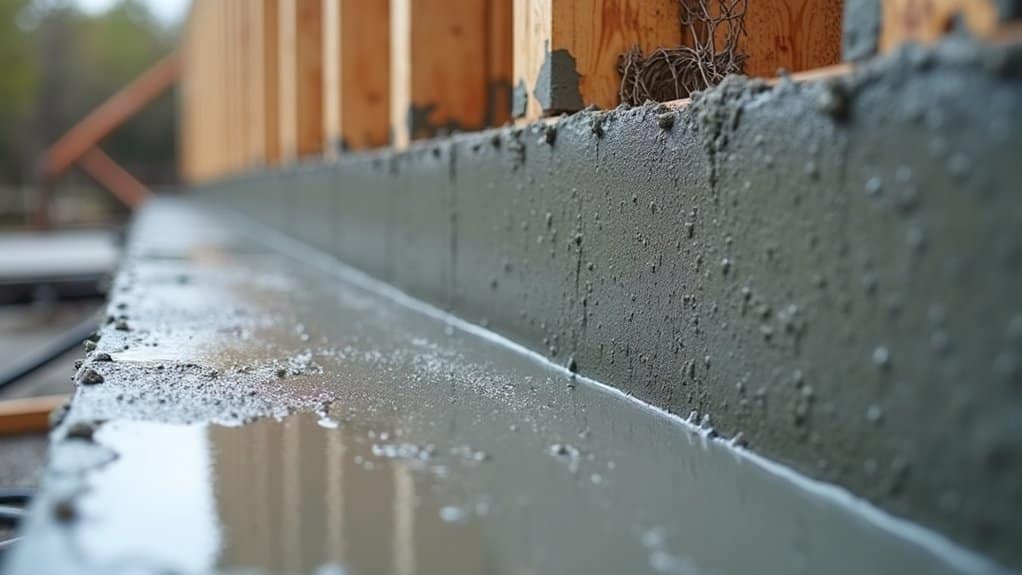
When you’re selecting a concrete application method for your pool shell, understanding the fundamental difference between gunite and shotcrete comes down to one critical factor: when water enters the mix.
Gunite uses a dry-mix process where water combines with material at the nozzle, giving you precise control over the water-cement ratio. This yields superior density and crack resistance for custom residential pools. Shotcrete premixes water offsite, ensuring consistent ratios with faster application speeds ideal for large-scale projects.
Your cost comparison should account for labor expertise, gunite demands skilled nozzlemen, while shotcrete reduces onsite mixing requirements. Material handling considerations differ noticeably: gunite generates more rebound waste, whereas shotcrete produces less overspray. For intricate designs with tanning ledges or waterfalls, gunite’s pause-and-restart capability prevents cold joints, delivering seamless structural integrity.
Poured Concrete and Cavity Block Wall Techniques
While gunite and shotcrete dominate pool construction discussions, poured concrete and cavity block wall techniques offer distinct structural advantages you shouldn’t overlook. Structural pool foundations using poured concrete deliver unmatched customizability, you can create circles, hearts, or any shape your design demands. Steel rebar reinforcement guarantees your foundation withstands heavy loads and hydrostatic pressure.
Poured concrete foundations give you complete design freedom while steel rebar ensures your pool stands up to serious pressure.
Cavity block wall installation uses insulated concrete forms that simplify construction while maintaining structural integrity. You’ll benefit from:
- Reduced labor costs without heavy machinery requirements
- Built-in insulation eliminating additional material expenses
- Forgiving installation that accommodates over-excavation through backfilling
Before pouring, predampen your subgrade to retain hydration water and prevent cracking. Use spacers for proper reinforcement cover, and always verify forms resist vibration during concrete placement.
Stainless Steel Pool Options: Self-Supporting and Lining Variants
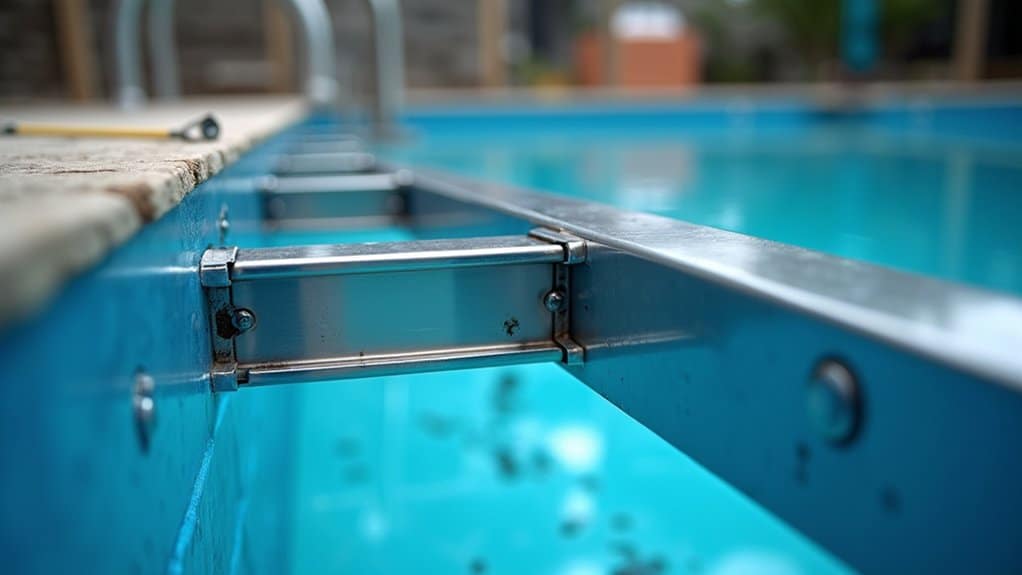
Stainless steel pools eliminate the need for extensive structural support systems because they’re engineered to bear loads independently on a simple foundation slab or strip footing. You’ll find self-supporting variants use rear reinforcements and inclined supports to achieve static load-bearing capacity, making them ideal for raised installations where weight matters.
The lining variant clads existing concrete structures with stainless steel sheets, offering minimized construction costs while maintaining durability. You’re working with 316L low-carbon stainless steel panels, typically 2mm thick for walls and 1.5mm for floors.
These pools deliver enhanced corrosion resistance through high-grade materials like 254 SMO super austenitic grades. You’ll avoid crevices and dissimilar metal contacts to prevent accelerated deterioration. With proper installation, expect up to 50 years of service life without structural repairs or cracking issues.
The Critical Role of Foundation Slabs in Pool Durability
Your pool’s foundation slab serves as the primary load-bearing element that anchors the entire structure against hydrostatic pressure, soil movement, and equipment vibrations. When you’re supporting walls and mounting filtration systems, pumps, and heaters, the slab must distribute these concentrated loads evenly to prevent cracking or settlement. A properly engineered concrete foundation, reinforced and poured to minimum 100mm thickness, ensures your pool maintains structural integrity under both static weight and dynamic operational stresses.
Anchoring Pool Structural Integrity
Because foundation slabs bear the full weight of water, structural components, and dynamic soil forces, they serve as the critical anchor point for your pool’s long-term stability. Your concrete slabs must achieve minimum 10-inch thickness to support both static and dynamic loads effectively. Proper anchoring supports distribute pressure evenly across the soil, preventing shifting and structural compromise.
To guarantee your foundation performs safely for decades, you’ll need:
- Rebar spacing no more than 12 inches apart horizontally and vertically to resist hydrostatic and earth pressures
- 5,000 psi concrete strength compliant with IBC/IRC standards for maximum load capacity
- Soil bearing capacity analysis accounting for groundwater levels and settlement risks
These specifications protect against catastrophic failure while maximizing structural longevity.
Supporting Walls and Equipment
Foundation slabs don’t just support your pool shell, they anchor every vertical structure and mechanical component that keeps your system functioning safely. Your pumps, filters, and heaters generate vibration and dynamic loads that require secure equipment anchoring to prevent shifting or disconnection. Without proper slab thickness and reinforcement, these mechanical stresses accelerate cracking and compromise structural integrity.
Supporting equipment sizing directly influences your foundation requirements. Heavier filtration systems and heat pumps demand thicker concrete sections with rebar spaced no more than 12 inches apart. You’ll need to account for both static weight and operational vibrations when calculating load distribution.
Retaining walls and equipment pads must tie into your main slab system. This integration prevents differential settlement that causes cracks, leaks, and premature equipment failure over your pool’s 30-50 year lifespan.
How Steel Rebar Frameworks Enable Custom Pool Designs
When you’re building a custom pool, steel rebar forms the skeletal framework that makes complex designs structurally possible. Unlike rigid pre-cast sections, rebar’s malleable nature lets builders shape unconventional pool designs on-site, from sweeping curves to integrated spas with artistic architectural aesthetics.
Here’s what rebar enables structurally:
- Custom curves and freeform shapes that absorb tension forces without cracking
- Integrated features like tanning ledges, benches, and lighting niches with proper load distribution
- Multi-level designs where steps and depth changes maintain structural integrity
D250N grade steel, spaced 6-12 inches on center, distributes hydrostatic pressure evenly across your pool shell. Builders elevate the framework using chairs and spacers, ensuring adequate concrete coverage that prevents corrosion and extends your pool’s lifespan for decades.
Sprayed Concrete Methods for Free-Form Pool Shapes
That steel rebar framework you’ve carefully assembled requires a specialized encasement method to achieve its full structural potential, and sprayed concrete delivers exactly that. Optimizing shotcrete mixture means using more cement and less water than cast-in-place concrete, producing compressive strengths of 6,000-7,000 psi. Ensuring nozzle pressure control allows the nozzleman to compact material densely around rebar, eliminating air pockets.
| Method | Pressure Delivery | Best Application |
|---|---|---|
| Wet-Mix | Pump through hose | Consistent layer thickness |
| Dry-Mix (Gunite) | Cannon under high pressure | Variable thickness control |
| Both Methods | Pneumatic spray | Dense, homogeneous structure |
You’ll achieve watertight, crack-resistant shells in 4-6 hours. The low water content minimizes volume change during hydration, while one-sided forming handles vertical surfaces without hydrostatic pressure concerns.
Engineering Standards and Structural Calculations for Custom Builds
Because your free-form pool shell must perform under multiple opposing forces, you’ll need engineering calculations that satisfy specific code requirements before construction begins.
Engineering calculations aren’t optional for free-form pools, they’re essential safeguards against the complex forces your shell must withstand.
Your structural engineer references ACI 318 for reinforcement specifications and ASCE 7 for loading criteria. Site soil condition assessments from geotechnical reports determine wall thickness, steel spacing, and footing depth. Industry consultation requirements guarantee compliance with IBC-adopted standards across all fifty states.
Your custom build calculations must address:
- Hydrostatic uplift forces that threaten to float your empty pool shell from saturated ground
- Lateral soil pressures pushing against walls under full and empty conditions
- Seismic zone requirements that dictate additional reinforcement for ground movement resistance
These load-focused analyses protect your investment and confirm occupant safety throughout your pool’s lifespan.
Frequently Asked Questions
How Long Does a Structural Pool Typically Last Before Needing Major Repairs?
Your structural pool’s longevity depends on the material you choose. Concrete pools offer the greatest structural pool longevity, lasting 50+ years before major repairs, though you’ll need resurfacing every 10-15 years. Fiberglass gives you 25-50 years of reliable service. Key pool lifespan factors include soil stability, freeze-thaw exposure, and your maintenance routine. You’ll maximize safety and durability by addressing minor cracks promptly before they compromise structural integrity.
Can Structural Pools Be Built on Sloped or Uneven Terrain?
Yes, you can construct structural pools on sloped or uneven terrain, though you’ll face significant excavation challenges that require careful engineering. Your contractor must address steep slope foundations by designing retaining walls and reinforced concrete shells that resist lateral soil pressure per ASCE 7 loading criteria. You’ll need proper drainage systems to prevent hydrostatic pressure buildup against walls. A structural engineer should calculate load-bearing requirements to guarantee long-term stability and safety.
What Permits Are Required Before Starting Structural Pool Construction?
You’ll need several permits before breaking ground on your structural pool. Start with a building permit for pools exceeding 5,000 gallons, then obtain permits for electrical work covering all wiring installations. You’ll also require permits for excavation through your local zoning department, plus mechanical permits for gas piping and heating components. Don’t overlook separate permits for pool decks and enclosures, each guarantees your installation meets safety codes and load-bearing requirements.
How Do Groundwater Levels Affect Structural Pool Design and Installation?
High groundwater levels directly impact your pool’s structural integrity and installation approach. You’ll need thorough soil testing to assess soil composition and water table depth before excavation begins. If groundwater sits within 2 feet of your excavation base, you’ll require hydrostatic relief valves, increased rebar density, and dewatering systems. Proper site drainage through French drains and perimeter trenches prevents dangerous uplift forces that could compromise your pool’s foundation stability.
What Maintenance Schedule Keeps Structural Pool Shells in Optimal Condition?
You’ll maintain your structural pool shell effectively by conducting regular inspections daily for equipment and safety systems, while performing structural integrity assessments monthly to check for cracks, stains, and surface deterioration. Annually, you should examine walls, floors, and plumbing for any signs of compromise. Don’t skip lubrication of seals and gaskets monthly, this prevents leaks that can undermine your pool’s load-bearing capacity and compromise the foundation’s safety over time.