
Filling in your old fiberglass pool costs $5,000 to $10,000 on average, with a national in-ground average near $8,000. If you want the shell gone completely, full removal of a 12’x24′ shell runs about $7,500, and complex jobs can hit $19,000. Choose partial fill instead, and you’ll start around $2,000. Your final price depends on size, disposal fees, permits, and site access. Here’s how each factor shapes your total.
Key Takeaways
- Filling in an old fiberglass pool typically costs $5,000 to $10,000, with a national average around $8,000 for in-ground pools.
- Partial fill (backfilling the shell in place) starts near $2,000, while full shell removal averages $7,500 and can reach $19,000.
- Material and labor drive nearly all costs, with dirt fill running $8 to $12 per cubic yard based on pool volume.
- Pool size, regional prices, permits, disposal fees, and site access can swing the total by thousands of dollars.
- Filling in recovers none of the original installation investment, representing only 15% to 30% of that sunk cost.
What It Costs to Fill In a Fiberglass Pool
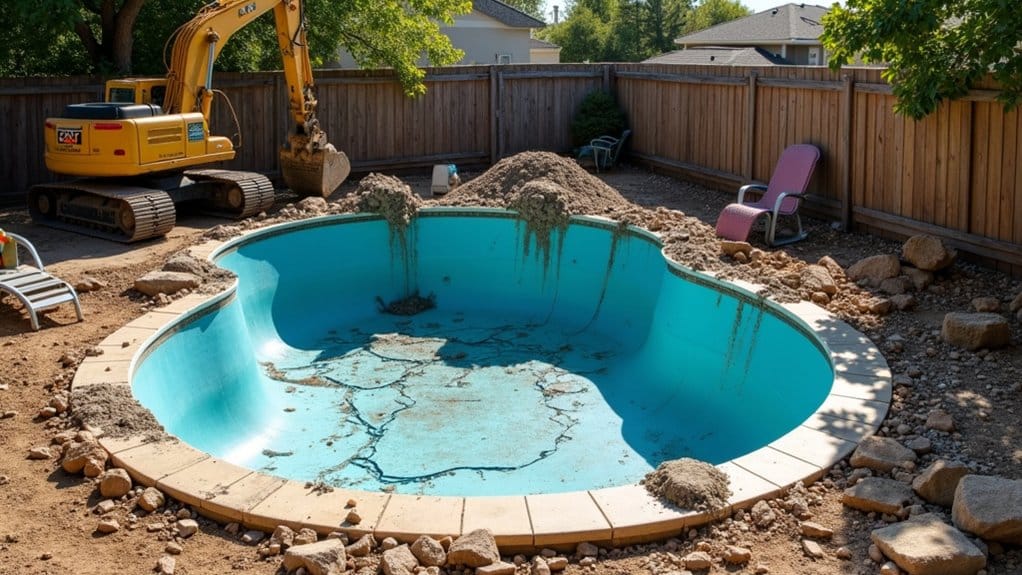
Filling in an old fiberglass pool typically costs between $5,000 and $10,000, though your final price depends on whether you opt for a partial fill or full shell removal. The national average cost to fill in a pool sits around $8,000, ranging from $4,000 to $12,000. If you’re pursuing full fiberglass pool removal cost estimates, expect roughly $7,500 to cut a standard 12’x24′ shell into pieces and haul it away. Complex or oversized pools push the pool demolition cost up to $19,000. Small-scale partial fills can start as low as $2,000 when you’re only backfilling with dirt or gravel. Your site accessibility, shell size, disposal fees, and local permit requirements all directly scale what you’ll ultimately pay.
Partial Fill vs. Full Removal: The Price Gap
Partial fills and full removals differ in price because of what each job requires. When you’re filling in a pool using the partial method, crews cut holes in the shell’s bottom, punch drainage points, then backfill with dirt or gravel at $8 to $12 per cubic yard. Small-scale projects start around $2,000, keeping costs low.
Full pool removal costs more because it demands cutting the entire fiberglass shell into pieces, hauling debris, and disposing of it. Removing a 12’x24′ shell averages $7,500, while complex or oversized jobs climb toward $19,000.
The price gap comes down to labor hours, disposal fees, and equipment access. Partial fills save money upfront, but full removal eliminates buried structures that can complicate future construction.
Material and Labor Costs for a Pool Fill-In
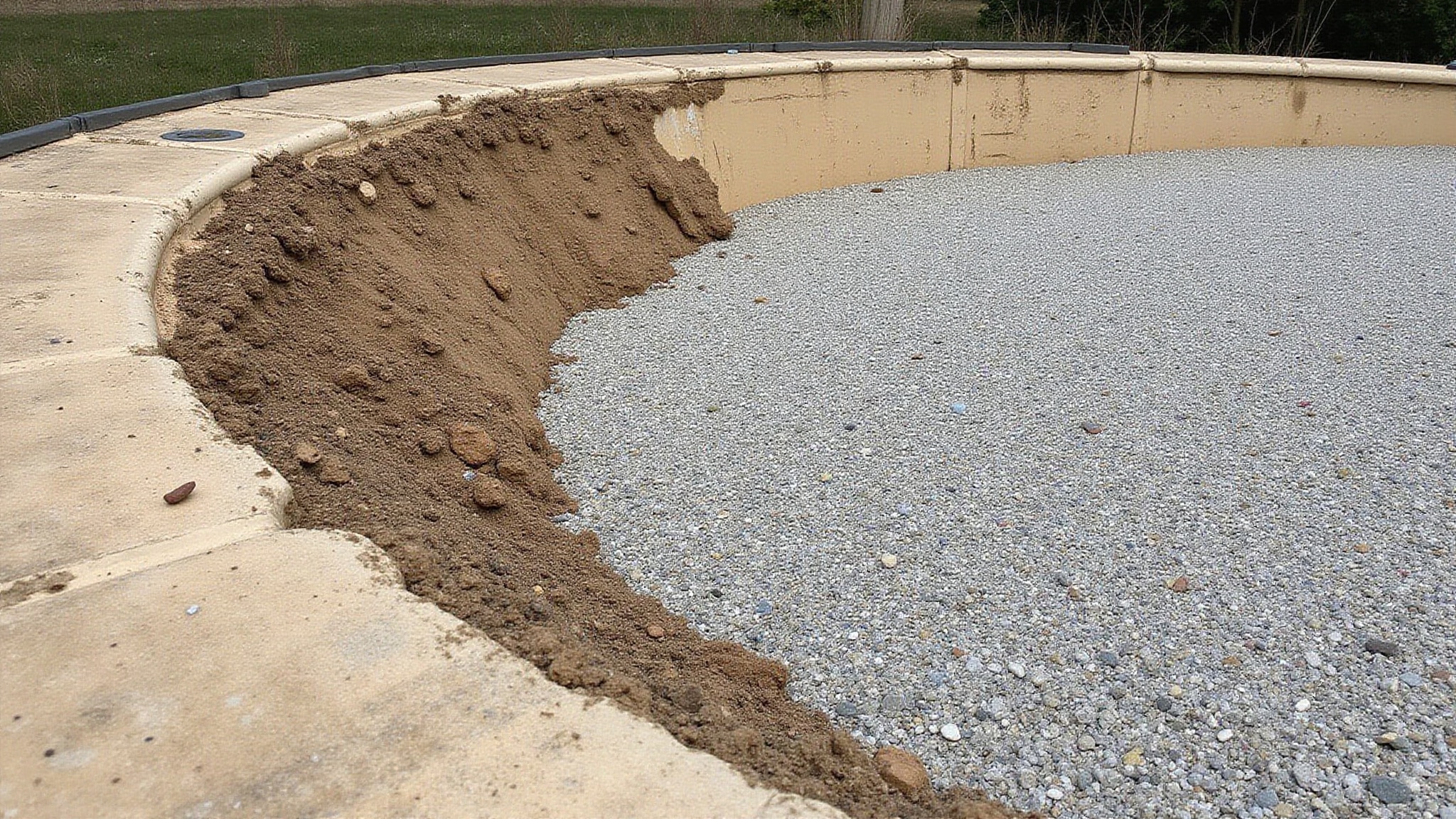
Material and labor account for nearly all of your total cost for a pool fill-in. Your fill material, dirt or gravel, runs $5 to $15 per cubic yard, though filling specifically with dirt costs $8 to $12 per cubic yard. Adding topsoil or a concrete slab cap pushes that figure higher. If you go the DIY route, expect $3,000 to $11,900 for materials alone, then tack on $1,000 to $4,000 in labor, bringing your DIY total to $4,000 to $15,900. Professional filling includes labor that can push costs substantially higher, but you’re paying for proper compaction, shell cutting, and code compliance. Site accessibility and yard conditions directly affect equipment access and labor hours, so factor those variables into your budget early.
How Pool Size Changes Your Fill-In Bill
Pool size changes your fill-in bill more than any other factor, since every cubic yard of dirt or gravel scales directly with the volume you need to backfill. A standard 12’x24′ fiberglass shell cut into pieces averages around $7,500 for full removal, but stretch that footprint to 35′ or larger and your costs climb toward the $19,000 ceiling for complex jobs. At $5 to $15 per cubic yard for gravel, or $8 to $12 for dirt, larger pools demand far more material. Bigger shells also mean more cutting time, higher disposal fees, and extended labor hours. If you’re only partially filling, you’ll trim volume needs, but full removal on a large pool multiplies every line item across material, labor, and hauling.
Regional Prices, Permits, and Disposal Fees
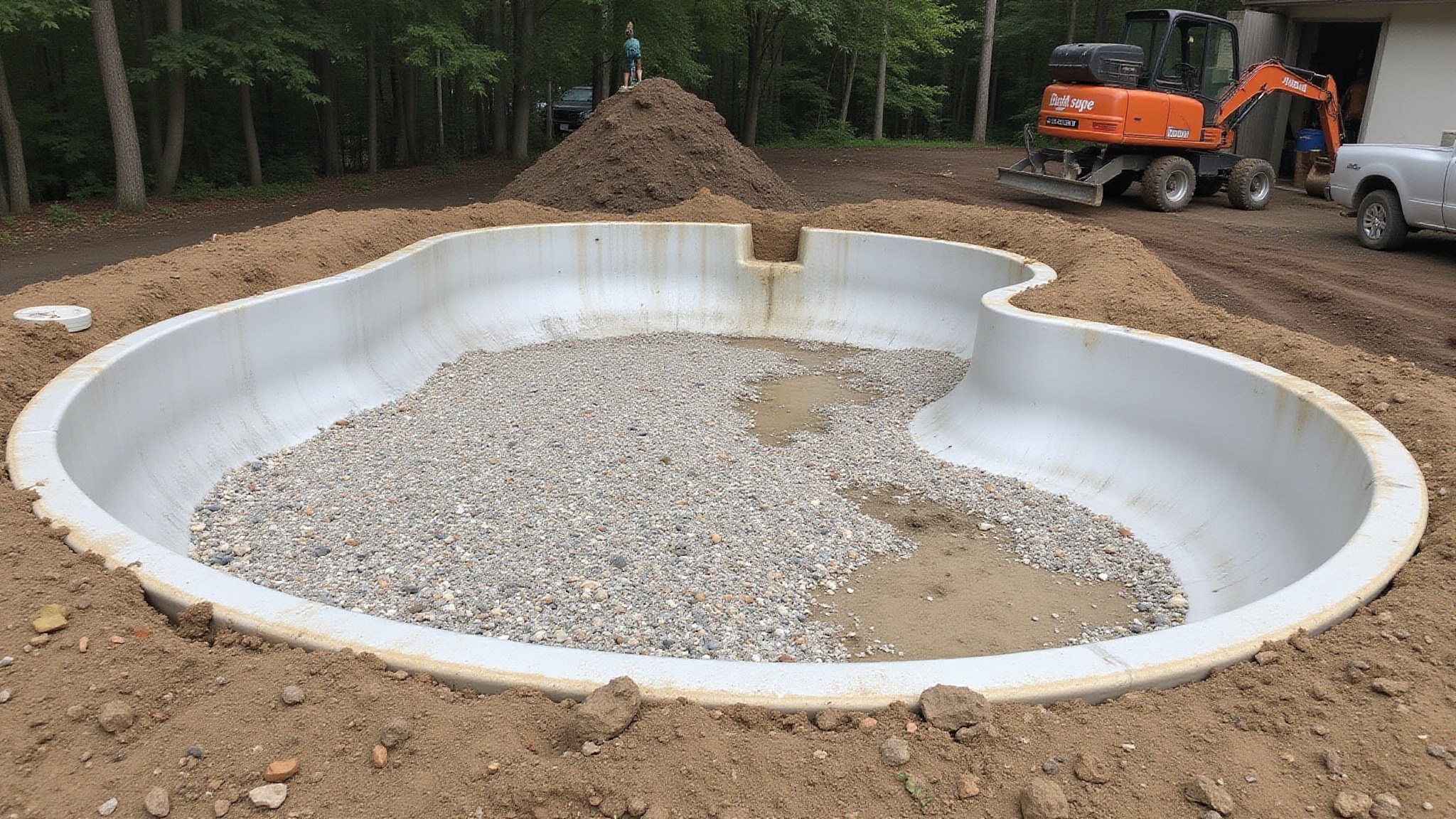
Regional prices, permits, and disposal fees swing costs by thousands, depending on where you live just as much as your pool’s dimensions. Local soil availability sets your fill material rate. Dirt runs $5 to $15 per cubic yard, while dirt-specific fills cost $8 to $12. Debris disposal fees for cut fiberglass shells add up fast in areas with limited landfill access, pushing complex removals toward $19,000.
- Permits and inspections: Many jurisdictions require permits for filling in-ground structures, adding fees plus inspection scheduling delays.
- Disposal fees: Cutting the shell into pieces increases hauling and landfill charges regionally.
- Site prep: Yard conditions and equipment access drive labor hours higher.
Always verify local regulations before budgeting your project.
5 Factors That Push Your Fill-In Price Higher
Your biggest cost driver is choosing full removal over a simple fill, since cutting the fiberglass shell into pieces and hauling debris pushes a 12’x24′ job to around $7,500, versus fill-only options starting near $2,000. Site access compounds this: if your yard can’t accommodate excavators or dump trucks, crews spend extra labor hours moving material by hand. Both factors can drive complex removals up to $19,000.
Full Removal vs. Fill
Full removal and partial fill-in represent two very different cost structures. Full removal requires cutting the fiberglass shell into pieces, hauling debris, and paying disposal fees, driving costs higher. A partial fill leaves the shell in place and simply backfills, cutting labor and material expenses considerably.
- Full removal of a 12’x24′ shell averages around $7,500, with complex or large pools reaching up to $19,000.
- Partial fill-in starts as low as $2,000 for small-scale projects, avoiding shell-cutting and disposal charges.
- National average for filling any in-ground pool sits at $8,000, ranging from $4,000 to $12,000.
Weigh disposal fees, compaction requirements, and future land use before you commit to either approach.
Site Access Challenges
Site access challenges directly drive labor hours and, ultimately, your final bill. If your yard offers tight gates, steep grades, or limited clearance, crews can’t bring in full-sized excavators and dump trucks. They’ll rely on smaller machines or manual labor instead, stretching a one-day job into several. That’s where your costs climb toward the $19,000 ceiling for complex removals.
Consider the ripple effects: restricted access means dirt and gravel, already $5 to $15 per cubic yard, must be wheelbarrowed or conveyed in, adding labor hours. Debris disposal gets pricier too, since crews haul fiberglass pieces farther to reach trucks.
Walk your site with the contractor. Accurate access assessments prevent surprise change orders mid-project.
Should You DIY the Fill-In or Hire a Pro?
DIY the fill-in if you have a small pool and basic skills, but hire a pro for complex removals or if you want guaranteed code compliance. DIY filling ranges from $3,000 to $11,900 excluding labor, and adding your own labor costs of $1,000 to $4,000 pushes totals to $4,000 to $15,900. Professionals cost more but guarantee code compliance and proper disposal.
DIY filling small pools saves money, but complex removals demand professional expertise for code compliance and proper disposal.
Consider these factors before choosing:
- Compaction: Pros ensure proper packing, preventing future settling and sinkholes that DIY jobs often overlook.
- Shell cutting: Full removal requires cutting the fiberglass shell into pieces, adding disposal fees and time.
- Insurance: DIY excavation lacks coverage for accidents, while professional services carry liability protection.
If you’re filling a small pool, DIY saves money. Complex removals demand professional expertise.
Fill-In Cost vs. What You Paid to Install It
You likely spent an average of $33,270 to install your fiberglass pool, with most projects landing between $45,000 and $100,000. Filling it in costs a fraction of that, ranging from $5,000 to $10,000, or roughly $7,500 for full removal of a 12’x24′ shell. Don’t expect to recover that original investment, though, you’re paying to eliminate an asset, not sell it, so treat the fill-in as a sunk cost tied to reclaiming your yard.
Installation Investment Recap
Fiberglass pool installations represent a significant investment, and understanding that original outlay helps frame your fill-in decision. Comparing what you’ll spend now against what you originally invested matters before committing to filling in that pool. When creating an inviting atmosphere around your pool area, considering the best plants for pool landscaping is essential. These plants not only enhance the aesthetic appeal but also provide natural cooling and privacy.
- Original installation average: $33,270, with a range spanning $5,000 to $68,000 depending on size and site conditions.
- Turn-key packages (2026): $85,000 to $200,000, while basic installs with concrete decking run $65,000 to $110,000.
- Typical homeowner spend: $45,000 to $100,000 for complete fiberglass pool projects.
Weigh those figures against fill-in costs of $5,000 to $10,000. You’re recouping none of that installation investment, but you’re eliminating ongoing maintenance, insurance, and liability expenses that’ll otherwise keep draining your budget indefinitely.
Fill-In Price Comparison
Filling in a fiberglass pool runs $5,000 to $10,000, while you likely paid $33,270 on average, and anywhere from $45,000 to $100,000 for a complete project. When you stack fill-in costs against your original installation price, the disparity is stark. Fiberglass pool running costs can accumulate quickly, especially when considering maintenance and repairs. Routine upkeep can add hundreds to thousands of dollars each year, impacting your overall financial planning.
That means you’re recovering pennies on the dollar. Your fill-in expense typically represents just 15% to 30% of your initial investment. Even a full shell removal, averaging $7,500 and reaching $19,000 for complex jobs, stays well below what you sank into turnkey installation.
Compare your options carefully. A partial fill costs less than full removal, but limits future landscaping. Resurfacing ($5,000 to $15,000) rivals fill-in pricing, yet preserves the pool. Weigh disposal fees, permits, and site prep against your property’s long-term value.
Cost Recovery Reality
You cannot recover your original investment, so filling in a fiberglass pool is a sunk-cost decision, not a return on it. You originally spent an average of $33,270, potentially up to $68,000, on installation. Now you’re spending an additional $5,000 to $10,000 to make it disappear. That’s money out on both ends, with no resale premium to offset it. Fiberglass pools with sun shelves offer a way to enhance your outdoor living space. They provide a stylish and functional area for relaxation and recreation.
Consider these hard numbers before committing:
- Original install: $33,270 average, ranging $5,000, $68,000, sometimes reaching $100,000 on turn-key projects.
- Fill-in cost: $5,000, $10,000 partial fill; full removal averages $7,500 and can hit $19,000.
- Net loss: Combined spend regularly exceeds $40,000 with zero direct financial recovery.
Treat fill-in as liability reduction, removing maintenance costs and safety risks, not asset preservation.
Conclusion: What to Expect When Filling In a Pool
Filling in an old fiberglass pool is a practical way to reclaim a backyard, but the cost depends on the pool’s size, access, and how the work is done. A proper fill-in involves handling the plumbing and electrical, breaking or removing the shell, and compacting the fill so the ground stays stable, which is why doing it right matters for the long term. It can affect property value, insurance, and what you can build on top later. Working with an experienced contractor keeps the project safe and up to code.
Invest in a Pool That Lasts Decades
Understanding true pool costs helps you invest smarter and enjoy your fiberglass pool for years to come. At Schiller Pools in Palm City, FL, our experienced team provides trusted Fiberglass Pool Installation with transparent pricing and 40+ years of Florida expertise. Call +1 (561) 475-5997 today and get your free estimate.
Frequently Asked Questions
How Long Does It Take to Fill in a Fiberglass Pool?
Most fill-ins take one to a few days, depending on the pool’s size, access to the yard, and whether the shell is fully removed or partially demolished in place. Permitting and inspections can add time before the work starts. A contractor can give a realistic schedule once they have seen the site.
Will Filling in My Pool Affect My Property Value?
It can go either way. Some buyers see a filled-in pool as a plus because it removes maintenance and opens up yard space, while others may have wanted a pool. A properly documented, permitted fill-in reassures buyers there are no hidden issues. How it affects value depends on your market and how the work was done.
Do I Need to Notify My Insurance Company After a Fill-In?
Yes, it is a good idea. Removing a pool changes your property and can affect your coverage and premium, often lowering the liability risk. Letting your insurer know keeps your policy accurate. Keep the permit and documentation from the fill-in in case they ask for proof of how it was done.
Can I Build a Structure Over a Filled-In Pool?
Sometimes, but it takes care. Ground over a filled-in pool can settle if it was not properly compacted, which is a problem for anything heavy like an addition or garage. Lighter features may be fine. Building over it usually requires proper engineering, compaction, and permits, so consult a professional before planning a structure.
How Do I Handle Pool Plumbing and Electrical During a Fill-In?
The plumbing should be drained and capped and the electrical safely disconnected by a qualified electrician before filling begins. Skipping these steps can leave hazards or cause problems later. Because it involves code and safety, this part of a fill-in is best handled by professionals who can disconnect and document everything properly.