
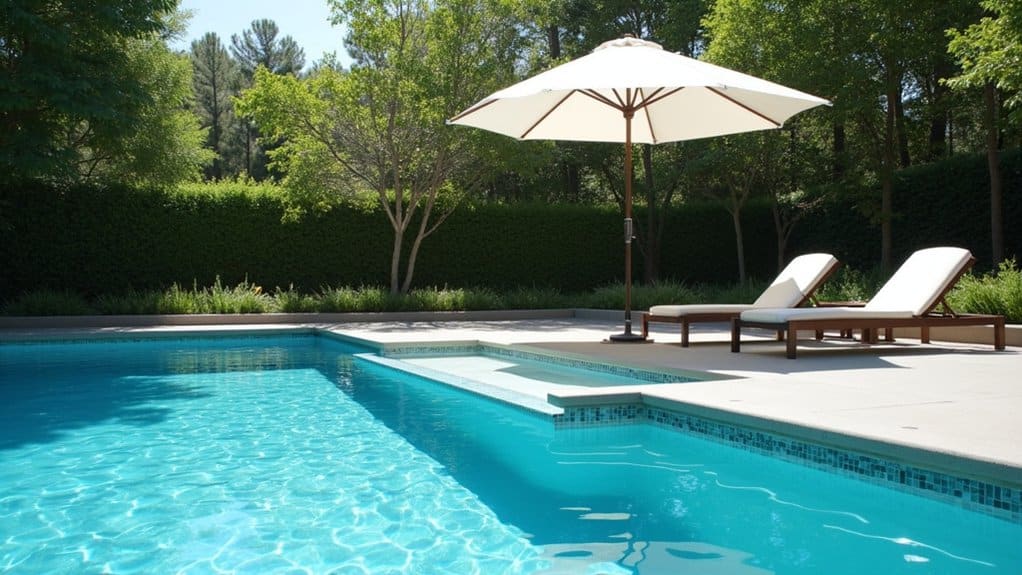
A fiberglass pool with a sun shelf gives you a flat, shallow ledge, typically 6 to 12 inches deep, with 10 inches being most popular, for tanning and lounging. You’ll fit a couple of lounge chairs and an umbrella comfortably. Install a corrosion-resistant brass or stainless steel umbrella sleeve during construction, embedding it about eight inches into the structure. Position it so it won’t block movement. Keep going to master sizing, installation, and long-term maintenance.
Key Takeaways
- A fiberglass pool sun shelf is a flat, shallow ledge (typically 6, 12 inches deep, with 10 inches most popular) designed for tanning and lounging.
- Shelf sizes range from 5’6″ by 12′ to 8’10” by 18’1″, fitting a couple of lounge chairs and an umbrella comfortably.
- The umbrella sleeve is embedded into the ledge during construction, extending about eight inches into the underlying structure for stability.
- Use brass or stainless steel sleeves for corrosion resistance in submerged, chemically treated water conditions.
- Fiberglass shelves cost $2,000, $4,000 and require only routine cleaning, outperforming concrete and vinyl on cost, maintenance, and durability.
What Is a Sun Shelf, Really?
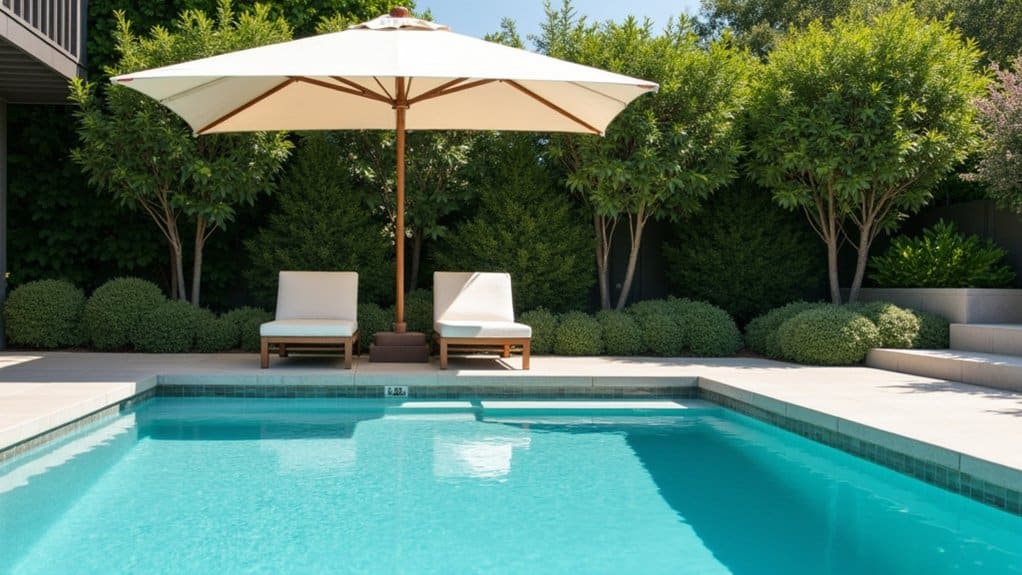
A sun shelf is a flat, shallow section of your pool that works like an oversized step. You’ll also hear it called a tanning ledge, Baja shelf, or Baja ledge, but they all describe the same feature. A fiberglass pool sun shelf sits just above the main pool area, giving you a shallow spot to lounge, play, or cool off without fully submerging. Depth typically ranges from 6 to 12 inches, with 10 inches being the most popular. A pool tanning ledge measures anywhere from 5’6″ by 12′ to 8’10” by 18’1″, fitting a couple of lounge chairs and an umbrella. Add an umbrella sleeve pool feature, a hidden brass or stainless socket embedded during construction, and you’ll anchor shade securely overhead.
Sun Shelf Sizes and Depths That Work Best
When you’re sizing your sun shelf, plan for dimensions between 5 feet 6 inches by 12 feet and 8 feet 10 inches by 18 feet 1 inch, giving you enough room for a couple of lounge chairs and an umbrella. Keep the depth within the 6-to-12-inch range, with 10 inches being your best target for comfortable tanning and lounging. Match your dimensions to the furniture you’ll place there, since the shelf needs to accommodate both seating and clearance for movement.
Standard Dimension Ranges
Standard sun shelf dimensions span a practical range, running from 5 feet 6 inches by 12 feet on the compact end to 8 feet 10 inches by 18 feet 1 inch at the larger end. These measurements give you enough room to fit at least a couple of lounge chairs and an umbrella comfortably. Depth matters just as much as surface area when you’re evaluating a sun shelf pool. Depth typically falls between 6 and 12 inches, with 10 inches being an especially popular choice for tanning and lounging.
Because fiberglass pool features come factory-molded, you can’t modify these depths after construction, so you’ll want to select the right model upfront. Multipurpose designs let depths vary within that 6-to-12-inch range across different fiberglass models, matching your intended use. Landscaping around fiberglass pools can enhance the overall aesthetic of your outdoor space. Consider incorporating native plants and durable hardscaping materials to complement the sleek design of the pool.
Ideal Depth Measurements
The ideal depth for a fiberglass tanning shelf is 10 inches, the most popular measurement and for good reason. Fiberglass models range from 6 to 12 inches, so pick based on your priorities. If tanning and lounging drive your decision, stay shallow, around 6 to 8 inches keeps most of a lounge chair dry while still cooling your feet. If you want kids splashing or full-body cooling, lean toward the deeper end near 12 inches.
The 10-inch depth splits the difference, giving you enough water to cool off comfortably without submerging seated bodies entirely. At 10 inches, you’ll fit lounge chairs, keep an umbrella base stable, and let children play safely under supervision, a genuine multipurpose depth that works across scenarios.
Sizing for Furniture
Sizing for furniture depends on the pieces you intend to place. Sun shelf dimensions typically range from 5 feet 6 inches by 12 feet up to 8 feet 10 inches by 18 feet 1 inch. To fit a couple of lounge chairs and an umbrella comfortably, aim toward the larger end of that spectrum. Measure your chairs and account for clearance around them, so you’re not crowding the space or blocking movement in and out of the shelf.
If you’re adding an umbrella sleeve, position it centrally or offset toward one side, depending on chair placement. Remember, fiberglass ledges come factory-molded and can’t be modified later, so select a model whose dimensions match your furniture goals before construction begins.
How to Install a Sun Shelf Umbrella Sleeve
When you install the umbrella sleeve, embed it into the ledge surface during pool construction, extending the slim socket about eight inches down into the underlying structure. This depth anchors the pole securely and keeps the base hidden below the shelf. Choose a sleeve made of brass or stainless steel for corrosion resistance, and pair it with rust-proof hardware to withstand continuous submersion in chemically treated water.
Sleeve Placement and Depth
Embed the umbrella sleeve directly into the ledge surface and down into the pool’s structure, so plan its placement before the shell is set. Choose a slim brass or stainless steel socket for corrosion resistance against chemically treated water. Extend the sleeve about eight inches down into the gunite, concrete, stone, or ground structure beneath the ledge. This depth anchors the pole securely and keeps the base hidden.
Position the socket where it won’t obstruct movement in and out of the shelf, leaving room for lounge chairs. Alternatively, set the sleeve along the pool’s perimeter coping, adjacent to a bench or spa. Confirm the canopy will clear people using the shelf, then verify the sleeve sits flush and level before finishing the surface.
Material and Anchoring Requirements
Select hardware built to endure constant submersion and splashing, since pool water carries corrosive chemicals. Choose a sleeve made of brass or stainless steel, since both resist corrosion under continuous exposure to chemically treated water. Embed the socket during construction, extending it roughly eight inches down into the gunite, concrete, stone, or ground structure. This depth anchors the pole securely and keeps the sleeve hidden below the shelf surface.
Pair the sleeve with a pole rated for submersion, then fit a canopy of UV-resistant fabric supported by rust-proof hardware. Confirm the canopy sits high enough to clear people moving in and out of the shelf. These material and anchoring choices guarantee your umbrella stays stable, corrosion-free, and functional for years.
What Makes a Pool-Safe Umbrella and Pole?
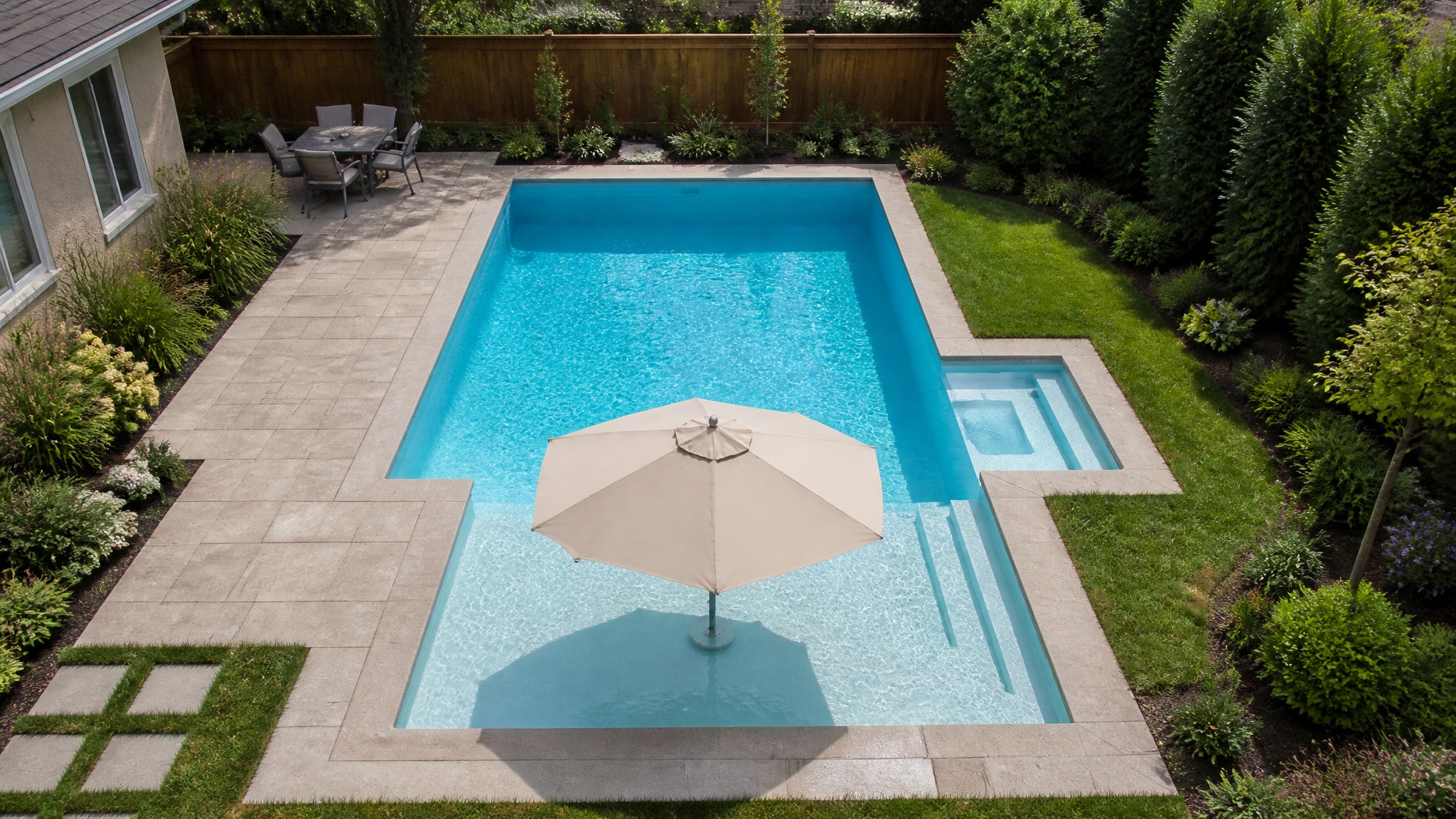
A pool-safe umbrella and pole meet three requirements: submersion tolerance, corrosion resistance, and UV stability. Your pole must withstand continuous submersion and repeated splashes from chemically treated water without degrading. Choose poles built for pool placement specifically, since standard patio poles corrode when exposed to pool chemistry. Pair that pole with rust-proof hardware throughout. Every fastener, joint, and connection point risks failure without it. Your canopy fabric needs UV resistance to endure prolonged outdoor exposure without fading or breaking down. Height matters too: select a pole tall enough to provide comfortable clearance for people moving in and out of the shelf. Get these three factors right, and your umbrella performs reliably through seasons of sun and submersion.
Why Fiberglass Pools Win on Sun Shelves
Fiberglass pools win on sun shelves because they outperform concrete and vinyl on cost, maintenance, and durability. You’ll pay $2,000 to $4,000 for a factory-molded ledge, compared to $3,000 to $5,000 for concrete. These pre-molded features arrive ready to use, so you skip the labor-intensive forming that concrete requires. Maintenance stays minimal: you won’t acid wash every 3, 5 years like concrete, nor resurface a vinyl liner every 7, 10 years. The gelcoat surface resists chemical absorption and staining, holding up against treated water and UV exposure. The monthly cost of a fiberglass pool can vary based on the size and features you choose. Many homeowners find that the long-term savings on maintenance and repairs make fiberglass a worthwhile investment.
Keep in mind you can’t modify the molded shape after construction, so choose your dimensions carefully upfront. To prevent sagging, make sure your installer places a pier structure and grout beneath the ledge, eliminating hollow spots and ensuring solid, lasting support.
How to Keep Your Sun Shelf Solid and Supported
Keeping your sun shelf solid and supported requires proper backing underneath the fiberglass shelf. Even though your fiberglass shelf arrives factory-molded and structurally sound, it still needs proper support underneath to stay that way. Without adequate backing, the ledge can develop hollow spots or sag over time, compromising both safety and aesthetics. During installation, your contractor must address the void beneath the molded shelf using proven support techniques.
- Install a pier structure underneath the ledge to bear the load and prevent sagging under the weight of water, people, and furniture.
- Pump grout beneath the shelf to fill voids, eliminate that hollow feeling underfoot, and create solid, uniform support.
- Verify even contact across the entire underside so no unsupported gaps remain before backfilling.
Get these steps right, and your shelf stays rock-solid for decades.
What a Factory-Molded Sun Shelf Costs
A factory-molded tanning ledge in a fiberglass pool costs $2,000 to $4,000 added to your total pool cost. That’s noticeably less than a concrete pool’s ledge, which averages $3,000 to $5,000. When you factor in materials and installation complexity, total tanning ledge costs across all pool types run from $2,000 to $8,000. If you’re drawn to premium finishes like specialized aggregate or custom tile work, expect the price to climb to $6,000 to $8,000. Removing an old fiberglass pool can be a challenging task, especially if it has been in place for many years. Careful planning and proper tools are essential to ensure safety and efficiency during the removal process.
You’re paying for more than aesthetics, though. Fiberglass ledges come factory-molded, so they require minimal maintenance compared to concrete or vinyl. You won’t face the recurring costs concrete demands, acid washing every 3, 5 years and resealing, or vinyl’s replacement cycle every 7, 10 years.
Sun Shelf Ledges: Fiberglass vs. Concrete vs. Vinyl
Fiberglass, concrete, and vinyl each handle a sun shelf differently, and those differences shape your maintenance schedule, longevity, and long-term costs:
- Fiberglass: You get a factory-molded ledge that adds $2,000 to $4,000 and requires minimal maintenance. Just confirm the installer places a pier structure and grout underneath to prevent sagging and hollow spots.
- Concrete: Expect $3,000 to $5,000, with acid washing every 3, 5 years and periodic resealing to block water absorption. Premium aggregate or custom tile pushes costs to $6,000, $8,000.
- Vinyl: You’ll monitor chemistry carefully and plan for liner replacement every 7, 10 years.
Match your material to the upkeep you’re realistically willing to perform, not just upfront pricing.
Sun Shelf Maintenance by Ledge Material
Sun shelf maintenance depends on your ledge material, since each one reacts differently to sun, chemicals, and standing water. If you’ve got fiberglass, you’re in luck: the factory-molded surface demands minimal upkeep, requiring only routine cleaning to keep it looking sharp. Concrete ledges are more demanding. You’ll need to acid wash every 3, 5 years and reseal regularly to prevent water absorption that degrades the surface over time. Vinyl-lined ledges require the closest attention. You’ll have to monitor your water chemistry carefully, since imbalances accelerate wear, and plan on replacing the liner every 7, 10 years. Match your effort to the material, and you’ll extend your shelf’s lifespan while avoiding costly repairs. Ignore these differences, and you’ll pay for it later.
Conclusion: Making the Most of a Sun Shelf
A sun shelf turns the shallow end of a fiberglass pool into a relaxed lounging and play space, and an umbrella sleeve adds shade right where you need it. It suits families, sunbathers, and anyone who wants to cool off without fully getting in. Adding lighting, heating, and the right depth makes it even more comfortable and usable. Planned into the design, a sun shelf is one of the most popular ways to get more out of a backyard pool.
Build the Custom Fiberglass Pool of Your Dreams
From backfill selection to smart automation systems, every detail of your fiberglass pool deserves expert planning and installation. At Schiller Pools in Stuart, FL, our experienced team provides trusted Fiberglass Pool Installation with expert craftsmanship and 40+ years of local experience. Call +1 (561) 475-5997 today and get your free estimate.
Frequently Asked Questions
Can I Add Lounge Chairs and Toys on a Sun Shelf?
Yes. Sun shelves are designed for shallow-water loungers, in-pool chairs, and toys, which is a big part of their appeal. Look for furniture made for pool use so it holds up to water and sun, and keep an eye on children playing there. The umbrella sleeve lets you add shade over the area on hot days.
Are Sun Shelves Safe for Toddlers and Young Children?
They can be a great feature for young children because the shallow water lets them play within easy reach, but they are not a substitute for supervision. A child should never be left alone on a shelf or near any water. With an attentive adult close by, a sun shelf gives little ones a safe, fun place to splash.
Do Sun Shelves Work Well With Pool Heating Systems?
Yes. A sun shelf is part of the same body of water, so a pool heater warms it along with the rest of the pool. Because the shelf is shallow, it tends to warm up quickly and can feel especially comfortable. If you use the pool in cooler months, a heater makes the shelf a pleasant spot to relax.
Can I Install Underwater Lighting in My Sun Shelf?
Yes, and it is a popular addition. LED lighting in or near the sun shelf highlights the feature and makes the area safer and more inviting at night. It is easiest to plan the lighting during the build so the wiring is set before the shell is installed, so mention it early in the design.
How Do I Keep Water Temperature Comfortable on Shallow Shelves?
Because shallow water heats and cools faster, a shelf can get warm in direct sun and cool in the evening. A pool heater helps hold a steady, comfortable temperature, and the umbrella sleeve provides shade to keep it from overheating midday. Circulation from the pool also helps even out the temperature across the shelf.