
For lap swimming, you’ll find most pools maintain temperatures between 78-82°F (25.5-28°C), which optimizes your thermoregulation during sustained aerobic activity. Competitive pools follow stricter World Aquatics standards of 77-82°F (25-28°C), with 79.7°F (26.5°C) representing the precise sweet spot for peak performance. These ranges prevent muscle stiffness while avoiding overheating during intense efforts. Understanding how standard pool temperature variations affect different strokes and events can help you train more effectively. For lap swimming, you’ll find most pools maintain temperatures between 78, 82°F (25.5, 28°C), which aligns with the ideal pool temperature for swimming and optimizes your thermoregulation during sustained aerobic activity. Competitive pools follow stricter World Aquatics standards of 77, 82°F (25, 28°C), with 79.7°F (26.5°C) representing the precise sweet spot for peak performance, helping prevent muscle stiffness while avoiding overheating during intense efforts.
How Water Temperature Affects Speed, Comfort, and Safety
Your comfort depends on swimming pool temperature standards that prevent extremes. Water below 70°F causes muscle stiffness and cramping, while temperatures above 80°F increase overheating risk and reduce mental focus. The olympic pool temperature range of 25-28°C allows full effort without muscle constriction. A 4-degree Fahrenheit difference can dramatically impact a swimmer’s perception and comfort level during training sessions. Your comfort depends on swimming pool temperature guidelines that prevent extremes, ensuring water stays within ranges that support both safety and performance. Water below 70°F causes muscle stiffness and cramping, while temperatures above 80°F increase overheating risk and reduce mental focus. The Olympic pool temperature range of 25, 28°C allows full effort without muscle constriction, and even a 4-degree Fahrenheit difference can dramatically impact a swimmer’s perception and comfort level during training sessions.
Safety concerns emerge at temperature extremes. Cold water below 21°C risks hypothermia during prolonged exposure. Warm water above 27°C elevates dehydration rates, with sweat loss peaking at 32°C. Cold water exposure also constricts blood vessels, reducing muscle blood flow and increasing energy expenditure as the body works to maintain its stable internal temperature of 98.6°F. Warmer pool temperatures also create increased chlorine demand, requiring facility managers to monitor and adjust sanitizer levels more frequently to maintain safe water quality for swimmers.
Standard Pool Temperatures for Lap Swimming and Fitness
The standard pool temperature for lap swimming falls within 78-82°F (25.5-28°C), according to Aquatic Exercise Association (AEA) guidelines designed specifically for swim teams and fitness swimmers. This lap swimming pool temperature range optimizes thermoregulation during sustained aerobic activity.
The ideal lap swimming temperature of 78-82°F keeps your body cool during intense workouts while maintaining comfort.
USA Swimming recommends maintaining water at or below 82°F for adult aerobic lap swimming, while gym facilities typically keep pools at 80-82°F with cooler ambient air. Research shows that dehydration of just 2% can impair swimming performance, making temperature control essential for maintaining hydration during longer sessions.
Key standard swimming pool temperature considerations include:
- High-intensity training: 82°F or lower prevents overheating
- Fitness swimming: 78-84°F accommodates varied workout intensities
- Low-intensity sessions: 86-88°F suits recovery or technique work
You’ll find that cooler temperatures reduce fatigue during vigorous workouts by helping your body dissipate heat efficiently. Multi-purpose facilities may adjust temperatures based on programming demands, with most keeping pools between 83 and 86 degrees to accommodate various user groups. The FINA international standard for competitive swimming pools is 77-82.4°F (25-28°C), which aligns closely with lap swimming recommendations.
Olympic and FINA Competition Temperature Standards
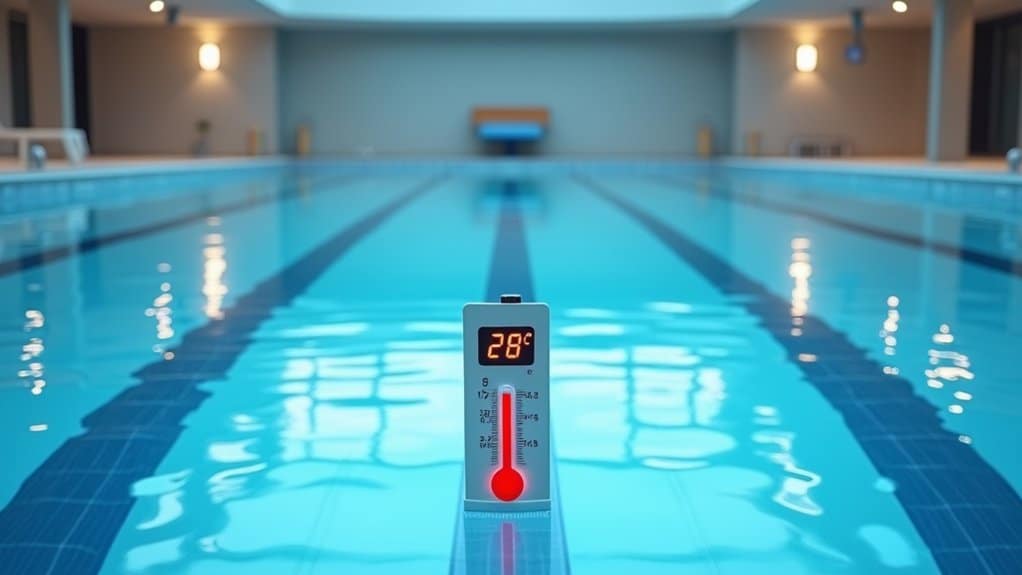
When you compete at the Olympic level, you’ll find pool temperatures strictly regulated between 25-28°C (77-82°F) by World Aquatics standards. This narrow range guarantees your body dissipates heat efficiently during intense exertion while preserving ideal muscle function. Research confirms that 27°C represents the competition sweet spot, with performances declining when temperatures exceed 29°C due to physiological strain. Warmer water is less dense, which creates less friction as your body moves through it. For open water swimming competitions, FINA established a maximum water temperature of 31°C (87.8°F), though competing at such elevated temperatures remains physiologically challenging for athletes. FINA-compliant pools must maintain proper filtration systems and undergo regular water testing to ensure maximum turbidity of 1.0 NTU for optimal visibility and swimmer safety.
Official Temperature Requirements
Official temperature requirements for Olympic and competitive swimming pools follow strict standards set by World Aquatics (formerly FINA) to guarantee fair competition and athlete safety. You’ll find these regulations apply across all major international events, with precise tolerances enforced through advanced monitoring systems.
World Aquatics specifies distinct temperature ranges for each aquatic discipline:
- Competition swimming: 25-28°C (77-82.4°F) to prevent muscle tightness and overheating
- Water polo: 79°F ±1°F to support player endurance during high-contact play
- Synchronized swimming: 81°F ±1°F for routines requiring sustained breath-holding
For diving events, you’ll notice regulations mandate temperatures not less than 79°F, ensuring diver safety and muscle readiness. Olympic facilities use systems capable of adjusting temperatures by less than 1°F increments, maintaining consistency throughout competitions. Many significant swimming records have been achieved when pools reached the perfect temperature within these official ranges. Indoor venues offer a distinct advantage over outdoor pools, as climate control systems enable consistent temperature maintenance regardless of external weather conditions. These regulated pools also maintain minimum light intensity of 1500 lux to ensure optimal visibility for both athletes and officials during competition.
Competition Sweet Spot
Within the 25-28°C (77-82°F) range permitted by World Aquatics, competitive swimmers and coaches have identified a narrower sweet spot that optimizes performance. Research pinpoints 26-27°C (78-80°F) as the ideal range, with 26.5°C (79.7°F) emerging as the precise competition sweet spot. At this temperature, you’ll experience optimal balance between heat dissipation and muscle function.
Studies confirm that 27°C produces the fastest 5km time trial results, while training facilities typically maintain exactly 79°F (26°C). You’ll find that even minor temperature variations, measured in increments of less than 1°F, can impact your performance and record-breaking potential.
This narrow sweet spot prevents the muscle stiffness associated with cooler water while avoiding the overheating hazards of warmer temperatures. Consistent temperature control guarantees fairness across competitive events.
NCAA Pool Temperature Rules for College Swimmers
College swimmers competing under NCAA regulations encounter strict pool temperature standards that directly impact their performance. Article 12 of the NCAA Swimming & Diving Rulebook mandates competition pools maintain temperatures between 26-27°C (79-81°F). This narrow range optimizes muscle function while preventing overheating during intense races.
You’ll find these specifications address multiple performance factors:
- Water temperature must stay within the 79-81°F window for competition
- Air temperature can’t drop more than 4°F below water temperature at deck level
- Diving tanks operate separately at 28-30°C for athlete safety
These standards align closely with World Aquatics (FINA) Olympic guidelines of 25-28°C, though NCAA’s range is slightly narrower. For training sessions, pools maintain 82°F or lower to support high-intensity workouts without risking dehydration or heat-related fatigue. Pools exceeding 82 degrees Fahrenheit create dangerous conditions including heat exhaustion and severe dehydration for athletes training at competitive intensity levels.
Best Water Temperatures by Stroke and Event Type
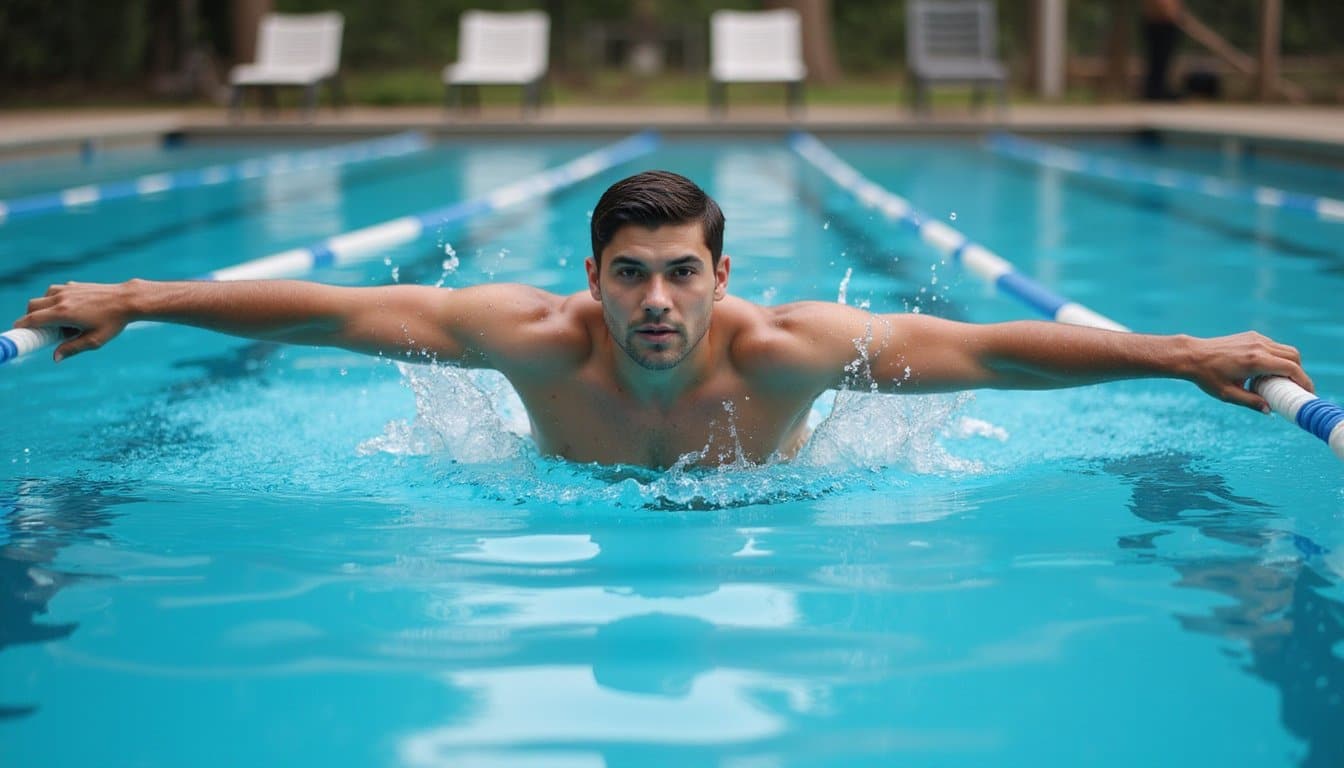
How precisely does water temperature affect performance across different swimming disciplines? You’ll find that each event type demands specific thermal conditions for ideal results. For freestyle and distance events, temperatures between 25, 28°C support efficient heat dissipation, with 27°C representing the perfect balance for endurance performance. Water polo requires 26°C to stimulate cardiopulmonary resilience during high-intensity play. Competitive aquatic venues are typically maintained at 78°F, 82°F (25.5°C, 27.5°C) to optimize athletic performance across these various disciplines.
| Event Type | Ideal Temperature |
|---|---|
| Freestyle/Distance | 27°C (80.6°F) |
| Diving | 26°C (78.8°F) |
| Synchronized Swimming | 27°C (80.6°F) |
Diving pools maintain 26°C to prevent thermal shock upon water entry while ensuring adequate muscle warming. Synchronized swimming competitions require precise 27°C conditions to support the muscle coordination necessary for choreographed routines. You should note that exceeding 28°C elevates metabolic loads and causes significant dehydration.
Indoor Pool Air Temperature Requirements
When you’re managing an indoor lap pool, maintaining proper air temperature is just as critical as water temperature for swimmer comfort and facility efficiency. ASHRAE standards recommend keeping air temperature 2-4°F above the water temperature, with a maximum of 86°F to control evaporation and humidity levels. At deck level, this differential prevents chilling when swimmers exit the water while minimizing moisture load on your dehumidification system. Maintaining humidity levels between 50-60% relative humidity as recommended by ASHRAE helps prevent condensation issues while discouraging the growth of fungi and bacteria in your facility. Indoor pool environments have higher dew point temperatures, making it critical to control space humidity since condensation becomes corrosive when it combines with off-gassed chloramines in the air.
ASHRAE Air Temperature Standards
Most indoor swimming facilities must balance air temperature with water temperature to maintain swimmer comfort and energy efficiency. ASHRAE standards provide specific guidelines you should follow when designing or operating natatoriums.
You’ll want to maintain air temperature 2 to 4°F above your pool’s water temperature. This differential prevents excessive evaporation while keeping swimmers comfortable when exiting the water. For a pool maintained at 84°F, you’d target 86°F indoor air. You’ll want to maintain air temperature 2 to 4°F above your pool’s water temperature, a guideline that aligns with average swimming pool temperatures and helps prevent excessive evaporation while keeping swimmers comfortable when exiting the water. For a pool maintained at 84°F, you’d target 86°F indoor air.
Key ASHRAE air temperature requirements include:
- Air temperature shouldn’t exceed 86°F to remain below the comfort threshold
- Maximum air temperature of 90°F applies for facilities serving elderly swimmers
- Design calculations should add 5°F above the dew point to prevent condensation on surfaces
These standards help you optimize energy consumption while creating appropriate thermal conditions for competitive and lap swimming environments.
Deck-Level Comfort Guidelines
Why does deck-level comfort matter so much in natatorium design? When you exit the pool, evaporative cooling rapidly draws heat from your wet skin, causing discomfort even at 85°F deck temperatures. You’ll experience shivering if the air-to-water temperature differential isn’t properly managed.
To maintain patron comfort, you should keep air temperatures 2-4°F above water temperature, with a maximum ceiling of 86°F. This heightened air temperature reduces evaporation rates from wet skin and minimizes thermal shock when swimmers move between water and deck areas.
Your HVAC system must direct 3-5 CFM per square foot across cold surfaces, particularly glass walls and windows. You’ll need 4-6 air changes per hour throughout the pool room, increasing to 6-8 air changes in spectator areas where occupant density demands greater ventilation capacity.
How to Check or Request a Pool Temperature Change
Checking pool temperature before your lap swim session helps you prepare for excellent performance and avoid discomfort. You can use several reliable methods to verify water conditions:
Knowing your pool’s temperature before diving in sets the stage for a comfortable, high-performance swim.
- Digital pool thermometers provide readings within 0.1°F precision
- Lifeguard stations typically display posted temperatures at public facilities
- Mobile apps connect to pool sensors for real-time monitoring
Staff check temperatures hourly during operating hours and maintain records for regulatory compliance.
If you need a temperature adjustment, submit a written request to the pool manager. Reference established guidelines from USA Swimming, World Aquatics, or the Red Cross to support your case. For competitive pools, group petitions from swim teams carry significant weight. Facilities prioritize seasonal adjustments, typically lowering temperatures in summer and raising them during winter months.
Ready to Transform Your Backyard?
Your dream pool is closer than you think. At Schiller Pools, our experienced team brings over 40 years of expertise to every project, delivering stunning fiberglass pool installations and custom pool construction that turn ordinary backyards into extraordinary outdoor retreats. With flexible financing options and lifetime warranty backing, there has never been a better time to get started. Call (561) 475-5997 today for your free estimate.
Frequently Asked Questions
Why Do Outdoor Pools Feel Warmer Than Indoor Pools at the Same Temperature?
You perceive outdoor pools as warmer because sunlight directly heats your skin’s surface, and higher summer humidity reduces evaporative cooling from your body. When you’re swimming indoors, cooler air temperatures create a greater contrast with the water, and wet skin amplifies the chill effect when you’re exposed to conditioned air. Additionally, outdoor breezes can feel invigorating rather than cold when combined with solar radiation warming your body.
Can Pool Temperature Affect My Risk of Getting Muscle Cramps?
Yes, pool temperature directly affects your muscle cramp risk. Cold water triggers vasoconstriction, reducing blood flow and oxygen delivery to your limbs. When you swim in temperatures between 5°C, 15°C, your hypothalamus activates heat-preservation responses that starve peripheral muscles of nutrients and impair metabolite clearance. This physiological response increases muscle stiffness and cramp susceptibility. You’ll reduce your risk by warming up thoroughly before entering cooler competitive or lap pools.
How Long Does It Take for a Pool to Reach Competition Temperature?
You won’t typically heat a competition pool from cold water right before an event. Facilities maintain temperatures between 77-82°F continuously throughout their operational season, ensuring readiness for scheduled competitions. The actual heating duration depends on water volume, heater capacity, initial temperature, and ambient conditions. For temperature adjustments, operators make minor corrections hours before events rather than performing major heating processes, with verification occurring before competition begins.
Do Heated Pools Cost More to Maintain Than Cooler Lap Pools?
Yes, heated pools cost more to maintain than cooler lap pools. You’ll pay higher electricity bills for constant heating, and your heater requires $100, $350 tune-ups. Indoor heated pools add $20,000, $30,000 in ventilation and dehumidification systems. You’ll also face more frequent pump repairs ($250, $800) since heating equipment experiences greater wear. Cooler outdoor lap pools avoid these HVAC expenses and reduce overall equipment strain, lowering your long-term maintenance costs considerably.
Should I Warm up Differently When Swimming in a Cooler Competition Pool?
Yes, you should adjust your warm-up routine for cooler competition pools. Start with thorough dryland exercises like goal post rotations and arm swings to elevate your core temperature before entering. Once in the water, begin with 200m easy swimming, then progress through building sets and stroke drills. You’ll also benefit from taking cold showers beforehand to acclimate your nervous system and reduce cold-water shock response during competition.
Lap Swimming Pool Temperature for Older Adults?
For older adults doing moderate lap swimming, 82, 86°F (28, 30°C) is often comfortable. More vigorous swimmers may prefer 78, 82°F (26, 28°C) to reduce overheating during longer workouts.
What Temperature Are Olympic Pools During Warm-Up Sessions?
Olympic warm-up pools are generally kept close to competition conditions, typically around 77, 82°F (25, 28°C). This helps swimmers prepare without a major temperature change before racing.
Olympic Pool Temperature Checked How Often During Competition?
Competition pools are typically monitored continuously by automated systems, with officials verifying conditions before and during events. World Aquatics competition water should remain around 25, 28°C (77, 82°F) rather than being checked only at a fixed hourly interval.