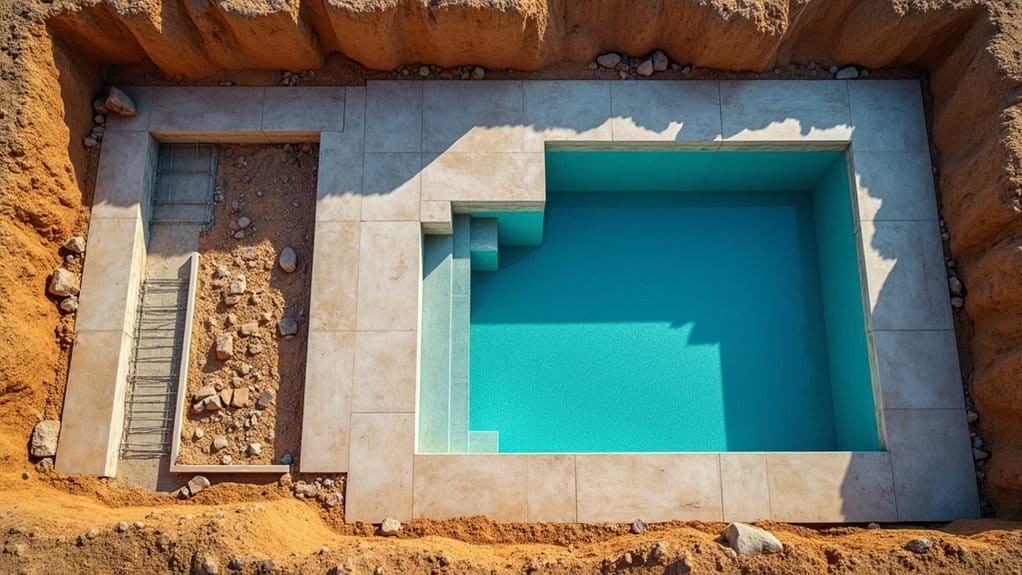
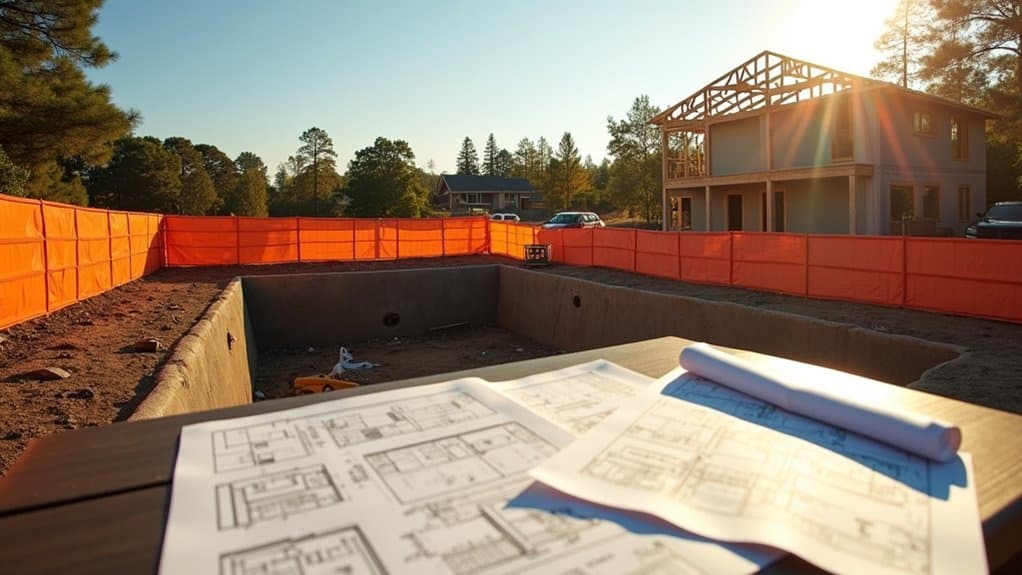
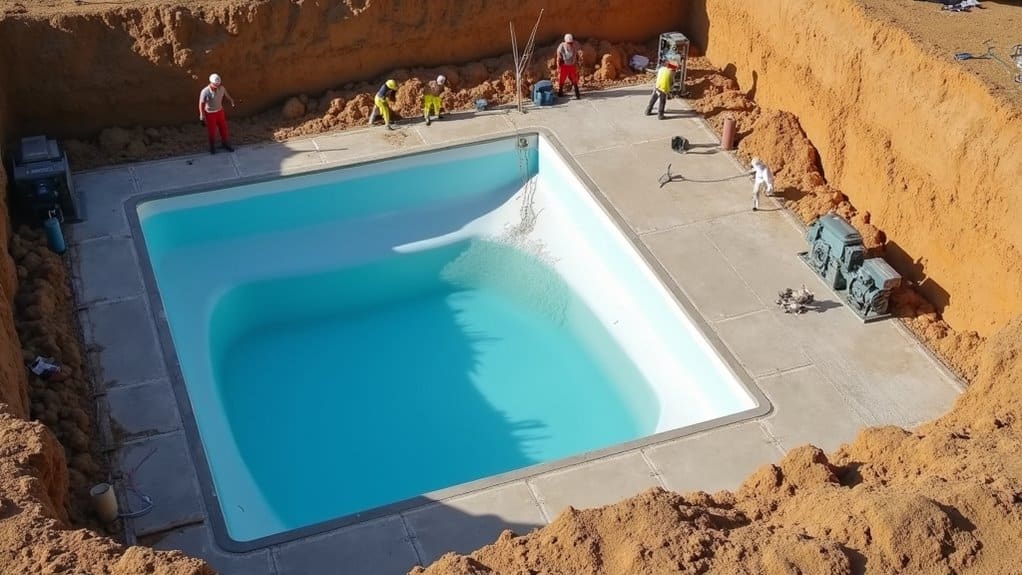
You can accurately calculate your swimming pool construction cost by breaking the project into individual components. Start with pool type, vinyl liner pools run $25,000, $75,000, fiberglass $40,000, $100,000, and concrete $50,000, $120,000. Factor in excavation ($1,000, $5,000), site prep ($3,000, $5,000), permits ($450, $1,800), and labor, which typically accounts for 25%, 50% of your total budget. Don’t forget extras like decking, fencing, and water features, since each phase below carries specific cost ranges you’ll want to explore.
What Does Pool Construction Cost in 2025?
In 2025, building an inground swimming pool typically costs between $50,000 and $150,000, though your final price depends heavily on the pool type, site conditions, and features you choose. Fiberglass pools run $30,000 to $85,000, vinyl liner pools range from $25,000 to $65,000, and gunite concrete pools cost $50,000 to $120,000. Inflation, labor shortages, and tariffs continue driving prices upward.
Your pool construction cost calculation must account for excavation, permits, equipment, decking, and safety fencing beyond the shell itself. Excavation expenses alone can average $2.50 to $15.00 per cubic yard, depending on soil type, digging depth, and terrain complexity. A thorough residential pool construction cost analysis should also factor in 2025-specific pressures: tight skilled-labor markets, elevated financing rates, and supply chain constraints. These variables won’t ease soon, making accurate upfront budgeting essential before you break ground.
Pool Construction Cost by Type: Above-Ground to Concrete
When you compare pool types side by side, the cost differences are substantial, above-ground pools run $1,200 to $6,000 for installation, while inground options jump from $20,000 for a basic vinyl liner pool to $120,000 for a fully customized concrete build. Your choice of material directly determines both upfront costs and long-term financial commitments, since ten-year ownership costs range from roughly $60,700 for above-ground pools to as high as $147,500 for concrete. Understanding how each pool type’s pricing breaks down helps you match your budget to the right construction method before you commit. Fiberglass pools fall in the mid-range, with total installation running $35,000 to $50,000, though they offer lower maintenance needs that can reduce long-term expenses compared to other inground options.
Above-Ground Pool Pricing
Above-ground pools offer the lowest entry point into pool ownership, with total installed costs typically ranging from $1,000 to $6,000, a fraction of what you’d pay for any inground option.
For accurate swimming pool cost estimation, break pricing down by type:
- Inflatable pools: $100, $800, requiring minimal setup
- Steel frame pools: $1,000, $3,000, offering durable metal construction
- Round pool kits: Starting at $1,500, maximizing space efficiency
- Oval pools: $4,500+, requiring additional structural support
Professional installation adds $1,000 to $3,000 beyond material costs, while site prep runs $500 to $3,000. Don’t overlook liners ($100, $660), covers ($30, $300), and water fill costs ($8, $900). Effective pool construction budget planning means accounting for these components upfront, since bundled packages often include pumps, filters, and ladders. Models like the Trevi 211 come in a wide selection of sizes ranging from 12′ to 30′ round and multiple oval configurations, so pricing varies significantly based on the pool dimensions you choose.
Inground Material Cost Comparison
Three distinct materials dominate inground pool construction, vinyl liner, fiberglass, and concrete, and each carries dramatically different upfront costs, maintenance demands, and lifespans that directly shape your total investment. The vinyl liner pool installation process is often considered one of the most straightforward among the options available. This ease of installation can lead to quicker turnaround times, allowing homeowners to enjoy their new pools sooner.
| Material | Installation Range |
|---|---|
| Vinyl Liner | $35,000, $75,000 |
| Fiberglass | $40,000, $100,000 |
| Concrete/Gunite | $50,000, $120,000 |
When running a vinyl liner pool cost comparison, you’ll find it’s the most budget-friendly option upfront but requires liner replacement every 7, 10 years. Fiberglass delivers the lowest annual maintenance at $500, $1,500. Concrete offers 50, 100 year longevity but demands $2,700, $4,000 yearly in upkeep.
Your pool excavation cost estimate, averaging $2,500, applies across all three types, though challenging terrain adds $6,000, $12,000. Factor labor at 25%, 50% of total project costs regardless of material choice.
How Size and Shape Change Your Pool Construction Cost
Your pool’s dimensions directly drive material quantities, excavation volume, and labor hours, so even a modest increase in length or depth can push costs up by thousands of dollars. Choosing a freeform or curved shape over a standard rectangle increases your perimeter footage, complicates construction, and raises expenses for coping, tiling, and custom finishing. Adding features like built-in spas, tanning ledges, or variable depth zones further compounds these size and shape costs, making accurate upfront calculations essential for staying on budget.
Pool Dimensions Impact Cost
Because pool dimensions directly determine the volume of materials, labor hours, and long-term maintenance expenses, size is one of the most influential factors in your total construction cost. When you evaluate pool size and depth cost factors, you’ll find that material cost pool building scales predictably with square footage.
Consider these size-based cost benchmarks for vinyl liner pools:
- 12×24: $45,000, $70,000
- 15×30: $55,000, $60,000+
- 16×32: Over $65,000
- 20×40: At least $90,000
Perimeter drives costs more than length alone, meaning two pools with similar area but different shapes can vary greatly in price. Annual maintenance also scales with surface area, averaging $3,000, $6,000 across sizes. Larger pools demand more chemicals, longer filtration cycles, and higher filling costs, compounding your long-term financial commitment.
Complex Shapes Cost More
While a pool’s square footage drives material volume and labor hours, its shape exerts an equally powerful influence on your final construction cost. Rectangular pools minimize expenses because straight lines simplify excavation, steel reinforcement, plumbing, and finishing. A 15×30-foot rectangular vinyl liner pool starts around $45,000, while concrete versions begin at $65,000. Including pools in your construction budget is crucial for accurate financial planning. By accounting for these water features early on, you can avoid unexpected costs that may arise later in the project.
Complex shapes increase labor at every construction stage. Kidney, figure-8, and lagoon designs demand more rebar bending, shotcrete adjustments, and finishing time, pushing lagoon-style pools to $38,000, $150,000. Custom pool design pricing reflects this intensity: curves complicate vinyl liner fitting, raise gunite application costs, and multiply long-term expenses for resurfacing and covers. Fiberglass pools limit complex options since shells are factory-molded, tying price more to size than shape. You’ll consistently spend less choosing rectangular forms across all material categories.
Feature Additions Increase Price
Beyond the base price set by your pool’s dimensions and shape, feature additions drive costs upward at every stage of construction. Understanding feature and system additions driving expenses higher helps you prioritize upgrades within your budget. Each add-on affects your pool financing and cost breakdown differently:
- Heating, lighting, and diving boards increase your project total beyond base construction estimates
- Decking installations require additional concrete, and many proposals include only minimal patio space
- Retaining walls, electrical work, and gas line installation represent hidden costs that surface during site-specific assessments
- Fencing, drainage systems, and land surveys add expenses based on local regulations and property conditions
You’ll want to itemize every feature separately so you can track exactly where each dollar goes.
Material and Finish Costs in Pool Construction
The materials you select for your pool’s structure directly determine both upfront construction costs and long-term maintenance expenses. When analyzing material and finish costs in pool construction, you’ll find vinyl ranges from $130, $240 per square foot, while concrete runs $200, $350 per square foot. Fiberglass pool installation pricing falls between $175, $330 per square foot, with shell costs currently at $20,000, $30,000.
Longevity greatly impacts your total investment. Vinyl lasts approximately 10 years, requiring liner replacements costing $3,000, $7,500. Fiberglass lasts 25 years and resists saltwater degradation. Concrete delivers 50, 100 years of durability but demands resurfacing every 10, 15 years at $8,000, $10,000. Don’t overlook fencing requirements either, materials cost $10, $45 per linear foot, totaling $2,000, $13,500 for typical installations.
What You’ll Pay for Labor, Excavation, and Site Prep
- Standard dig: $1,000, $5,000, including soil hauling
- Rocky or sloped terrain: adds hundreds to thousands extra
- Site preparation with grading: $3,000, $5,000 in detailed breakdowns
- Permits and engineering plans: $2,000, $5,000 combined
You’ll also face extended timelines with concrete pools, excavation alone takes a week, while walls add 20, 60 days of labor-intensive work. After the wall construction, you’ll need to account for the pool construction timeline for homeowners, as installing surfaces can take additional time. It’s essential to communicate these timelines with any contractors involved.
How Location Affects Your Pool Construction Cost
Where you build your pool matters just as much as what you build, regional differences in labor rates, material costs, and permitting fees can shift your total budget by tens of thousands of dollars. Northeast inground pools run $45,000, $85,000, while Midwest projects drop to $35,000, $70,000. Western states fall between $41,000, $91,000.
Your pool building cost per square foot fluctuates based on local labor availability, soil conditions, and terrain complexity. Rocky or unstable ground demands specialized excavation, and difficult site access raises equipment transport expenses considerably.
Don’t overlook permit and inspection fees pool construction requires, building permits alone range from $450 to $1,800 depending on state regulations. Strict local codes may mandate surveys, site plans, and construction drawings, adding both time and cost before any digging begins.
Features and Extras That Raise Pool Construction Cost
Once you move beyond the basic pool shell and excavation, optional features and upgrades become the fastest way to inflate your total construction budget. Your pool decking and patio cost calculation alone can range from $5,000 to $20,000 depending on whether you choose basic concrete at $10, $15 per square foot or premium pavers at $20, $40 per square foot.
Water features and decorative elements add significant costs:
- Bubblers: $1,000, $2,500 each
- Deck jets: $1,000, $1,500 per unit
- Waterfalls: $1,300, $25,000 based on complexity
- Feature-rich slides: $8,000, $12,000
Safety equipment also impacts your budget. Automatic safety covers run $12,000, $17,000, while custom safety covers cost $1,700, $5,000. Waterline tile installation adds $4,500, $8,500. You’ll want to prioritize features that deliver the highest value relative to your budget constraints.
How to Estimate Your Total Pool Construction Cost
Three primary methods help you estimate your total pool construction cost before committing to a contractor: the cost-per-square-foot method, the sum-of-individual-phase-costs approach, and online estimator tools.
The cost-per-square-foot method calculates pool shell construction pricing based on water surface area, excluding decks, fencing, and site work. Minimum pool size for reliable estimates is 1,500 square feet. The sum-of-individual-phase-costs approach breaks expenses into components, bottom membrane, side walls, skimmers, coping, and perimeter piping, giving you granular budget control.
Online estimator tools from manufacturers like Latham and Thursday Pools let you input pool type, size, location, and accessories for instant 2025 pricing ranges. These calculators support preliminary backyard pool project budget planning but won’t replace contractor quotes, since actual costs vary by geography, labor rates, and design complexity.
Ready to Transform Your Backyard?
Your dream pool is closer than you think. At Schiller Pools, our experienced team brings over 40 years of expertise to every project, delivering stunning fiberglass pool installations and custom pool construction that turn ordinary backyards into extraordinary outdoor retreats. With flexible financing options and lifetime warranty backing, there has never been a better time to get started. Call (561) 475-5997 today for your free estimate.
Frequently Asked Questions
How Much Does It Cost to Operate a Pool Annually?
You’ll typically spend $1,000 to $6,000 annually to operate your pool. Electricity for pumps, heaters, and lights costs you $300 to $1,500 per year, while chemicals run $400 to $800. You’ll pay $50 to $250 for water refilling due to evaporation. Equipment repairs can add $200 to $2,000+ yearly. Don’t forget long-term costs, you’re looking at pump replacements every 5, 10 years and resurfacing every 10, 15 years.
What Chemical Levels Should Be Maintained to Reduce Pool Costs?
You’ll reduce pool costs by maintaining chlorine between 1.0, 3.0 PPM, pH at 7.4, 7.6, total alkalinity at 80, 120 PPM, and cyanuric acid at 30, 50 PPM. Keeping pH at 7.5 maximizes chlorine’s effectiveness at 50, 60% activity, cutting chemical waste. Proper cyanuric acid levels prevent 95% chlorine dissipation from UV exposure, while stable alkalinity eliminates frequent pH corrections. These balanced levels protect equipment from corrosion and scale, minimizing costly repairs.
How Long Does a Typical Swimming Pool Construction Project Take?
You can expect a typical inground pool construction project to take 8, 12 weeks, though realistic timelines stretch to 8, 16 weeks when you factor in delays. Concrete pools average 6, 8 weeks with efficient contractors, while fiberglass pools install in as little as 3 weeks. Pre-construction alone, design, permitting, and planning, adds 4, 12 weeks. Weather disruptions, site access challenges, and permit backlogs can extend your project considerably, directly increasing labor and overhead costs.
Does Building a Pool Increase Your Home’s Resale Value?
Yes, building a pool typically increases your home’s resale value by 5, 8% nationally, translating to $20,000, $32,000 on a $400,000 home. You’ll recover roughly 40, 60% of your installation cost, though warm climates yield considerably better returns, Fort Myers, for example, shows a 20.4% premium. You shouldn’t expect full cost recovery, but you’ll maximize ROI by choosing inground construction, maintaining proper condition, and adding higher-end finishes that boost buyer appeal.
What Financing Options Are Available for Swimming Pool Construction?
You can finance your pool through several options. Home equity loans offer fixed rates with lump-sum disbursement, while HELOCs provide flexible, as-needed borrowing, ideal for phased construction. Personal loans don’t require home collateral, and lenders like LightStream offer competitive fixed rates based on your credit profile. Dealer financing through companies like Lyon Financial or AMS streamlines approvals with loans up to $200,000 and terms extending to 30 years, though you’ll typically pay higher interest rates.