


Yes, you can include a pool in a construction loan as long as you specify it in your original application and the total project cost stays within the lender’s loan-to-value cap, typically 80% of the appraised value. You’ll need a minimum credit score of 620, 650, a DTI ratio under 43%, and detailed contractor agreements. Note that FHA 203(k) loans explicitly exclude pools as luxury items. Below, you’ll find the exact requirements, approval steps, and alternative financing options to evaluate.
Can You Finance a Pool With a Construction Loan?
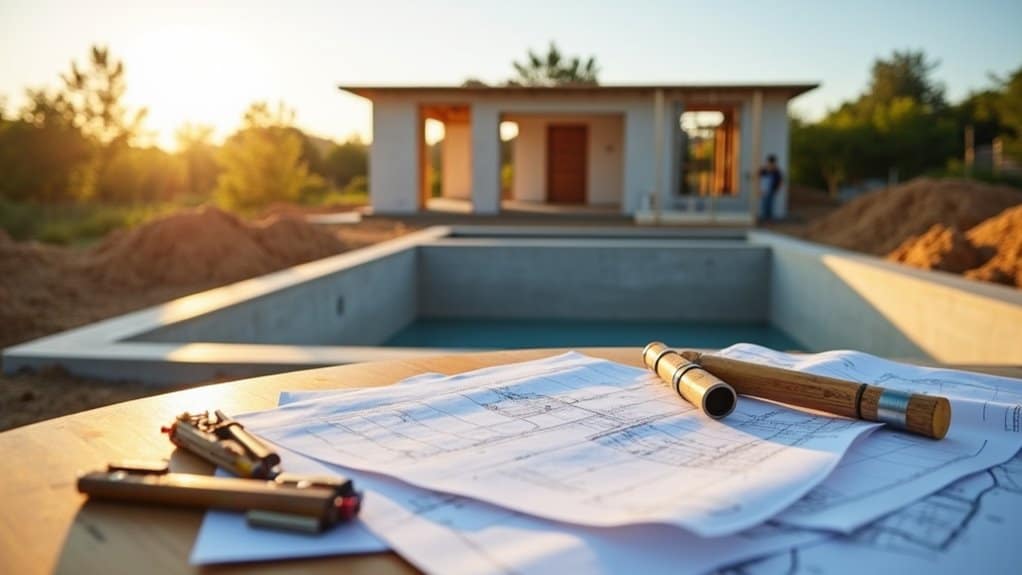
When you’re building a new home from the ground up, a construction loan can finance your swimming pool, provided the pool is specified in the original loan application and incorporated into the overall project scope. Your lender will require detailed project plans, contractor agreements, and building permits that explicitly include the pool.
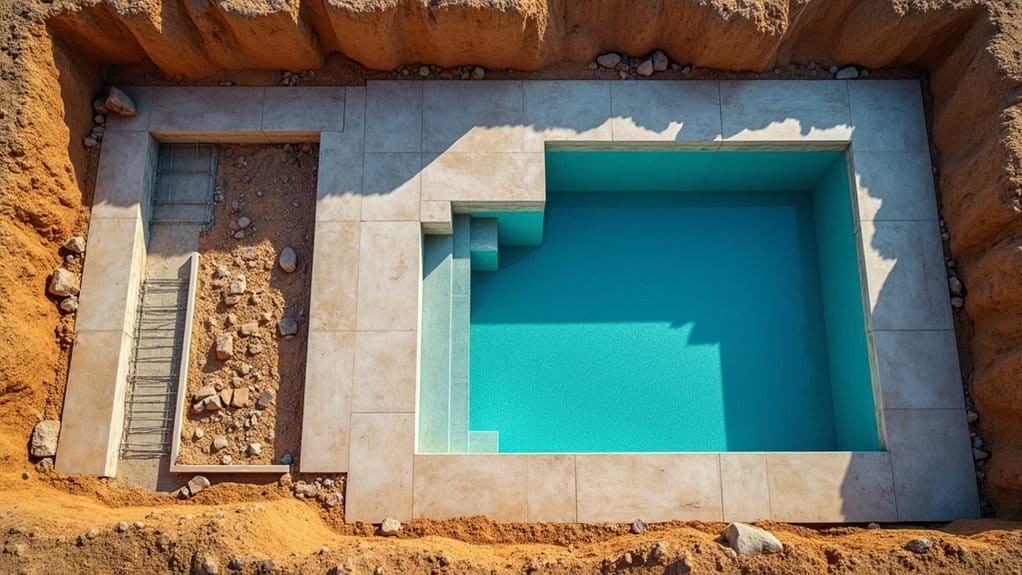
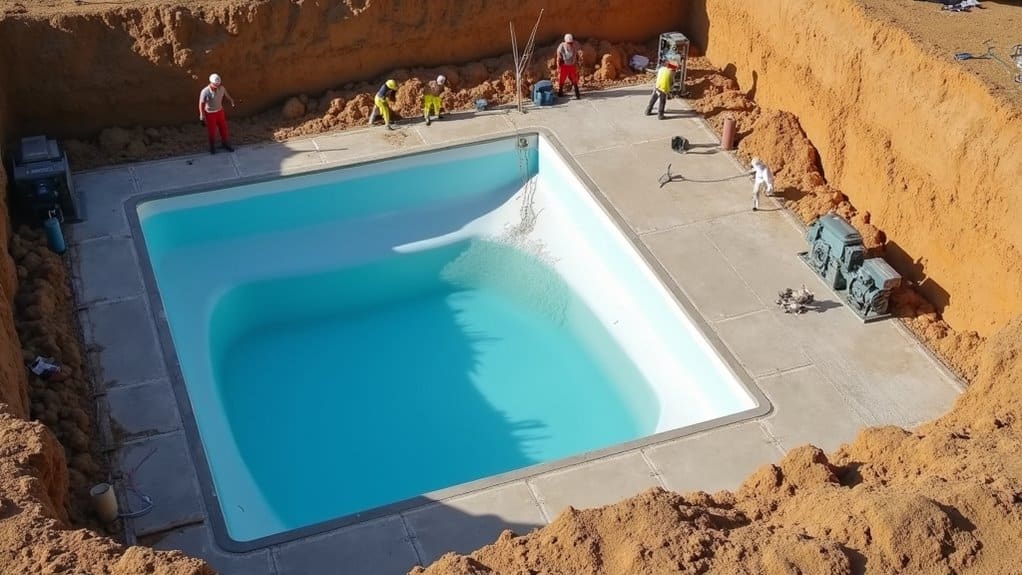
Pool construction financing through a construction loan follows a construction loan draw schedule, where funds are released in phases as work progresses, typically after excavation, structural installation, plumbing, and final inspection. Each phase requires mandatory verification before subsequent disbursements. Pool construction timelines can vary significantly based on several factors, including project size and weather conditions. Delays in any phase of construction can lead to extended timelines and increased costs.
You’ll need a minimum credit score of 620, 650, though scores above 720 secure better rates. Your debt-to-income ratio must remain within the 36, 43% threshold lenders require. If a construction loan isn’t feasible, homeowners can also explore alternatives like home equity loans, HELOCs, or personal loans, since in-ground pools average $50,000 to $60,000 and often require dedicated financing solutions.
How Construction Loans Cover Swimming Pools
When you’re building a new home, you can include pool costs directly in your construction loan budget, which consolidates financing for the home and pool into a single loan product with unified terms. Your lender will assess pool financing loan options based on the appraised value of the completed property, meaning the pool’s contribution to overall property value directly affects how much you can borrow under loan-to-value limits. Understanding how construction budget inclusion and appraisal value impact work together helps you structure a loan that covers the full project scope without exceeding lender thresholds. Since construction loans typically have variable interest rates and shorter terms than standard mortgages, it’s important to plan for potential rate fluctuations when budgeting for the added cost of a pool.
Pool Financing Loan Options
Although construction loans can bundle pool costs into a single financing package, they aren’t the only path to funding a swimming pool, and understanding each option’s structure helps you select the most cost-effective route. Beyond mortgage construction loan pool inclusion, several pool financing options exist: One important factor to consider in your budget planning is swimming pool cost estimation methods. These methods can vary widely depending on the type of pool you want, the materials used, and additional features like landscaping or lighting.
- Home equity loans, Fixed-rate second mortgages with lump-sum disbursement, minimum draws starting at $15,000, and potential tax-deductible interest.
- HELOCs, Variable-rate revolving credit lines offering flexible draws for ongoing pool-related expenses, secured by your home’s equity.
- Personal pool loans, Unsecured financing from $5,000 to $300,000 with APRs between 6% and 36%, requiring no home equity but carrying higher rates. These loans provide quick access to cash for immediate pool construction needs, making them a practical choice when time is a priority.
- Specialized pool lenders, Stage-funded loans disbursed at construction milestones, with direct-to-consumer options providing homeowner-controlled flexibility.
Construction Budget Inclusion
Because construction loans operate on a structured draw schedule, your pool’s costs must be itemized within the overall project budget before the lender approves the first disbursement. Your construction loan financing must align with the lender’s loan-to-value requirements, typically capped at 80 percent of the completed property’s appraised value.
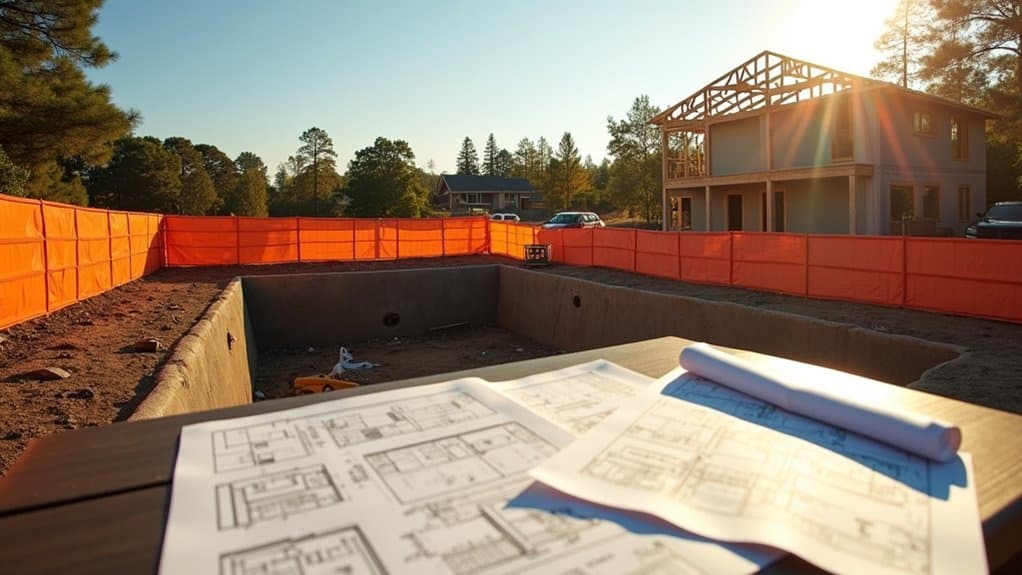
When handling construction budgeting for pool installation, you’ll need contractor agreements, engineering approvals, and building permits submitted alongside architectural plans. Lenders release funds in stages, excavation, structural installation, plumbing, and final inspection, so each pool-related cost must correspond to a specific draw milestone. Safety compliance features, including four-foot fencing and anti-entrapment drain covers, must also appear as line items. Your debt-to-income ratio can’t exceed 43 percent, ensuring you can manage payments across the full project scope.
Appraisal Value Impact
Your lender doesn’t base the construction loan amount on what you plan to spend, it’s based on what the completed property will appraise for. The appraisal value increase with pool addition must be supported by comparable sales in your area, or you’ll face a financing gap.
Here’s how appraisal mechanics affect your loan:
- Comparable sales set the ceiling. Appraisers pull recent sales of similar properties to establish your after-build value. If nearby homes lack pools, yours may not appraise higher.
- Loan to value ratio construction loans typically cap at 80%. Your pool cost must fit within that margin.
- Material quality matters. Permanent structural features receive stronger valuation recognition than cosmetic upgrades.
- Market saturation limits returns. Pools add measurable value only where comparable homes include similar amenities.
FHA, USDA, and Conventional Pool Loan Rules
Different government-backed and conventional loan programs impose distinct rules on whether a pool can be financed as part of a construction or purchase loan. Under fha construction loan guidelines, the 203(k) program explicitly excludes swimming pools as luxury items from eligible renovations. However, you can purchase a home with an existing pool if it meets FHA appraisal standards and complies with local building codes.
USDA loan programs primarily address multifamily construction pooling under RD Section 538, with limited single-family pool-specific guidance.
Conventional pool loan rules don’t prohibit pools in purchase transactions but typically require higher credit thresholds, around 720 or above, for construction financing. You’ll need existing pools appraised without structural deficiencies. Regardless of loan type, lenders must verify local code compliance per HUD 4000.1 requirements before approving your project.
Credit Score and Down Payment Minimums by Loan Type
If you’re using an FHA loan to finance a home with a pool, you’ll need a minimum credit score of 580 to qualify for the standard 3.5% down payment, while scores between 500 and 579 require a 10% down payment. Many lenders set their own overlays above these FHA minimums, often requiring mid-600s FICO scores before they’ll approve a one-time close construction loan that includes pool costs. You should verify your lender’s specific thresholds early in the process, since falling short of their internal credit requirements can delay or disqualify your pool financing even if you meet FHA’s baseline standards.
FHA Score Requirements
How strictly do credit score thresholds affect your ability to finance a pool through an FHA construction loan? FHA guidelines establish precise minimums that directly determine your eligibility and down payment structure for a home improvement loan for pool installation.
- 580+ FICO score: You’ll qualify for 3.5% down payment, making mortgage refinance for pool construction more accessible within FHA parameters.
- 500, 579 FICO score: You’re required to provide 10% down payment, considerably increasing upfront capital requirements.
- Below 500 FICO score: You’re ineligible for FHA financing entirely, eliminating this pathway.
- Lender overlays: Many lenders impose 620, 640 minimums despite FHA’s published thresholds, narrowing actual approval rates.
Your DTI ratio must remain under 43%, though scores at 580+ may allow flexibility up to 50% with qualifying lenders.
Down Payment Thresholds
Three primary loan programs, FHA, conventional, and VA, each set distinct down payment minimums that directly affect how much capital you’ll need upfront when financing a pool within a construction loan.
| Loan Type | Minimum Down Payment |
|---|---|
| FHA | 3.5% (620+ FICO); 10% (below 580) |
| Conventional | 5%, 25%, credit-dependent |
| VA | 0% for eligible borrowers |
You should explore down payment assistance programs, as eligibility varies by lender and jurisdiction. Land equity can substitute for cash if you own the lot outright.
Your property value increase with pool addition factors into the appraised value, potentially improving your loan-to-value ratio and reducing down payment requirements. Lenders typically require liquid reserves of two to six months’ payments alongside your down payment at closing.
Appraisals, Builders, and Draw Schedules: What Lenders Review
Lenders scrutinize three core components before approving a construction loan that includes a pool: the appraisal, the builder’s documentation, and the draw schedule. An appraisal with pool addition estimates your completed property’s value by comparing plans, specifications, and budgets against similar homes. Your builder must submit detailed construction documents that meet lender underwriting requirements construction loans demand for approval.
Here’s what lenders specifically review:
- Appraisal accuracy, confirms the loan amount doesn’t exceed projected property value, including pool improvements.
- Builder documentation, validates plans, specs, and budgets align with appraised value and loan terms.
- Draw schedule alignment, guarantees funds release only after verified construction progress on approved features.
- Condition and quality ratings, flags physical deficiencies affecting safety, soundness, or structural integrity before funding proceeds.
Construction Loan vs. Home Equity Loan for a Pool
When you’re deciding between a construction loan and a home equity loan to finance a pool, the funding mechanism creates the most immediate practical difference. Construction loans disburse funds in stages tied to inspections, charging interest only on drawn amounts. Home equity loans require full funding interest from day one.
A home construction loan pool addition typically carries 5, 8% APR, while home equity loans range 4, 6% APR with lower origination fees. Construction loans require approximately 20% down but base approval on projected completed value, no prior equity necessary. VA construction loan pool coverage may apply if you’re building during initial home construction, though eligibility requirements vary by lender.
Construction loans demand detailed plans, contractor agreements, and budget documentation. Home equity loans rely on existing equity, credit score, and current appraisal.
How to Add a Pool to Your Construction Loan
Adding a pool to your construction loan requires coordinating with your lender before architectural plans reach final approval, since the pool must appear in the original project scope to qualify for staged disbursement. Once you have the necessary funding in place, you can begin the vinyl liner pool installation steps. It’s important to hire professionals who understand the specifics involved in this type of pool setup.
To secure lender approval for pool construction, follow these steps:
- Submit pool specifications, including contractor agreements, engineering plans, and permits, alongside your primary building documents for residential construction loan coverage.
- Request an updated appraisal reflecting the completed property value with the pool included.
- Confirm the draw schedule incorporates pool-specific milestones such as excavation, plumbing, and final inspection.
- Verify loan terms, review APR, fees, and monthly payments to guarantee the added pool cost doesn’t push your debt-to-income ratio beyond acceptable thresholds.
Early integration prevents costly post-construction financing alternatives.
Ready to Transform Your Backyard?
Your dream pool is closer than you think. At Schiller Pools, our experienced team brings over 40 years of expertise to every project, delivering stunning fiberglass pool installations and custom pool construction that turn ordinary backyards into extraordinary outdoor retreats. With flexible financing options and lifetime warranty backing, there has never been a better time to get started. Call (561) 475-5997 today for your free estimate.
Frequently Asked Questions
Does Adding a Pool to a Construction Loan Increase the Interest Rate?
Adding a pool to your construction loan doesn’t automatically increase your interest rate. Your lender sets the rate based on market conditions at issuance, and it applies uniformly across the entire loan, including the pool component. However, if the added cost raises your loan-to-value ratio above 80% or pushes your debt-to-income ratio beyond 43%, you’ll face stricter terms. You should review your pool designation’s rate structure, as “CL” pools maintain consistent rates while “CS” pools allow variation.
Can an Above-Ground Pool Be Financed Through a Construction Loan?
You generally can’t include an above-ground pool in a construction loan because lenders classify it as a temporary or removable structure rather than a permanent improvement. Construction loans require features that increase the property’s appraised value, and above-ground pools don’t meet that threshold. You’ll need alternative financing, dedicated pool lenders like LightStream or HFS Financial offer same-day approval, while personal loans provide quick funding without collateral or appraisal requirements.
What Happens if Pool Construction Costs Exceed the Original Loan Estimate?
If pool construction costs exceed your original loan estimate, you’ll need to request a loan modification or secure supplemental financing. Your lender will reassess the loan-to-value ratio against the property’s updated appraisal to determine whether additional funds can be approved. You must submit revised contractor agreements, updated permits, and adjusted architectural plans. If the overage pushes your debt-to-income ratio above 43 percent, you’ll likely face denial or restructured terms.
Are Pool Safety Features Like Fencing Included in Construction Loan Costs?
Yes, you’ll typically need to include pool safety features like fencing, self-closing gates, and anti-entrapment drain covers in your construction loan budget. Lenders won’t approve your project without verifying compliance with local building codes and national pool safety standards. Most jurisdictions require fencing at least 4 feet high. You should factor these costs, alongside your base pool installation, into your total project estimate before submitting contractor agreements and permit documentation for lender review.
How Long Does Pool Construction Add to the Overall Building Timeline?
Adding a pool typically extends your building timeline by 8, 12 weeks. If you’re choosing fiberglass, you’ll complete construction in 3, 6 weeks, while concrete pools require up to 3 months due to curing. You’ll also need to factor in 2, 6 weeks for permitting, which varies by jurisdiction. Complex designs can stretch timelines to 6 months. You should coordinate pool construction draws with your lender’s disbursement schedule to avoid delays.