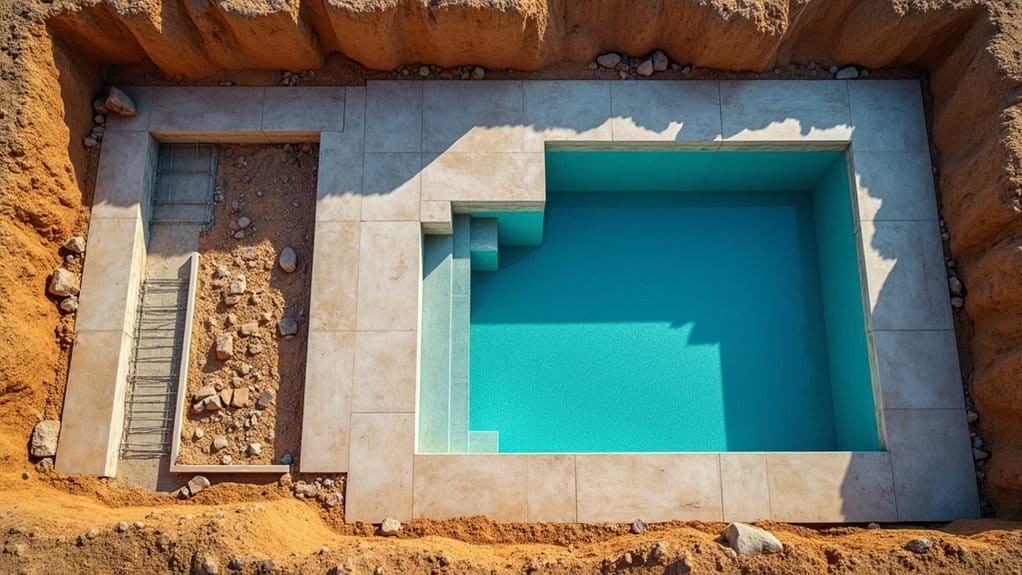
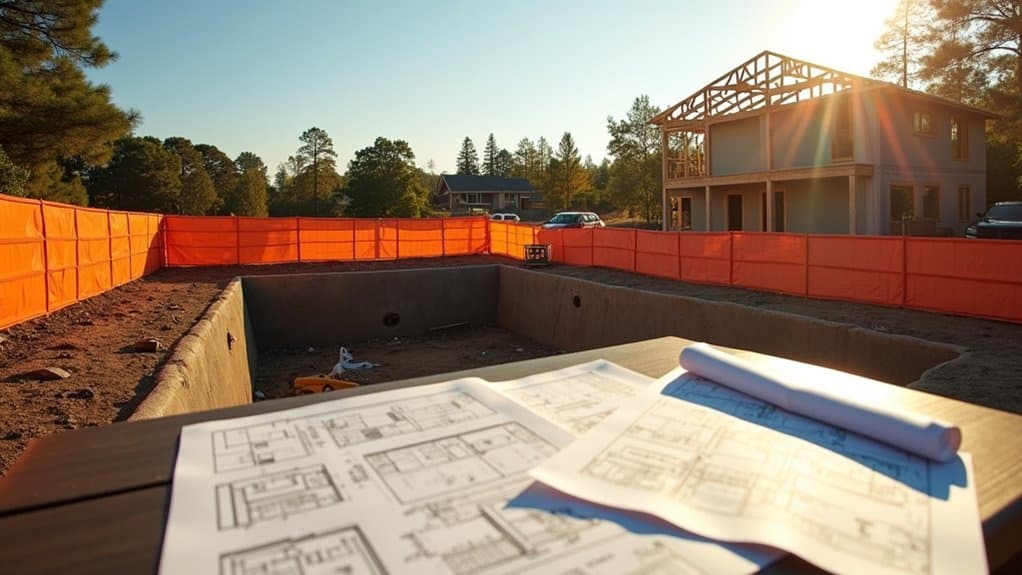
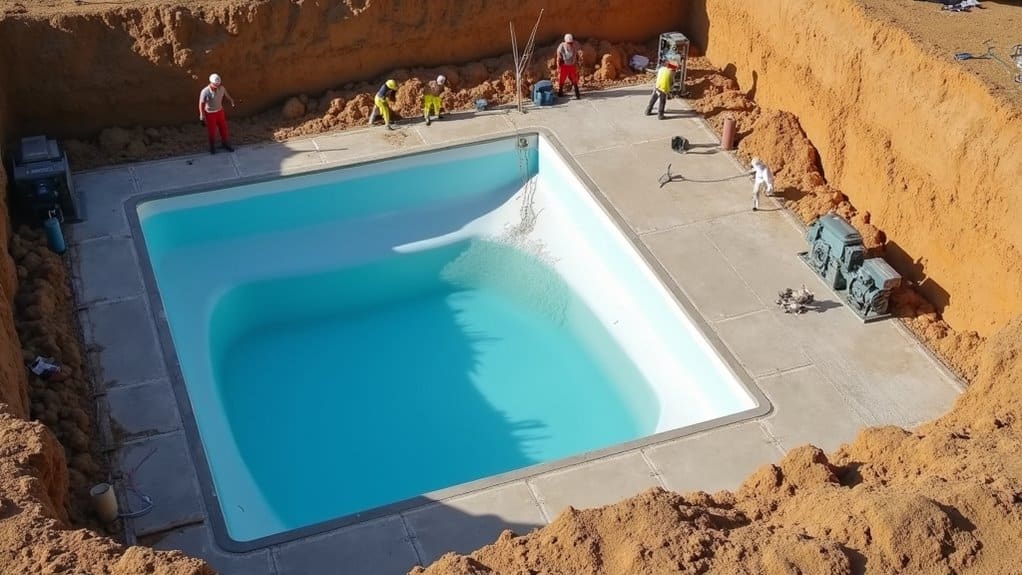
You’ll typically spend $500 to $1,500 on most fiberglass pool repairs, though costs range from $300 for a minor gel coat crack up to $8,000+ for full structural reinforcement. Hairline crack fixes run $300, $400, leak detection adds $100, $500, and gel coat restoration costs $2,000, $4,000. Factors like damage severity, pool size, and your region directly impact the final bill. Below, you’ll find detailed breakdowns for every repair type and cost-saving strategy.
Fiberglass Pool Repair Costs at a Glance
Fiberglass pool repairs span a wide cost range, from as little as $10 for a minor crack fix to $6,500 or more for full resurfacing, so understanding where your specific issue falls helps you budget accurately. Repair techniques for fiberglass pools can vary significantly in complexity. Proper maintenance and timely repairs can extend the life of your pool and enhance its appearance. Investing in quality repairs not only ensures safety but also improves the overall swimming experience.
Your fiberglass pool repair cost depends on damage severity and repair type. Crack repairs average $650, with fiberglass-specific cracks running $300, $400. Structural crack work costs $75 per linear foot, while severe cases reach $3,100. Leak detection adds $100, $500, and shell leak repairs total $350, $2,700.
When evaluating fiberglass pool crack repair pricing, factor in associated expenses: gelcoat application ($300, $400), equipment repairs ($50, $5,000), and drain fixes ($400, $1,500). The national average for in-ground fiberglass repairs sits between $500 and $1,500.
Minor Surface Fixes: Gel Coat, Scratches, and Leaks
When your fiberglass pool develops minor surface damage, you’ll typically encounter three categories of repair: gel coat restoration, scratch and ding fixes, and leak detection and sealing. Gel coat repairs for minor surface issues range from $2,000 to $4,000, while isolated scratch and crack fixes using gelcoat application can cost as little as $300 to $400, and leak detection and sealing generally runs between $350 and $3,500 depending on the source and severity. Understanding each repair type’s scope and cost helps you prioritize fixes before small problems escalate into structural damage requiring considerably more investment. Addressing these issues promptly is essential, as a quality resurfacing can extend pool lifespan by 15 to 30 years when combined with proper ongoing care.
Gel Coat Repair Costs
Most gel coat repairs on fiberglass pools fall into one of two cost tiers: minor stress crack fixes ranging from $200 to $500, and more extensive repairs that exceed $1,000 when technicians must grind through damaged gel coat to inspect the underlying fiberglass layers. Fiberglass pool wall repair techniques can significantly enhance the longevity of the pool structure. Properly addressing issues such as cracks or structural weaknesses helps prevent further damage and costly repairs in the future.
Your gel coat repair cost depends on several variables that directly affect your final invoice:
- Small, isolated stress cracks can start as low as $100 for targeted spot repairs
- Widespread cracking in hard-to-reach areas drives costs above $1,000
- Labor accounts for the largest expense due to sanding, spraying, and curing requirements
- One gallon of gelcoat covers 40, 80 square feet per coat, with multiple coats increasing material needs
- Your fiberglass pool refinishing price escalates when technicians discover structural damage beneath the gelcoat surface
Neglecting gel coat maintenance allows water intrusion to cause blistering and cracking, which can escalate simple surface repairs into full structural restoration projects costing thousands more.
Scratch and Ding Fixes
Because fiberglass pools are cheaper to patch than concrete or vinyl alternatives, most scratch and ding repairs stay within the $300, $400 range for standard gel coat work. When you factor in repainting, your total reaches approximately $1,200. Understanding scratch repair pricing helps you budget accurately before hiring a technician.
| Repair Type | Cost Range |
|---|---|
| Gel coat patch (scratch/ding) | $300, $400 |
| Gel coat patch + repaint | $1,000, $1,200 |
| Epoxy paint scratch repair | $2,500, $3,000 |
| Full epoxy/polymer surface | $7,000, $12,000 |
You’ll need proper sanding and preparation before any fix holds long-term. Professional ding repair expenses include labor, and technicians prevent issues like bubbling or peeling that commonly plague DIY attempts. Epoxy paint options last roughly five years before reapplication.
Leak Detection Expenses
Leak detection marks the critical first step before any fiberglass surface repair can begin. You’ll spend between $150 and $300 for a basic visual inspection, while advanced methods like sonar or pressure testing run $400 to $800. Fiberglass pool leak repair services typically average $150 to $500 for professional detection alone.
- A pool line pressure test costs $200 to $500 specifically
- Detection combined with simple fixes averages $475 to $525 nationally
- Early detection prevents repairs from escalating to $1,000, $5,000
- Draining the pool for access adds $175 to $230
- Your pool repair labor cost estimate ranges $45 to $65 per hour
Don’t skip detection. Pinpointing the exact leak location guarantees you’re fixing the right problem without unnecessary material waste.
Fiberglass Pool Crack Repair: Hairline to Structural
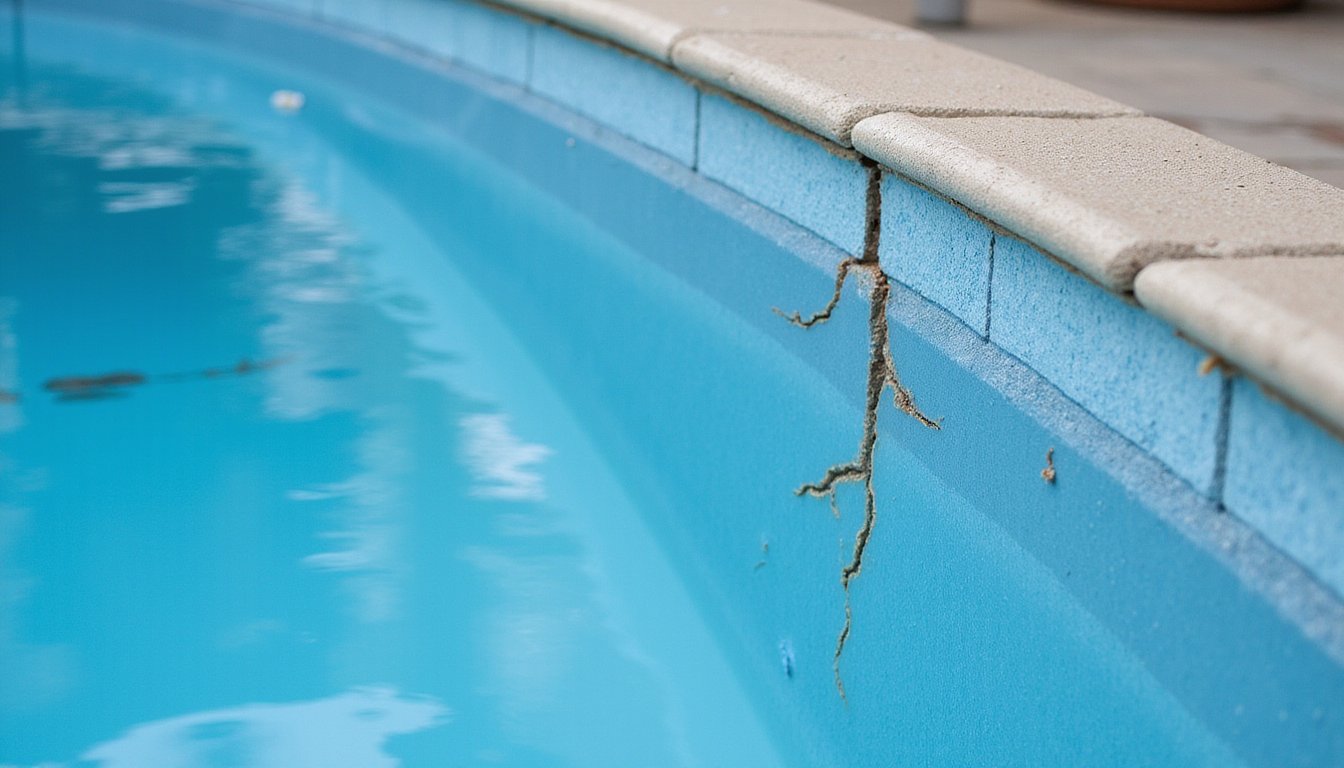
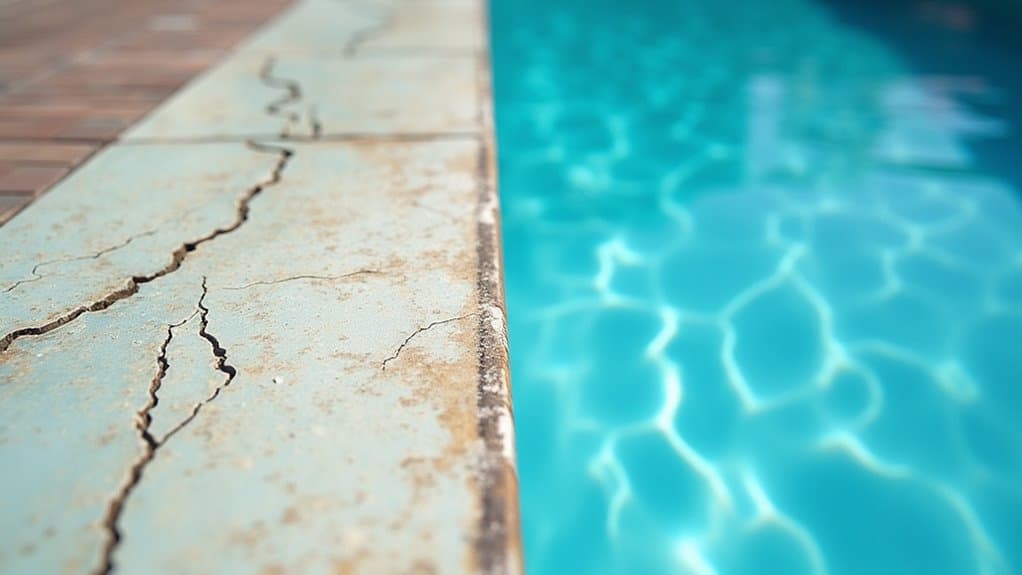
If you’ve noticed hairline cracks in your fiberglass pool’s gelcoat, you’re typically looking at $300 to $400 for a professional gelcoat application repair, though minor cases can start as low as $100 when surface patching doesn’t require draining the pool. Once cracks penetrate beyond the gelcoat into the structural fiberglass layers, repair costs escalate sharply to $1,000 to $5,000, depending on crack size, pool accessibility, and whether fiberglass reinforcement layers need rebuilding. Severe structural failures requiring full fiberglass layer replacement can reach $12,000 to $20,000, making early detection, typically $100 to $500 for professional assessment, a cost-effective first step before damage compounds.
Hairline Crack Costs
- Epoxy patches cost $35 to $50 per linear foot but last only 1 to 3 years before reapplication
- Untreated hairline cracks can progress into structural damage requiring $700 to $1,000+ repairs
- Surface-level cracks rarely cause water loss in early stages
- Professional repairs combine labor and specialized materials for lasting results
- A $200 fix today prevents a $6,500 resurfacing later
Structural Damage Pricing
When hairline cracks go unaddressed or when ground movement, hydrostatic pressure, or installation defects compromise the fiberglass shell itself, you’re looking at structural damage, and a considerably higher repair bill.
Fiberglass pool structural repair costs break down by method and severity:
- Epoxy injection: $300, $600 per crack for smaller structural fractures
- Stapling reinforcement: $500, $1,500 for mechanical stabilization
- Torque lock staples: $1,000, $2,500 depending on crack location
- Full structural reinforcement: $2,000, $8,000 for extensive damage
- Complete structural overhaul: $2,500, $15,000+ for severe cases requiring draining and extended downtime
Your pool structure reinforcement cost depends heavily on regional labor rates, damage accessibility, and material requirements. In New England, structural crack repairs commonly reach $6,000, $8,000. A professional assessment guarantees you’ll receive an accurate, scope-specific quote before work begins.
Fiberglass Pool Resurfacing vs. Shell Replacement
- Gel-coat resurfacing runs $3,000, $6,000 for moderate damage, lasting up to 25 years.
- EcoFINISH thermoplastic coatings cost $10,000, $13,000 for small-to-medium pools.
- Full shell replacement includes removal, excavation, and reinstallation, driving costs beyond $50,000.
- Labor alone averages $7.50 per sq. ft. for fiberglass resurfacing work.
- Resurfacing eliminates the need for replacement unless structural integrity is compromised.
Choose resurfacing when your shell remains structurally sound.
Pumps, Filters, and Equipment Upgrade Costs
Although your fiberglass shell may be in solid condition, the mechanical equipment that circulates, filters, and heats your pool water won’t last forever, and budgeting for these upgrades prevents unexpected downtime.
Pump replacement runs $700, $4,000, with most homeowners spending around $1,300. Motor-only swaps cost $200, $800 when the pump housing remains functional. Filter replacement averages $1,500, $2,000 installed, varying by sand, cartridge, or DE type. Heater upgrades span $1,500, $5,000 depending on fuel source and efficiency rating.
When reviewing pool repair contractor pricing, bundle equipment replacements to reduce labor costs. Adding a pump timer ($50, $100) optimizes energy use. Drain repairs add $400, $700. Understanding these fiberglass pool refurbishment costs alongside shell repairs gives you a complete financial picture for maintaining your pool’s operational integrity. Evaluating the cost factors for fiberglass pool resurfacing is essential for budget planning. Many homeowners underestimate these expenses, which can lead to unexpected financial strain.
What Makes Fiberglass Pool Repair Cost More or Less?
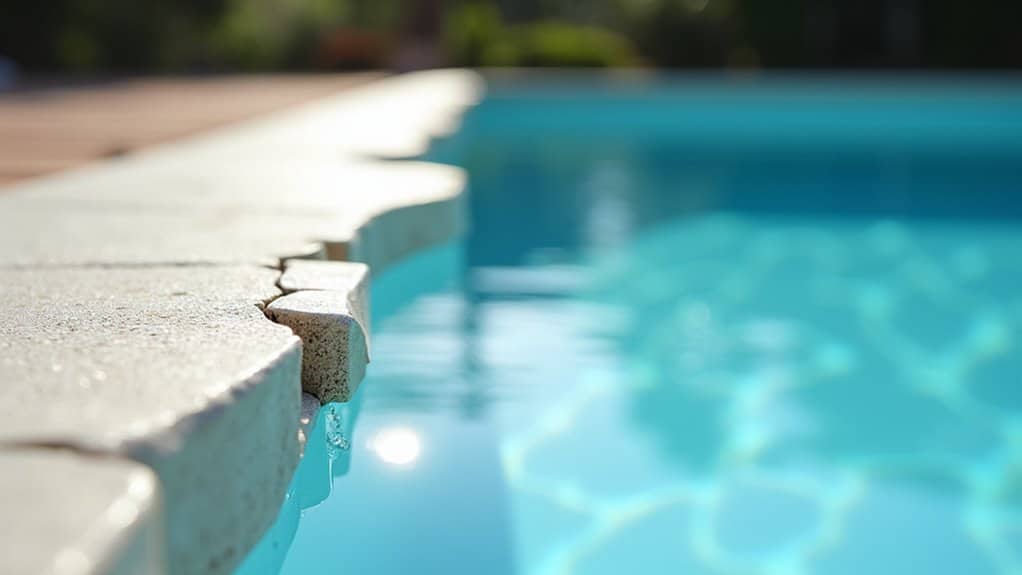
Beyond equipment and mechanical systems, the repair bill for your fiberglass shell itself hinges on several intersecting variables, damage severity, repair complexity, material grade, geographic location, and pool dimensions.
Your fiberglass shell repair costs depend on damage severity, material quality, location, and pool complexity working together.
- Damage size and severity: Crack sealing runs $1,000, $2,500, while structural reinforcement escalates to $4,000, $8,000. Pool surface delamination repair cost typically falls within $2,000, $4,000 for resurfacing.
- Repair type complexity: Shell patches require $3,000, $6,000; leak fixes span $1,200, $3,000.
- Material and labor quality: Premium resins increase durability but raise upfront costs. Surface prep alone adds $500, $1,500.
- Geographic location: Northeast contractors charge higher rates due to scarcity, while southern states offer lower labor costs.
- Pool size and shape: Complex designs expand repair scope, increasing material and labor demands for fiberglass pool restoration services.
Ready to Transform Your Backyard?
Your dream pool is closer than you think. At Schiller Pools, our experienced team brings over 40 years of expertise to every project, delivering stunning fiberglass pool installations and custom pool construction that turn ordinary backyards into extraordinary outdoor retreats. With flexible financing options and lifetime warranty backing, there has never been a better time to get started. Call (561) 475-5997 today for your free estimate.
Frequently Asked Questions
How Long Does a Fiberglass Pool Repair Take to Fully Cure?
Your fiberglass pool repair’s curing time depends on the method used. Gel coat repairs typically cure within 24 to 48 hours, letting you resume pool use quickly. Epoxy paint resurfacing requires approximately two weeks for full curing before you can fill the pool. Thermoplastic coatings cure in just a few days, minimizing downtime. Temperature and humidity directly affect curing speed, so you’ll want to schedule repairs during ideal weather conditions.
Can Improper Water Chemistry Cause Fiberglass Pool Damage Over Time?
Yes, improper water chemistry directly damages your fiberglass pool over time. If you let pH drop below 7.2, acidic water dissolves the gelcoat, forming microcracks and causing delamination within 2, 5 years. Chlorine levels exceeding 5 ppm bleach and weaken surfaces, making them brittle. You’ll want to maintain pH between 7.2, 7.8 and calcium hardness at 175, 275 ppm. Weekly testing alone reduces long-term repair frequency by 60%.
What Warranty Coverage Should I Expect for Fiberglass Pool Repairs?
You’ll typically find manufacturer warranties covering shell defects for 5, 10 years, while installation labor warranties protect against workmanship errors for 1, 5 years. You should verify that your warranty covers structural issues like cracks and delamination. Keep detailed records of proper water chemistry maintenance, since manufacturers won’t honor claims if you’ve neglected chemical balance. Note that cosmetic damage, UV degradation, and environmental factors like soil shifting aren’t usually covered under standard warranties.
Does Groundwater Pressure Underneath Affect Fiberglass Pool Repair Costs?
Yes, groundwater pressure greatly increases your fiberglass pool repair costs. Hydrostatic pressure beneath the shell can cause lifting, cracking, and structural distortion, pushing repairs from standard gel coat fixes ($300, $400) to $5,000, $25,000 for structural reinforcement. You’ll also face excavation expenses, drainage system installation, and resurfacing costs totaling $12,000 or more. Installing hydrostatic relief valves and improving perimeter drainage helps you prevent recurrence and control long-term repair expenses.
How Often Should Fiberglass Pools Be Professionally Inspected for Damage?
You should schedule professional inspections for your fiberglass pool at least once annually, ideally before swimming season begins. During these inspections, technicians evaluate your gelcoat layer for scratches, cracks, and UV degradation while checking for structural stress caused by hydrostatic pressure. If you’ve experienced severe weather or noticed water chemistry imbalances, particularly pH below 7.0 or chlorine exceeding 5 ppm, you’ll want an additional mid-season inspection to catch surface deterioration early.