

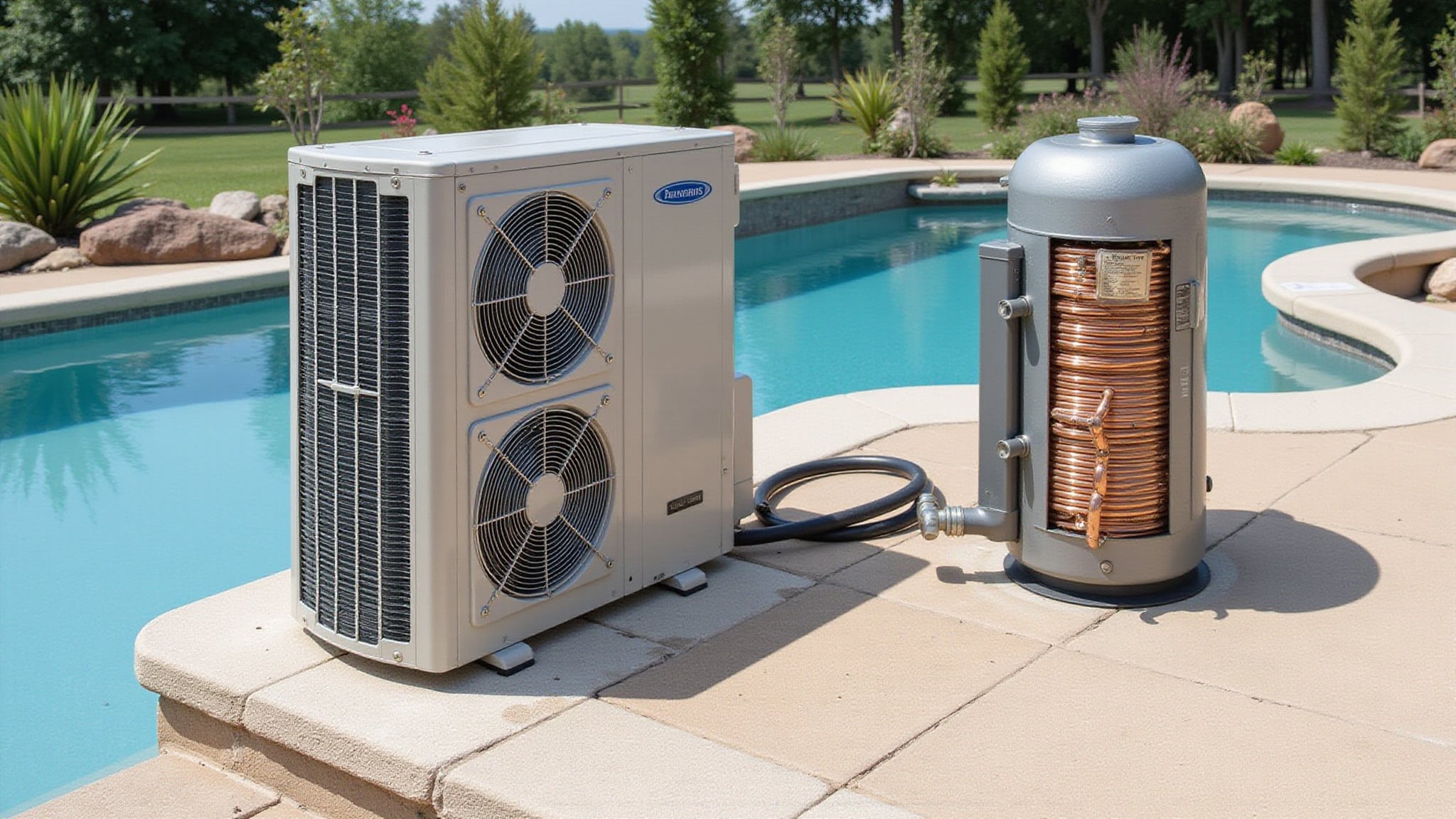
Inside a heat pump, you’re moving existing heat. A compressor pressurizes refrigerant that absorbs thermal energy from ambient air, even air that feels cool, then transfers it to your pool water through a heat exchanger. A gas heater works differently. You burn natural gas or propane in a combustion chamber, converting chemical energy into heat on demand through a copper coil. That single distinction drives everything, efficiency, speed, and cost differences worth understanding.
Key Takeaways
- Heat pumps move existing heat using a compressor and refrigerant cycle, while gas heaters produce heat through fuel combustion.
- Inside a heat pump, refrigerant absorbs thermal energy from ambient air, then a compressor pressurizes it to raise temperature.
- Gas heaters burn natural gas or propane in a combustion chamber, transferring heat via a copper coil heat exchanger.
- Heat pumps achieve COP values of 3.0, 7.0, whereas gas heaters operate below 1.0 (roughly 0.8, 0.95).
- Heat pumps depend on ambient temperatures above 50°F, while gas combustion delivers full output regardless of outdoor conditions.
How Each Pool Heater Actually Makes Heat
Each pool heater makes heat in one of two ways: heat pumps move existing heat, while gas heaters create it. A heat pump uses electricity to run a compressor and refrigerant cycle, extracting thermal energy from ambient air, even air that feels cool to you, and transferring it into your pool water. A gas pool heater burns natural gas or propane inside a combustion chamber, then passes that heat through a copper coil or heat exchanger as water flows past. When you compare a heat pump vs gas pool heater, you’re really comparing heat transfer against combustion. One relocates heat that already exists, the other generates heat directly through fuel combustion.
Refrigerant Cycle vs Combustion Chamber Explained
When you run a heat pump, its refrigerant compressor cycle captures thermal energy from ambient air and transfers it into your pool water, moving heat rather than generating it. A gas heater works differently, burning natural gas or propane inside a combustion chamber to produce heat directly, then passing it to the water through a copper heat exchanger. You’re comparing two fundamentally distinct heat transfer methods: one extracts existing thermal energy, while the other creates it through combustion.
Refrigerant Compressor Cycle
A refrigerant compressor cycle captures ambient thermal energy through a refrigerant and compressor rather than generating heat outright. When you run a heat pump pool system, the refrigerant absorbs thermal energy from outside air, even air that feels cool to you. The compressor then pressurizes this refrigerant, raising its temperature markedly. As the hot refrigerant flows through a heat exchanger, it transfers thermal energy into your pool water. The refrigerant expands, cools, and cycles back to repeat the process.
This mechanism explains why you’ll see a COP of 3.0, 7.0, delivering 300%, 700% efficiency. In any pool heater comparison, that’s the critical distinction: you’re moving existing heat, not creating it. The compressor’s electrical input drives the transfer, extracting far more thermal energy than the electricity consumed.
Combustion Chamber Basics
A combustion chamber is where a gas heater generates heat directly by burning natural gas or propane. You’re converting chemical energy into thermal energy through combustion, releasing hot gases that immediately transfer heat to your pool water. Unlike a heat pump that relocates existing thermal energy, this approach creates heat on demand. As water flows through a copper coil or heat exchanger, it absorbs this heat directly from the surrounding combustion byproducts. This direct-generation approach explains why gas heaters operate at 83%, 95% thermal efficiency. You’ll always get less than 1 BTU of output per BTU of fuel input, yielding a COP below 1.0. But you gain speed: a 400,000 BTU unit raises a 20,000-gallon pool 1°F every 30 minutes, delivering rapid, on-demand heat regardless of ambient air temperature.
Heat Transfer Methods
Heat pumps and gas heaters use fundamentally different thermodynamic pathways: one moves heat, the other makes it. When you run a heat pump, its refrigerant and compressor cycle extract thermal energy from ambient air, even air that feels cool, and transfer it into your pool water. You’re relocating existing heat, not generating it, which is why heat pumps hit COPs of 3.0, 7.0.
A gas heater works differently. You burn natural gas or propane inside a combustion chamber, generating heat directly. That heat passes through a copper coil or heat exchanger as water flows across it. Because you’re converting fuel to thermal energy, you’re bound by combustion efficiency, 89%, 95% at best. One process captures and moves; the other creates from chemical fuel.
Which Pool Heater Warms Your Water Faster?
Gas heaters warm your water faster, winning decisively when speed matters. When you fire up a 400,000 BTU gas unit, it raises a 20,000-gallon pool by 1°F every 30 minutes, roughly 2°F hourly, with high-output models pushing 5, 10°F per hour. Heat pumps can’t match this. They deliver just 1, 3°F hourly because they extract ambient thermal energy through a refrigerant-compressor cycle rather than generating heat directly through combustion.
You’ll get on-demand warmth from gas, hitting your target temperature in about an hour. Heat pumps require several hours, delivering BTUs slowly over extended periods. If you need rapid heating for weekend swims or spa temperatures, gas responds immediately. Heat pumps suit patient, daily maintenance heating where you’re not racing the clock. Your timeline dictates the winner here.
What COP Reveals About Heat Pump Efficiency
When you examine a heat pump’s coefficient of performance (COP), you’re measuring how many BTUs of heat it delivers per BTU of electrical energy consumed. Heat pumps achieve COP ratings of 3.0, 7.0, meaning 300%, 700% efficiency, while gas heaters operate at 0.8, 0.95 because combustion can’t exceed the energy contained in the fuel. That efficiency gap translates directly into cost savings per BTU, letting you extract $5, $6.50 worth of heat for every $1 of electricity at COP 5.0, 6.5.
Understanding COP Ratings
A COP rating measures how much heat energy a heat pump delivers relative to the electrical energy it consumes. When you see a COP of 5.0, the unit moves five BTUs of thermal energy for every BTU of electricity drawn, delivering 500% efficiency. Heat pumps achieve COP values between 3.0 and 7.0 because they don’t generate heat; they transfer it from ambient air using a refrigerant and compressor cycle. Gas heaters, by contrast, operate at COP 0.8, 0.95, converting less than one BTU of output per BTU of fuel input. That fundamental difference explains why heat pumps deliver $5, $6.50 worth of heat per $1 of electricity at COP 5.0, 6.5, operating at four to six times lower cost per BTU delivered.
Efficiency Versus Gas Heaters
Heat pumps outperform gas heaters because they move heat rather than create it, delivering multiples of the electricity you input. When you burn fuel, you’re capping efficiency at the fuel’s chemical energy. 89%, 95% converts to usable heat, meaning you always lose some BTUs to combustion inefficiency. Heat pumps extract ambient thermal energy and deliver far more heat than the energy they consume.
Compare the raw numbers:
- Gas heaters operate at COP 0.8, 0.95, outputting less than 1 BTU per BTU consumed.
- Heat pumps achieve COP 3.0, 7.0, delivering 300%, 700% efficiency.
- You get $5, $6.50 of heat per $1 of electricity at COP 5.0, 6.5.
- Cost per BTU runs 4, 6 times lower with heat pumps.
That’s thermodynamic leverage combustion physically can’t replicate.
Cost Savings Per BTU
Cost savings per BTU come down to COP, the multiplier that translates directly into cost-per-BTU savings, and once you run the arithmetic, the gap becomes undeniable. Your heat pump operating at a COP of 5.0 to 6.5 extracts $5 to $6.50 of delivered heat for every $1 of electricity consumed. Compare that against a gas heater’s COP of 0.8 to 0.95, where you lose energy, you get less than 1 BTU out per 1 BTU input. That’s a 4-to-6-times lower cost per BTU delivered. The thermodynamic reason is straightforward: your heat pump moves existing thermal energy rather than generating it through combustion. Gas heaters convert fuel directly, capped near 95% efficiency. Heat pumps leverage ambient air’s stored heat, so you multiply output well beyond your input.
Heat Pump vs Gas Heater Running Costs
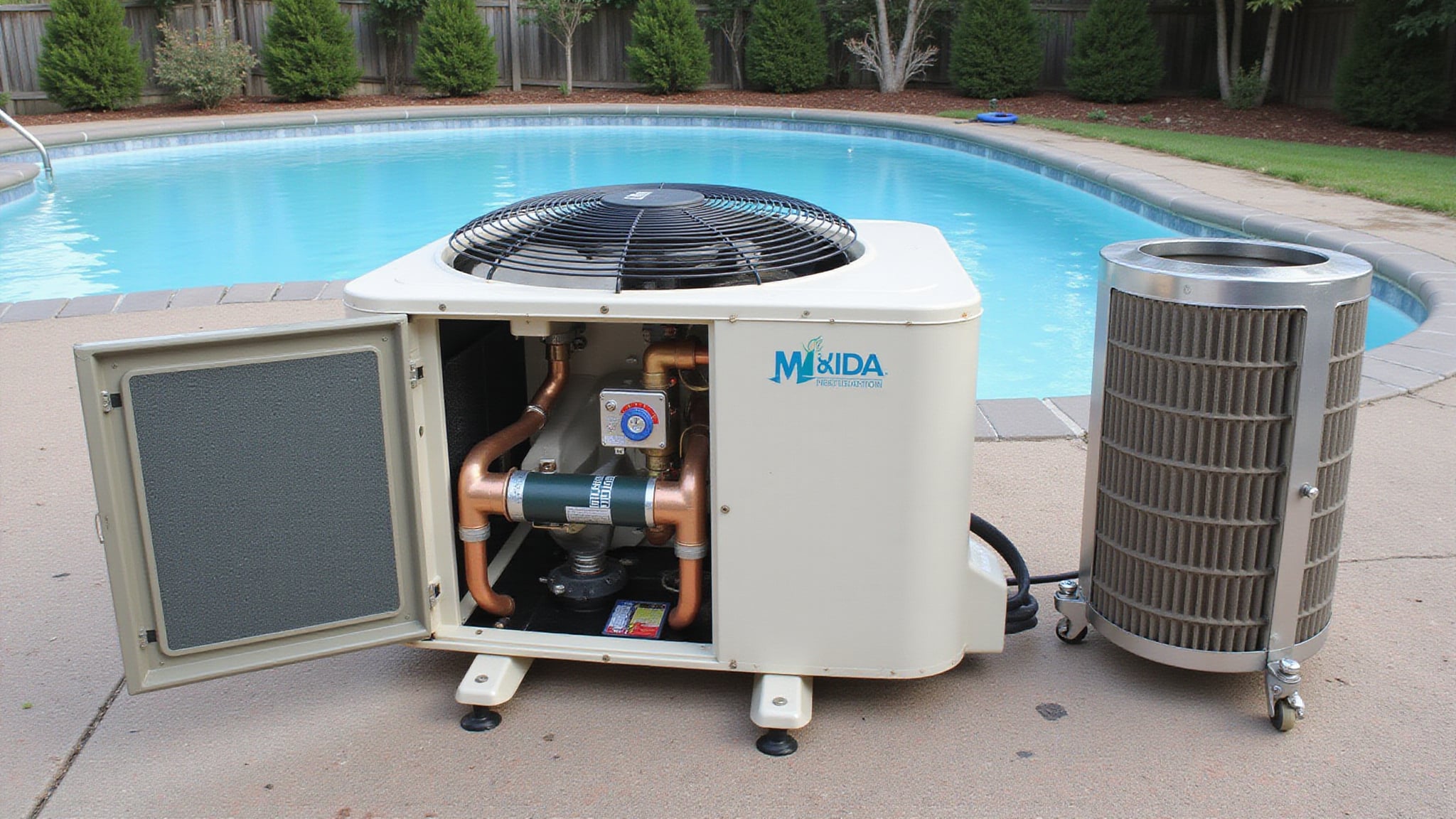
Heat pumps cost far less to run than gas heaters, delivering 300%, 700% efficiency by moving 3 to 7 BTUs of heat per BTU of electrical input, while gas heaters operate at a COP of just 0.8, 0.95. That thermodynamic gap translates directly into what you’ll pay to run each system:
Heat pumps move heat instead of making it, delivering up to 700% efficiency while gas barely breaks even.
- Hourly cost: $0.63 for heat pumps versus $3, $9 for gas heaters.
- Monthly cost: $50, $100 for heat pumps against $300, $500 for gas units.
- Annual cost: $500, $1,200 for heat pumps compared to $1,500, $3,000+ for gas.
- Heat-up event: gas adds $12, $24 to raise 20,000 gallons from 70°F to 82°F.
Since heat pumps harvest ambient thermal energy instead of combusting fuel, you’re paying only to move heat, not generate it.
Upfront Price and Long-Term Heater Value
Heat pumps carry a steeper entry price of $2,000, $7,000 against $1,500, $6,000 for gas units, but that initial gap tells only part of the story. You’re weighing capital cost against thermodynamic efficiency over the equipment’s service life. A heat pump’s COP of 3.0, 7.0 delivers 300%, 700% efficiency, moving ambient thermal energy rather than combusting fuel, so you recover the premium through drastically lower operating costs, $500, $1,200 annually versus $1,500, $3,000+ for gas.
Lifespan compounds this advantage. Heat pumps last 10, 15 years; gas units survive just 5, 10. You’re replacing gas equipment roughly twice as often while paying more each month to run it. Factor in reduced maintenance, and the heat pump’s higher sticker price steadily converts into superior long-term value across years of consistent daily operation.
How Cold Weather Favors Gas Heaters
Cold weather favors gas heaters because combustion generates heat directly, independent of ambient conditions. When ambient temperatures drop below 50°F, a heat pump’s efficiency collapses because there’s less thermal energy in the air for the refrigerant to extract. You’ll notice the compressor cycle struggling to capture usable heat, dragging the COP downward. Gas heaters, however, don’t rely on ambient conditions, delivering identical performance across a wide range:
- 30°F to 100°F: Gas units maintain full output regardless of outside air.
- Cold mornings: You get reliable, on-demand heat when heat pumps stall.
- 5, 10°F per hour: Rapid temperature rise beats a heat pump’s 1, 3°F.
- Spa temperatures: Gas supports year-round high-heat capability.
If you’re heating in cold climates, gas combustion sidesteps the thermodynamic ceiling that limits refrigerant-based extraction entirely.
Heat Pump vs Gas Heater Lifespan and Upkeep
Heat pumps last 10, 15 years while gas heaters give you just 5, 10. This gap traces directly to operating mechanics. Your heat pump moves thermal energy through a sealed refrigerant-compressor cycle, avoiding the corrosive combustion byproducts that degrade gas units. Gas heaters expose copper heat exchangers to direct flame and acidic condensate, accelerating wear.
Upkeep follows the same logic. Heat pumps demand lower maintenance costs that gradually offset their higher upfront investment, especially under daily use across long operating seasons. Gas heaters suit occasional, quick-heating applications, but frequent combustion cycling shortens component life.
If you’re running your pool consistently, you’ll extract more value from a heat pump’s durability. Reserve gas systems for intermittent, on-demand heating scenarios where longevity matters less.
Which Pool Heater Fits Your Swimming Habits?
Your swimming frequency determines which pool heater fits your thermal demands. Your usage frequency determines whether rapid BTU delivery or sustained low-cost operation optimizes your setup. Match your swimming pattern to the appropriate heat-transfer mechanism:
- Daily swimmers: Choose a heat pump. Its COP of 3.0, 7.0 delivers 1, 3°F/hour continuously at $50, $100 monthly, ideal for maintaining stable temperatures long-term.
- Weekend swimmers: Select a gas heater. Its 5, 10°F/hour rise heats on demand within an hour, despite $300, $500 monthly costs.
- Cold-climate users: Pick gas. It performs identically from 30°F to 100°F, unaffected by ambient thermal extremes.
- Mild-climate users: Deploy a heat pump. It extracts ambient heat efficiently above 50°F, extending your season 2, 3 months.
Align equipment with frequency, climate, and thermal expectations.
Conclusion: Choosing Between a Heat Pump and a Gas Heater
Heat pumps and gas heaters warm a pool in very different ways. A heat pump moves heat from the air and is highly efficient to run, but it works slowly and needs mild temperatures, while a gas heater warms water fast in any weather but costs more to operate. The right choice depends on your climate, how quickly you want heat, and your budget for running costs. Many owners pick a heat pump for steady, economical heating and gas when speed matters most. Natural ways to warm pool water can be more sustainable options that some owners explore. Utilizing solar blankets, for instance, can capture and retain heat from the sun, making it an eco-friendly choice.
Call Today and Build a Pool Made for Easy Care
Every well-built fiberglass pool starts with proper construction, right from the first shovel of dirt to the final finish. At Schiller Pools in Stuart, FL, our skilled team delivers dependable Pool Construction built around lasting quality and low-maintenance living. Call +1 (561) 475-5997 today and start planning your dream pool.
Frequently Asked Questions
Can I Use a Heat Pump and Gas Heater Together?
Yes, and some owners do. A heat pump can handle efficient everyday heating, with a gas heater on hand to warm the pool quickly or in cold weather when the heat pump slows down. Pairing them gives you both efficiency and speed. An installer can set them up to work together through your equipment or automation.
What Size Pool Heater Do I Need for My Pool?
Sizing depends on your pool’s surface area and volume, how fast you want to heat it, and your climate and wind exposure. An undersized heater struggles to keep up, while an oversized one costs more than needed. A pool professional can calculate the right capacity for your pool so you get efficient, effective heating.
Are Pool Heaters Safe to Install Indoors?
Gas heaters need proper venting and combustion air, so indoor installation has strict requirements and is not always allowed. Heat pumps are electric and need good airflow, which also complicates indoor use. Because of the safety and code issues, any indoor heater installation should be evaluated and done by a qualified professional.
Do Pool Covers Affect Heater Performance and Efficiency?
Yes, and in a good way. A cover dramatically reduces heat loss and evaporation, so the heater runs less and holds temperature more easily. Using a cover is one of the most effective ways to cut heating costs with either a heat pump or a gas heater. It is a simple add-on that pays for itself.
Can I Install a Pool Heater Myself or Need Professionals?
Heater installation involves gas lines or electrical, venting, and plumbing connections, all of which carry safety and code requirements. For that reason, professional installation is strongly recommended and sometimes required to keep the warranty valid. A pro ensures the heater is sized, connected, and vented correctly and operates safely.