Converting your inground pool to saltwater requires hardwired electrical connections and generators rated for 40,000-60,000 gallons, while above-ground systems use plug-in power supplies and max out at 20,000 gallons. You’ll need to verify material compatibility first, steel and aluminum above-ground pools corrode at typical 3,000 ppm salt concentrations, though resin models handle saltwater fine. Above-ground pools actually see more dramatic maintenance improvements due to their smaller volumes. Guaranteeing proper sizing and installation methods confirms your conversion succeeds long-term.
Inground vs Above-Ground: Key Saltwater Conversion Differences
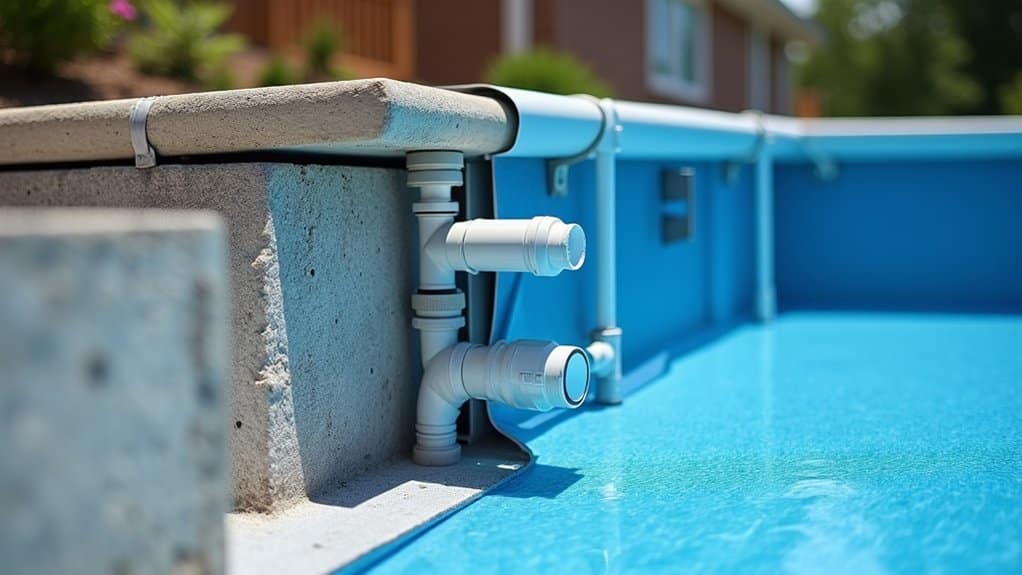
Converting your pool to saltwater requires understanding the fundamental differences between inground and above-ground systems. When comparing inground vs above-ground pools, you’ll find distinct variations in sizing, installation, and equipment requirements. one important aspect to consider in your decision-making process includes the benefits of converting to saltwater, which can significantly reduce chemical usage and maintenance costs over time. Additionally, saltwater systems often provide a more comfortable swimming experience due to the softer water, which is gentler on the skin and eyes. As you evaluate your options, these advantages can make a compelling case for choosing a saltwater setup for your pool.
Material compatibility determines whether conversion is feasible. Steel and aluminum above-ground pools corrode at 3,000 ppm salt concentration, making them incompatible. Resin above-ground models and most inground pools handle saltwater without damage. Even resin pools may contain some steel components, so installing a sacrificial anode helps redirect corrosion away from vulnerable metal parts.
Your electrical connection approach differs considerably between types. Above-ground systems use convenient plug-in power supplies, while inground pools require permanent hardwired connections installed by a licensed electrician. For inground installations, hiring a professional ensures proper generator selection and correct integration with your existing filtration system.
System sizing also varies. Above-ground chlorinators handle 10,000 to 20,000 gallons, whereas inground units manage larger volumes. You should oversize either system to extend cell life and maintain consistent chlorine output. Keep in mind that replacement cells cost $200-$700 and typically need replacing every 3 to 7 years, making proper sizing an important long-term investment.
Which Pool Type Benefits More From Saltwater?
When evaluating which pool type gains the most from saltwater conversion, above-ground pools consistently demonstrate greater overall benefits. You’ll notice maintenance improvements more dramatically in smaller volumes, where automated chlorine generation eliminates daily chemical handling. Your above ground pool salt water conversion delivers proportionally higher cost savings since simpler filtration systems already reduce operational expenses.
Saltwater pool compatibility works effectively for both configurations, but above-ground setups maximize practical advantages. You’re dealing with shorter lifespans (7-15 years), making reduced chemical wear particularly valuable. The gentler water quality proves more noticeable in shallower depths, enhancing comfort during frequent use. Above-ground pools constructed with durable resin or steel materials paired with vinyl liners adapt well to saltwater systems when properly maintained.
When comparing inground vs above ground pools, larger inground systems require more salt and complex maintenance regardless of conversion. Budget-conscious owners benefit most from above-ground saltwater systems, achieving superior value through combined upfront affordability and long-term savings. With above-ground pools starting as low as $2,000, the saltwater conversion investment represents a larger percentage of total cost but delivers meaningful returns. While inground pools offer the advantage of adding luxurious features like waterfalls and custom lighting, these benefits become less relevant when focusing purely on saltwater conversion value.
Equipment Requirements for Each Pool Type
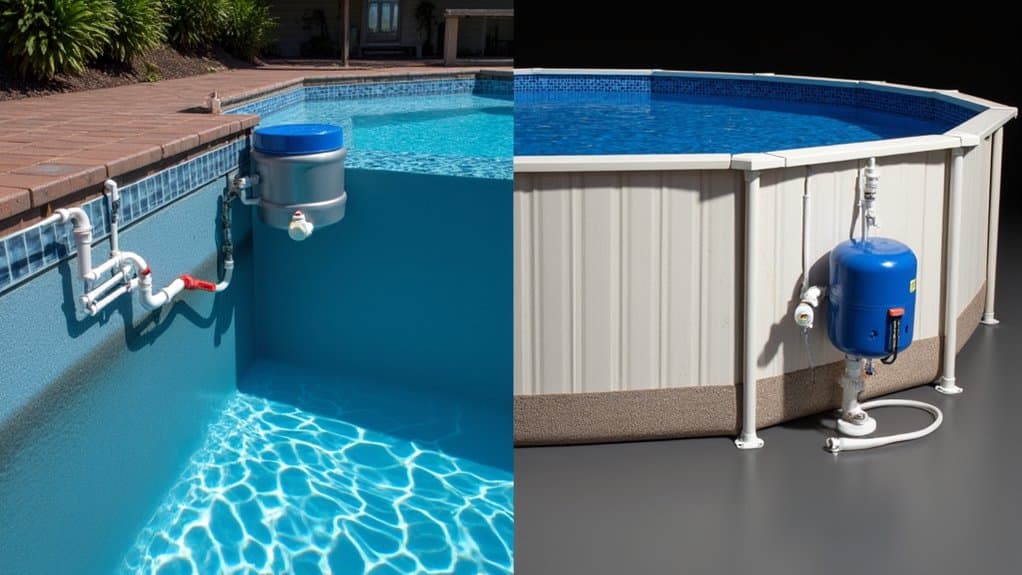
When sizing a saltwater chlorine generator for your inground pool, you’ll need a unit rated for at least your pool’s full gallon capacity, and oversizing by 25-50% extends cell life and handles peak bather loads. Above-ground pools require compatible components designed for smaller volumes and lower flow rates, typically with plug-in control boxes that eliminate complex electrical work. Both pool types demand matching your chlorinator’s cell size to existing plumbing diameter and ensuring installation occurs inline after the filter on the return side. Regardless of pool type, the system converts salt into chlorine through electrolysis to maintain consistent sanitation levels. For inground installations, Pentair, Hayward, and Zodiac are manufacturers with proven track records for semi-commercial grade generators that handle larger pool volumes reliably.
Inground Generator Sizing Needs
Inground salt chlorine generators carry capacity ratings measured in maximum gallons, with most residential models falling between 40,000 and 60,000 gallons. When you convert inground pool to saltwater, you’ll need to calculate your exact volume using the formula: Length × Width × Average Depth × 7.5 for rectangular pools. For oval pools, use the formula: Longest Diameter × Shortest Diameter × Average Depth × 6.7 multiplier to determine accurate volume.
Size your generator at least one-third larger than your actual pool volume. A 25,000-gallon pool requires a 40,000-gallon rated system, not a matched-capacity unit. This oversizing prevents continuous full-capacity operation, which accelerates cell degradation and shortens the standard three-to-five-year lifespan. Industry experts actually recommend choosing a salt chlorine generator rated for 1.5 to 2 times the actual pool volume for optimal performance and longevity.
Your pool liner saltwater compatibility matters during equipment selection. Operating at reduced capacity lets you throttle chlorine production based on seasonal demand. Hot summer months and heavy bather loads increase chlorine requirements, making undersized systems incapable of maintaining proper sanitation levels.
Above-Ground Compatible Components
Above-ground pools require the same core saltwater components as inground systems, but you’ll select equipment scaled for smaller volumes and different plumbing configurations.
You’ll need a chlorine generator with a cell sized for your pool’s gallon capacity, typically lower-output units rated for 15,000-25,000 gallons. Verify your existing pump handles saltwater; replace it if the manufacturer doesn’t rate it for salt exposure. Replacing the pump may be necessary if your current model isn’t compatible with the saltwater system. You’ll need a chlorine generator with a cell sized for your pool’s gallon capacity, typically lower-output units rated for 15,000, 25,000 gallons, and this equipment selection directly influences the overall saltwater pool conversion cost. Verify your existing pump can handle saltwater, replacing it if the manufacturer doesn’t rate it for salt exposure, as upgrading incompatible components may be necessary to ensure long-term system performance.
Essential components for your conversion include:
- Saltwater chlorine generator matched to pool volume
- PVC couplers and adapters fitting your plumbing size
- High-purity pool-grade salt (calculate 8.375 x salinity increase ÷ 100 per 10,000 gallons)
- Saltwater-specific test kit for salinity monitoring
- pH and alkalinity adjustment chemicals
Install the cell after your filter, connect it to the controller, and maintain salinity between 3,000-3,500 ppm. After adding salt to the pool, allow up to 24 hours for it to fully dissolve before activating your chlorine generator. Install the cell after your filter, connect it to the controller, and maintain salinity between 3,000, 3,500 ppm, as these steps are essential when converting chlorine pool to salt system setups efficiently. After adding salt to the pool, allow up to 24 hours for it to fully dissolve before activating your chlorine generator.
Generator Sizing for Inground and Above-Ground Pools
Salt chlorine generators come in distinctly different size ratings depending on whether they’re designed for above-ground or inground pools. Above-ground units max out at approximately 20,000 gallons, while inground generators handle 40,000 to 60,000 gallons.
Above-ground salt chlorine generators max out at 20,000 gallons, while inground units handle pools up to 60,000 gallons.
Calculate your pool’s volume using the appropriate formula. For rectangular pools, multiply length × width × average depth × 7.5. Round pools use diameter × diameter × average depth × 5.9.
You’ll want to oversize your generator beyond your pool’s actual volume. If you have a 24,000-gallon pool, select a 40,000-gallon rated unit rather than a 25,000-gallon model. This approach lets the salt cell operate below maximum capacity, extending its lifespan beyond the typical three to five years. The generator uses electrolysis to produce free chlorine, so running it at lower capacity reduces wear on the cell plates.
Your geographic location also impacts sizing, warmer climates require larger generators since higher temperatures accelerate chlorine breakdown.
Saltwater System Installation by Pool Type
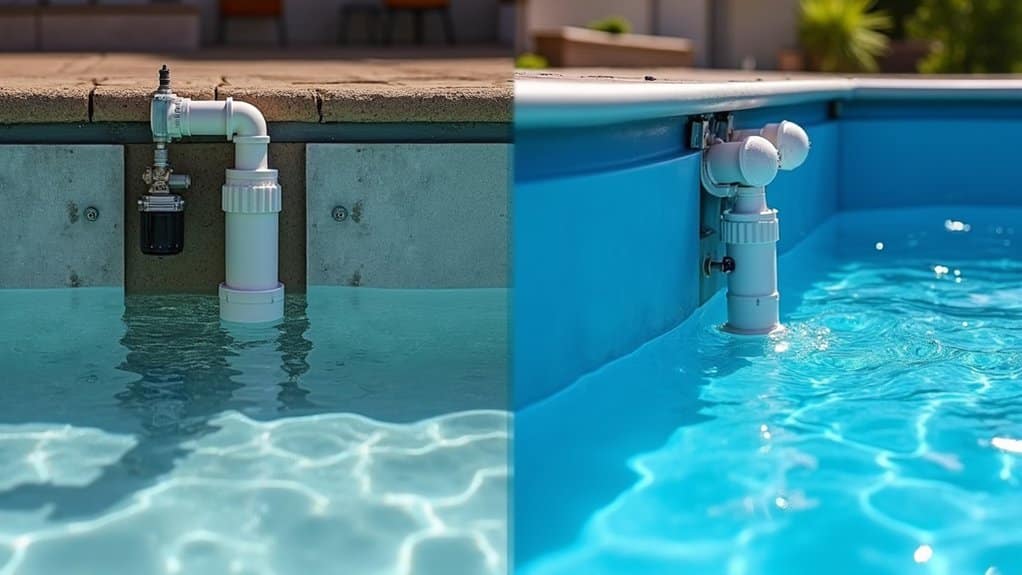
When you’re ready to install your saltwater system, the pool type dictates both the electrical requirements and physical mounting approach. Above-ground systems typically plug into standard 120-volt outlets, while inground setups require hardwired connections by a licensed electrician.
Physical installation differs substantially between pool types:
- Above-ground systems connect directly to return ports, eliminating separate flow switches
- Inground chlorinators integrate into main plumbing lines for permanent operation
- Vertical mounting below return jets allows proper gas dissipation in above-ground pools
- Return port diagnostics with indicator lights simplify above-ground troubleshooting
- Hardwiring guarantees stable, uninterrupted power for larger inground volumes
You’ll find above-ground conversions prioritize simplicity and DIY-friendly setup. When selecting an above-ground pool for saltwater conversion, choose models specifically designed and warrantied for saltwater use, as saltwater can be highly corrosive to standard above-ground pools. Inground installations involve complex site preparation, contributing to overall costs ranging from $25,000 to $38,500 for complete systems.
How to Add Salt for Proper Chlorine Levels
To achieve proper chlorine production, you’ll need to calculate the exact amount of salt based on your pool’s water volume and current salinity reading. Once you’ve determined the correct quantity, spread the salt evenly across the pool’s surface while the pump runs to prevent concentration in one area. After allowing 24 hours for full circulation, test your salinity levels to confirm they fall within your generator’s ideal operating range.
Calculate Salt Amount Needed
Achieving the ideal salinity level of 3200 ppm requires precise calculations based on your pool’s volume and current salt concentration. You’ll need to measure your existing salt levels first, then apply the appropriate formula for accurate results.
Use this calculation: Salt (lbs) = ((3200 – current ppm) x pool gallons x 8.34) / 1,000,000.
Here’s what you can expect for common pool sizes starting at 0 ppm:
- 8,000-gallon pool: 213 lbs of salt
- 10,800-gallon pool: 290 lbs of salt
- 12,000-gallon pool: 320 lbs of salt
- 15,000-gallon pool: 400 lbs of salt
- 20,000-gallon pool: 534 lbs of salt
If your pool already contains salt, subtract your current reading from 3200 ppm before calculating. Always retest after adding salt to confirm you’ve hit your target.
Spread Salt Evenly
Proper salt distribution across your pool’s surface prevents concentrated deposits that can damage plaster, vinyl liners, and equipment components. You’ll want to broadcast salt around the deep end perimeter, allowing gravity and circulation to aid dissolution. Run your pump continuously during addition, this prevents salt from settling in piles on the pool bottom.
| Technique | Method | Benefit |
|---|---|---|
| Perimeter Pour | Walk pool edge, adding small amounts | Even coverage |
| Bag Slice | Line bags at deep end, cut undersides | Controlled release |
| Immediate Brushing | Sweep settled salt toward drain | Surface protection |
Brush any accumulated salt immediately to prevent etching or scaling. Never pour directly into your skimmer, concentrated brine can cause chlorinator cell malfunction and equipment damage. Allow up to 24 hours for complete dissolution with continuous pump operation.
Test After Circulation
Once your salt has fully dissolved over 24 to 48 hours of continuous circulation, you’ll need accurate test results before powering on your chlorinator.
Collect your water sample elbow-deep, away from skimmers and return jets, using a clean container rinsed with pool water. Test immediately to prevent sample degradation.
Your critical parameters include:
- Salt levels between 2500, 4000 ppm per manufacturer specifications
- Cyanuric acid maintained at 60, 80 ppm for chlorine protection
- pH and total alkalinity within balanced ranges
- Calcium hardness appropriate for your pool surface
- Free available chlorine baseline before generator startup
Use salt test strips, digital meters, or conductivity sensors for accurate salinity readings. If salt measures low, add more and recirculate. If it’s too high, dilute with fresh water to prevent electrolytic cell damage.
Saltwater Conversion Costs: Inground vs Above-Ground
The cost of converting a pool to saltwater varies considerably between inground and above-ground installations. You’ll spend $500 to $1,500 for above-ground conversions, while inground pools require $1,000 to $2,500. Labor costs reflect this difference, above-ground installations run $600 to $1,200 total, compared to $1,200 to $2,500 for inground setups.
Pool size directly impacts your budget. A 10,000-gallon pool costs $700 to $1,230, whereas 30,000-gallon pools reach $1,430 to $2,950. Your salt chlorine generator represents the largest expense at $500 to $2,000, with pool salt adding $100 to $750.
Above-ground conversions cost less due to simpler plumbing access and smaller water volumes requiring lower-output generators. Inground pools demand more powerful systems and involve complex underground plumbing work, increasing both equipment and labor expenses.
Maintenance Schedules for Each Saltwater Pool Type
Beyond the initial conversion costs, your ongoing maintenance requirements determine the true long-term value of a saltwater system.
Both inground and above-ground saltwater pools follow similar maintenance schedules, though above-ground systems demand closer attention due to their smaller volume and faster chemical fluctuations.
Daily essentials for both pool types:
- Skim surfaces and clear debris before it reaches your skimmer
- Empty pump and skimmer baskets to maintain flow
- Hose down equipment to prevent corrosion buildup
- Check water levels affecting salt concentration
- Monitor chlorinator operation indicators
Weekly, you’ll test pH (7.2-7.6) and free chlorine (1-3 ppm), then vacuum and brush all surfaces. Monthly tasks include testing salinity (2700-4500 ppm), alkalinity, and calcium hardness.
Inspect your salt cell quarterly for calcium scale. Clean with diluted muriatic acid when needed, extending cell life to 5-7 years.
Ready to Transform Your Backyard?
Your dream pool is closer than you think. At Schiller Pools, our experienced team brings over 40 years of expertise to every project, delivering stunning fiberglass pool installations and custom pool construction that turn ordinary backyards into extraordinary outdoor retreats. With flexible financing options and lifetime warranty backing, there has never been a better time to get started. Call (561) 475-5997 today for your free estimate.
Frequently Asked Questions
Can I Convert My Saltwater Pool Back to Traditional Chlorine if Needed?
Yes, you can convert your saltwater pool back to traditional chlorine. You’ll need to drain approximately 50% of your water to reduce cyanuric acid levels from 80-90 ppm down to 40 ppm. Then, replace your salt cell with an in-line or off-line chlorinator, flow-through cells like Intellichlor accommodate direct replacement. You won’t need separate CYA supplementation afterward since chlorine tablets contain built-in stabilizers. Continue your regular pH, alkalinity, and hardness testing.
Will Saltwater Damage My Pool’s Landscaping or Surrounding Deck Materials?
Yes, saltwater can damage your landscaping and deck materials over time. Salt accumulates in soil, blocking water and nutrient absorption, causing plants to wilt, yellow, or die. Your grass may develop brown patches and stunted growth. Deck materials also corrode from repeated exposure.
You’ll want to install proper drainage systems, use salt-tolerant plants, and rinse vegetation with fresh water after splashes. Consider protective barriers between your pool and surrounding landscape.
How Does Saltwater Affect Swimmers With Sensitive Skin or Allergies?
Saltwater typically benefits your sensitive skin better than traditional chlorine pools. You’ll experience gentler, softer-feeling water that acts as a natural exfoliator and helps lock in moisture, ideal if you’re managing eczema, psoriasis, or allergies. You’ll also avoid the harsh chlorine-ammonia vapors that trigger asthma and respiratory issues. However, you should limit swims to 30-60 minutes, rinse immediately afterward, and apply moisturizer to prevent salt residue from drying your skin.
Do Saltwater Pools Freeze Differently Than Traditional Chlorine Pools in Winter?
Saltwater pools don’t freeze considerably differently than traditional chlorine pools. Your saltwater pool’s 3,000, 3,500 ppm salinity only lowers the freezing point by about 0.4°F, from 32°F to roughly 31.6°F. This provides virtually no meaningful freeze protection. You’ll still need identical winterization measures: protecting pipes, equipment, and plumbing from ice damage. The key difference involves removing and storing your salt cell to prevent cold-weather damage during winter months.
Can I Use My Existing Pool Cover With a Saltwater System?
Yes, you can use your existing pool cover with a saltwater system, but you’ll need to implement specific maintenance practices. Salt residue from evaporating water corrodes metal tracks, hardware, and pulleys on automatic covers. Drain standing water off your cover before retracting it, rinse components periodically to remove salt deposits, and keep chlorine output low when the cover’s closed. Consider upgrading to brass anchors for any attached equipment to prevent corrosion damage.