
Pool flocking, or flocculation, is a chemical treatment you’ll use when standard filtration can’t clear severe cloudiness. You’re adding aluminum sulfate-based compounds that carry positive electrical charges, which attract negatively charged suspended particles like dead algae, pollen, and dust. This coagulation process transforms invisible debris into visible aggregates that sink to your pool floor within 8-24 hours. You’ll then vacuum the sediment to waste, and verifying each step guarantees you’ll achieve crystal-clear results.
Pool flocking, or flocculation, is a chemical treatment you’ll use when standard filtration can’t clear severe cloudiness. To understand how does flocculant work in a pool, it helps to know that you’re adding aluminum sulfate-based compounds that carry positive electrical charges, which attract negatively charged suspended particles like dead algae, pollen, and dust. This coagulation process transforms invisible debris into visible aggregates that sink to your pool floor within 8, 24 hours. You’ll then vacuum the sediment to waste, and verifying each step guarantees you’ll achieve crystal-clear results.
How Pool Flocculant Clears Cloudy Water
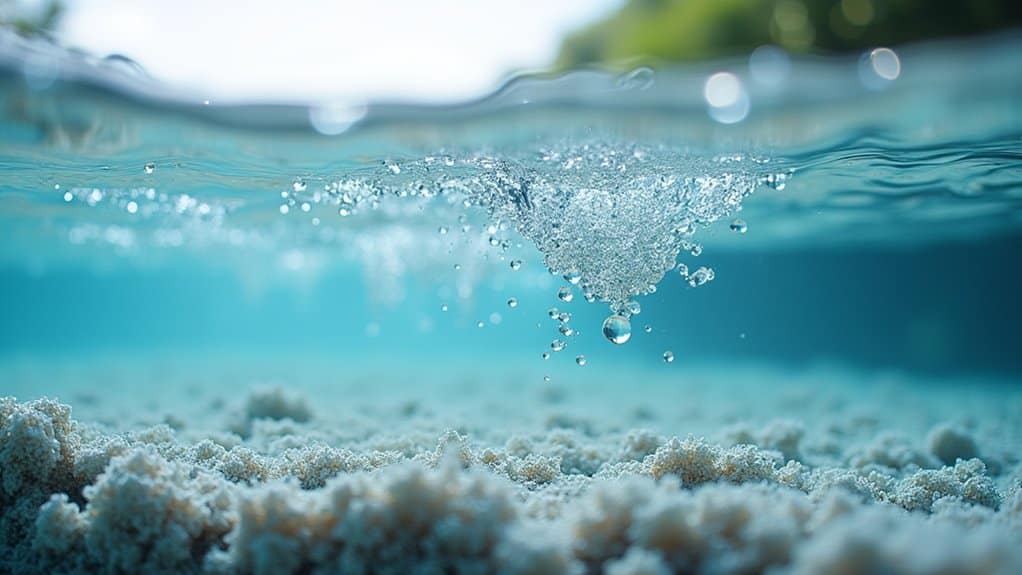
When your pool water turns cloudy, flocculant works through a straightforward chemical process. The aluminum sulfate in pool flock carries positive electrical charges that attract negatively charged suspended particles. These microscopic contaminants, dead algae, pollen, dust, sunscreen residue, and body oils, are too fine for standard filtration systems to capture.
Understanding what is flocking a pool means recognizing how coagulation transforms invisible debris into visible aggregates. When you’re flocking pool water, the chemical bonding pulls individual specks together into heavier clumps. Within 8 to 24 hours, these aggregates sink to the floor as sediment. This treatment is ideal for severe cloudiness that standard clarifiers simply cannot resolve.
Floccing a pool delivers results considerably faster than clarifiers, often overnight versus several days. The settled debris then requires manual vacuuming on waste mode for complete removal. For sand or DE filters, you’ll need to set the multiport valve to the waste position before beginning the vacuuming process. Before allowing anyone back in the water, test the chemistry to confirm all levels have returned to safe swimming range.
Prepare Your Pool Before Adding Flocculant
Proper preparation guarantees flocculant performs at peak efficiency and prevents costly treatment failures. Start by testing your water chemistry, pH must fall between 7.2 and 7.6, with chlorine levels within normal range. Check total alkalinity and calcium hardness as part of your pre-treatment assessment.
Next, evaluate current water condition. Drop a dark object into the shallow end to gauge visibility at four feet. This determines your dosing concentration, heavily cloudy pools require higher initial doses than slightly hazy water. As a general guideline, use 1 L of flocculant per 100,000 L of pool water and adjust based on cloudiness severity. Keep in mind that organic debris like algae responds differently than inorganic particles such as dirt or sand.
Verify your pool’s water level before proceeding. Vacuuming to waste removes substantial water, so keep a garden hose ready for refilling. Set your filter system to “Waste” or “Bypass” mode and turn off the pump. For saltwater pools, disable your salt chlorine generator to maintain chemical balance. After adding the flocculant, let the water sit for 8, 12 hours to allow debris to sink completely to the bottom.
Spread Flocculant Evenly Across the Surface
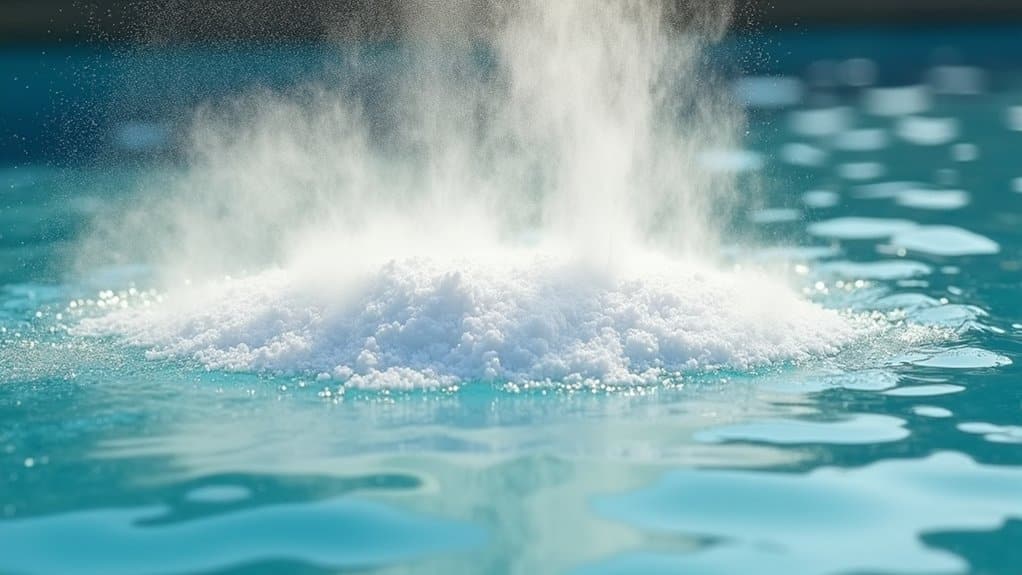
Before pouring flocculant directly into your pool, you’ll need to dilute it in a five-gallon bucket following the manufacturer’s specifications for your pool volume. Whether you’re using liquid or granular formulations, adhere to package-specific dilution ratios for optimal results.
Set your filter system to recirculate mode before application. Pour the diluted flocculant around the pool’s perimeter, distributing it evenly across the entire surface area. You’ll achieve broader coverage by dividing your total dosage into multiple batches, typically three applications of 4-5 oz each for a standard 16 oz treatment.
Apply the flocculant during evening hours after balancing your pH to the 7.0-7.6 range. This timing allows for a two-hour circulation period followed by overnight settling. Even distribution prevents over-flocculation and guarantees effective particle clumping throughout the water column. The flocculant causes microscopic debris like bacteria, algae spores, and other tiny particles to bind together and become heavy enough to sink to the bottom for removal. Keep in mind that flocculant works best with sand or DE filters, as cartridge filters can become severely clogged by the large clumped particles. Be careful not to add excessive amounts, as using too much flocculant can actually make your pool water cloudier instead of clearer.
Circulate the Flocculant for Two Hours
Set your pump to recirculate mode to bypass the filter and prevent floc particles from clogging the media. Run the system for a minimum of two hours to guarantee the flocculant disperses evenly throughout the water column. This circulation phase allows the chemical to contact suspended debris before you shut down the pump for the settling period. This step is essential because, unlike gradual clarifier action, flocculant requires thorough distribution to work effectively on all suspended particles. During this time, the flocculant works to aggregate tiny particles into heavier masses that will eventually sink to the pool floor. For best results, let the product sit overnight before proceeding to the vacuuming stage.
Use Recirculate Mode
Once you’ve added flocculant to your pool, you’ll need to switch your pump to recirculate mode, not filter mode, to prevent the chemical from getting trapped prematurely. Recirculate mode bypasses your filter media entirely, allowing the flocculant to circulate freely throughout the pool volume without removal. This setting’s only compatible with sand or DE filters equipped with multiport valves.
Run your pump continuously for two hours in recirculate mode. This duration guarantees even distribution of the flocculant, allowing its positive charge to bind with negatively charged debris particles. Disable any automatic timers to maintain uninterrupted operation. Shorter circulation periods risk incomplete mixing and compromised flocculation efficiency. For best results, begin the flocking process in the evening since overnight settling allows the particles adequate time to sink completely.
After the two-hour cycle, shut off your pump completely. The settled particles will then begin coagulating on the pool floor during the eight-hour settling phase.
Ensure Even Distribution
Kick off the two-hour circulation cycle immediately after adding flocculant to guarantee the chemical compound disperses uniformly throughout your pool’s water volume. This duration enables proper coagulation as the flocculant binds microscopic debris particles into larger aggregates. Running your pump for less time prevents even distribution, resulting in patchy treatment zones and suspended cloudiness. To enhance water clarity, consider using a quality pool flocculant that is compatible with your filtration system. This will aid in the efficient removal of debris and impurities, ensuring a crystal-clear swimming environment. Regularly monitoring and adjusting the chemical balance in conjunction with using flocculant can significantly improve your pool’s overall hygiene and appearance.
During circulation, the flocculant reaches all areas of your pool, promoting uniform coverage without localized buildup. This phase prepares particles for effective sedimentation once you shut down the system. After completing the two-hour cycle, turn off your pump immediately, over-circulation risks breaking down the clumps you’ve worked to form. Evening application works best, allowing the full circulation period followed by overnight stillness for ideal settling before manual vacuuming.
Let the Flocculant Settle Overnight
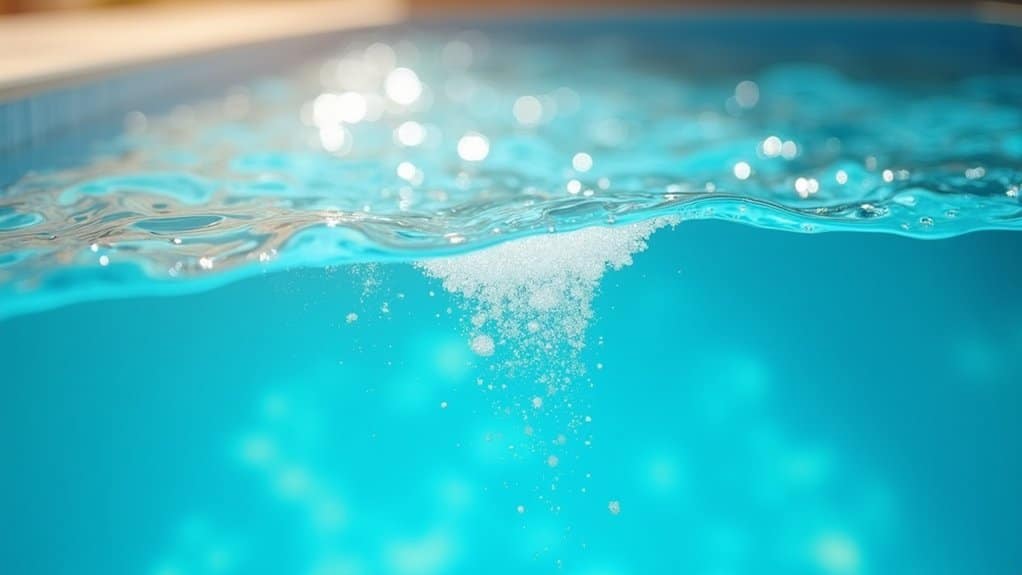
After you’ve circulated the flocculant for approximately 2 hours on the recirculate setting, it’s time to shut down the pump completely and let the coagulation process work. The water must remain undisturbed for a minimum of 8 hours to allow gravity to pull the chemically-bonded debris clusters to the pool floor.
During this settlement phase, you’ll notice sediment accumulating in ring-shaped formations at the bottom. Visible “pool cobwebs” and cloudy deposits indicate proper particle coagulation. Apply the flocculant at dusk to maximize overnight settling opportunities.
Don’t swim or operate any equipment during this critical window, movement disperses particles back into suspension. If standard settling proves insufficient, extend the period to 12-48 hours. You’ll know settlement is complete when there’s clear distinction between debris and water.
Vacuum Settled Debris on Waste Mode
The settlement phase typically concludes with a distinct layer of flocculated debris resting on your pool floor, now you’ll need to remove it using your multiport valve’s Waste setting.
Connect your backwash hose to the waste port and position it downhill for proper drainage. Fill the vacuum hose using your return jet to purge air, then shut off the pump before switching the multiport valve to Waste. Guarantee your heater’s off during this process.
Move the vacuum head slowly across the bottom to avoid disturbing settled particles. Starting at the shallow end, work in overlapping lines to ensure complete coverage of the pool floor. If the head sticks, briefly stop the pump. Monitor for suction loss or pressure spikes exceeding 10 PSI. Check that your skimmer basket and pump’s hair and lint trap are clear, since debris-filled baskets can cause suction loss during the vacuuming process.
After removing visible debris, turn off the pump, return the valve to Filter, and restart. Top off water lost during the process.
Repeat the Flocculant Process If Needed
You may need to repeat the flocculation process if your pool water remains cloudy or turbidity levels exceed 1 NTU after the initial treatment. When under-flocculation occurs, fine suspended particles won’t aggregate properly, leaving your water hazy despite completing the vacuum-to-waste cycle. Multiple treatment cycles can achieve full clarification, but you’ll need to reassess your dosage calculations and settling times before reapplication.
When Results Seem Incomplete
Sometimes a single flocculant application won’t deliver crystal-clear water, and you’ll need to repeat the process. Before re-dosing, identify the underlying cause of incomplete results. Living algae resists flocculant, shock your pool first to kill algae before flocculating dead cells. Verify your pH falls within the ideal 5.5-7.5 range, as values outside this window reduce floc formation effectiveness.
If flocculant remains visible, scoop excess from the surface with a dip net and vacuum settled material to waste before restarting circulation. Conduct small-scale jar tests to determine perfect dosage matching your specific water quality. Excess flocculant causes re-clouding, while insufficient amounts weaken particle bridging. Stirring the water too vigorously or prolonged agitation can break apart already formed flocs, reducing settling efficiency.
In cold water conditions, extend reaction time or increase dosage slightly to compensate for higher viscosity slowing particle collision and floc development.
Multiple Treatment Cycles
Even after completing an initial flocculant application, you may need to carry out multiple treatment cycles when visible cloudiness persists or turbidity readings remain above target thresholds. This commonly occurs in pools with heavy organic loads from pollen, dust, or bather waste accumulation, and in commercial facilities exceeding 100 m³ circulation volumes.
Between cycles, backwash your filter thoroughly after vacuuming to waste. Rebalance pH to 7.2-7.6 and verify chlorine levels before redosing. Increase flocculant concentration slightly, typically from 0.5 ml/m³ to 1 ml/m³, based on initial results. Recirculate for two hours, then allow 8-24 hours of undisturbed settling per cycle.
After the final cycle, monitor water chemistry and perform multiple backwashes if floc particles have accumulated. Resume normal filtration only after confirming clear water and balanced parameters.
Avoid These Pool Flocculant Mistakes
Although pool flocculant effectively clears cloudy water when used correctly, several common mistakes can sabotage your results and create additional problems.
Although pool flocculant effectively clears cloudy water when used correctly, understanding when to use flocculant in pool is essential, as several common mistakes can sabotage your results and create additional problems if the treatment is applied at the wrong time or under improper water conditions.
Incorrect Dosage
Overdosing causes particles to bind without sinking, creating floating debris that clogs your filter. Calculate precise amounts using pool volume calculators and manufacturer specifications.
Unbalanced Water Chemistry
You must balance pH between 7.4-7.6 before adding flocculant. High alkalinity or calcium hardness creates scale cloudiness that flocculant won’t address.
Improper Application
Add flocculant with your pump off, then run it for two hours to circulate evenly. Never mix flocculant with clarifier simultaneously.
Insufficient Settling Time
Wait 8-48 hours for deposits to sink completely. Rushing the process stirs up unsettled particles.
Wrong Vacuuming Technique
Vacuum slowly on the waste setting to bypass your filter. Automatic vacuums prove ineffective for floc removal.
Still Cloudy After Flocculant? Try This
Several factors can cause persistent cloudiness after flocculant treatment, and you’ll need to systematically troubleshoot each one. Start by testing your water chemistry, unbalanced pH, alkalinity, or calcium hardness considerably reduces flocculant efficacy.
Verify your filter compatibility before reapplication:
- Sand and DE filters handle flocculant clumps effectively
- Cartridge filters risk clogging and require clarifiers instead
- Filter balls need turbidity removers rather than standard floc
- Over-flocculation suspends fine particles, worsening haze
- Under-dosing fails to aggregate debris adequately
If you’ve confirmed proper dosage, reassess your settling protocol. Allow full overnight settling before vacuuming to waste slowly. Turn off circulation during the settling phase, switch off your pump 20 minutes post-application. Run filtration only after completing vacuuming to prevent cloud reformation.
Frequently Asked Questions
Can I Swim in My Pool While the Flocculant Is Settling Overnight?
No, you shouldn’t swim while flocculant settles overnight. The settling process requires completely still water for particles to bind and sink properly. If you enter the pool, you’ll disturb the floc, reducing its effectiveness and forcing you to restart the process. Additionally, the cloudy water obscures visibility hazards, and the settled particle layer creates slippery conditions on the pool floor. Wait until you’ve vacuumed to waste and tested water chemistry before re-entry.
How Often Should I Use Flocculant to Maintain Clear Pool Water?
You should apply flocculant once or twice weekly to maintain clear pool water. Your dosing frequency depends on several variables: water hardness, pool volume, bather load, and environmental debris levels. During high temperatures or heavy use periods, you’ll need to test daily and potentially increase application frequency. Always follow manufacturer recommendations for exact intervals, and combine flocking with your weekly shock treatment to optimize water clarity and maintain proper sanitation levels.
Is Pool Flocculant Safe for Pets That Drink Pool Water?
Most NSF/ANSI-certified flocculants are safe for pets when you use them as directed. Products like CV-600, CV-700, and natural aluminum-free options pose minimal toxicity risks. However, you shouldn’t let your pet drink pool water regularly, it causes gastrointestinal upset regardless of flocculant presence. Wait until the floc settles completely and water clears before allowing pet access. Always rinse your dog post-swim and monitor chemical balance to maintain safe swimming conditions.
Can I Use Flocculant With a Cartridge Filter Instead of Sand?
You can use flocculant with a cartridge filter, but you’ll need to follow a bypass method to avoid clogging. Remove your cartridge elements before adding flocculant to the water. Let particles settle overnight, then vacuum directly to waste, don’t route through the filter. Reinstall clean cartridges only after vacuuming’s complete. Alternatively, switch to a chitosan-based clarifier, which won’t damage cartridge media like traditional petroleum-based flocculants do.
What Is the Difference Between Pool Flocculant and Pool Clarifier?
Flocculant and clarifier both use positively charged ions to coagulate debris, but they differ in particle size and removal method. Flocculant builds larger clumps that sink to the pool bottom, requiring you to vacuum to waste within 8-16 hours. Clarifier creates smaller aggregates that remain suspended for your filter to capture. You’ll use flocculant for rapid clearing, often overnight, while clarifier works gradually through normal filtration cycles.