
You can use a fiberglass pool above ground, but you’ll need a shell that’s engineered for unsupported lateral loads. Standard fiberglass pools handle up to 18 inches of above-grade exposure without backfill, while anything higher demands thicker laminate schedules and reinforced ribs for proper load distribution. You’ll also need a compacted, level foundation to prevent shifting. The sections below cover exact cost ranges, retaining wall thresholds, and structural requirements you should know.
Can You Install a Fiberglass Pool Above Ground?
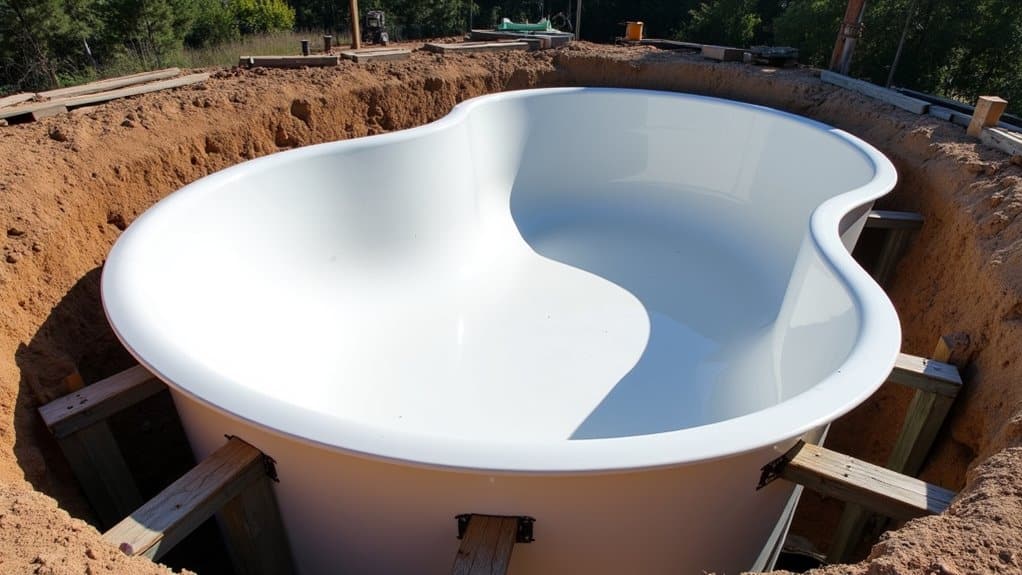
How structurally viable is a fiberglass shell when it’s elevated entirely above grade? Standard fiberglass pools handle inground or partial above-ground installations up to 18 inches without backfill. Beyond that threshold, you’ll need custom modifications, thicker shells (up to 1 inch versus the standard 3/8, 1/2 inch), marine-grade plywood reinforcement, and retaining walls limiting exposure above grade. The longterm effects of salt water in fiberglass pools can lead to a reduction in the lifespan of the pool shell if not properly managed. Regular maintenance, including balancing chemical levels and routine inspections, is crucial to mitigate these risks.
Above ground fiberglass pools work when you address hydrostatic pressure pushing outward against unsupported walls. You’ll need a flat, engineered foundation, and a crane sets the shell level per safety regulations. Barrier Reef Pools offers their entire range for above-ground setups, but you should confirm with your manufacturer to avoid voiding structural warranties. Full elevation demands precise load distribution and professional engineering oversight. Stronger structures benefit from curved pool designs, which distribute lateral forces more evenly, similar to the engineering principle behind water towers.
How Above-Ground Fiberglass Shells Are Built Differently
A fiberglass pool structural shell design for above-ground use addresses this through:
- Reinforced laminate schedules, thicker walls layered with vinyl ester and polyester resins increase load-bearing capacity without backfill dependency.
- Custom one-piece molding, factory-built to exact dimensions with pre-formed plumbing openings aligned during production.
- Straight-wall geometry, eliminates curvature that standard inground shells use to distribute soil pressure, requiring engineered compensation for lateral forces.
These aren’t cosmetic upgrades, they’re structural necessities. The foundation beneath these shells must be built on a compacted gravel layer spread evenly to ensure the entire surface remains smooth and stable enough to support the pool’s weight.
Best Yards for an Above-Ground Fiberglass Pool
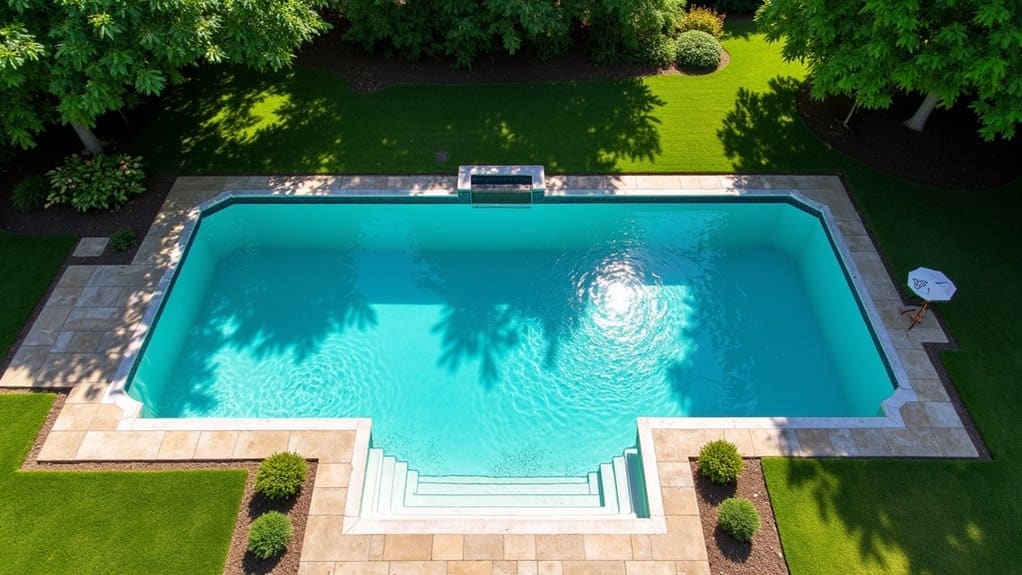
Because above-ground fiberglass shells lack soil backfill to distribute lateral loads, your yard’s baseline conditions directly dictate structural feasibility. The best yards for an above-ground fiberglass pool feature level terrain with stable, compacted soil, avoid sandy or silty ground that shifts under load. You’ll want to dig down the high side rather than building up the low side, maintaining at least 50% of the shell in mature soil for adequate support. Without this soil embedding, risk of bulging and long-term structural compromise increases significantly over time.
Position residential above ground fiberglass pool systems at least 20 feet from sloping hillsides to prevent ground creep. You’ll need proximity to power and water sources while avoiding underground utilities and overhead lines. Select sunny locations away from trees, ensuring clear sightlines from your house. In flood-prone areas, elevate installations up to 18 inches and anchor with cantilevered concrete patios to resist buoyancy forces.
What an Above-Ground Fiberglass Pool Actually Costs
Once you’ve confirmed your yard meets the structural and grading requirements, the next variable to lock down is budget, and above-ground fiberglass pools carry a wide cost spread.
- Shell + kit baseline: Complete above-ground fiberglass pools range $20,000, $75,000, with shells alone running $4,500, $30,000 depending on dimensions.
- Labor load: Installation averages $10,000, $20,000, typically requiring a five-person crew across 160 labor hours at roughly $5.50 per square foot.
- Pump and filtration: Expect $1,200, $4,500 for circulation hardware sized to turn over your volume every 6, 8 hours.
Size drives total cost linearly: a 10×20 pool averages $26,000, while a 16×32 hits $51,500. Above-ground configurations cut 30, 50% versus inground excavation costs. Vet fiberglass pool installation contractors against these benchmarks to avoid overloaded bids.
Base Prep and Support Your Above-Ground Pool Needs
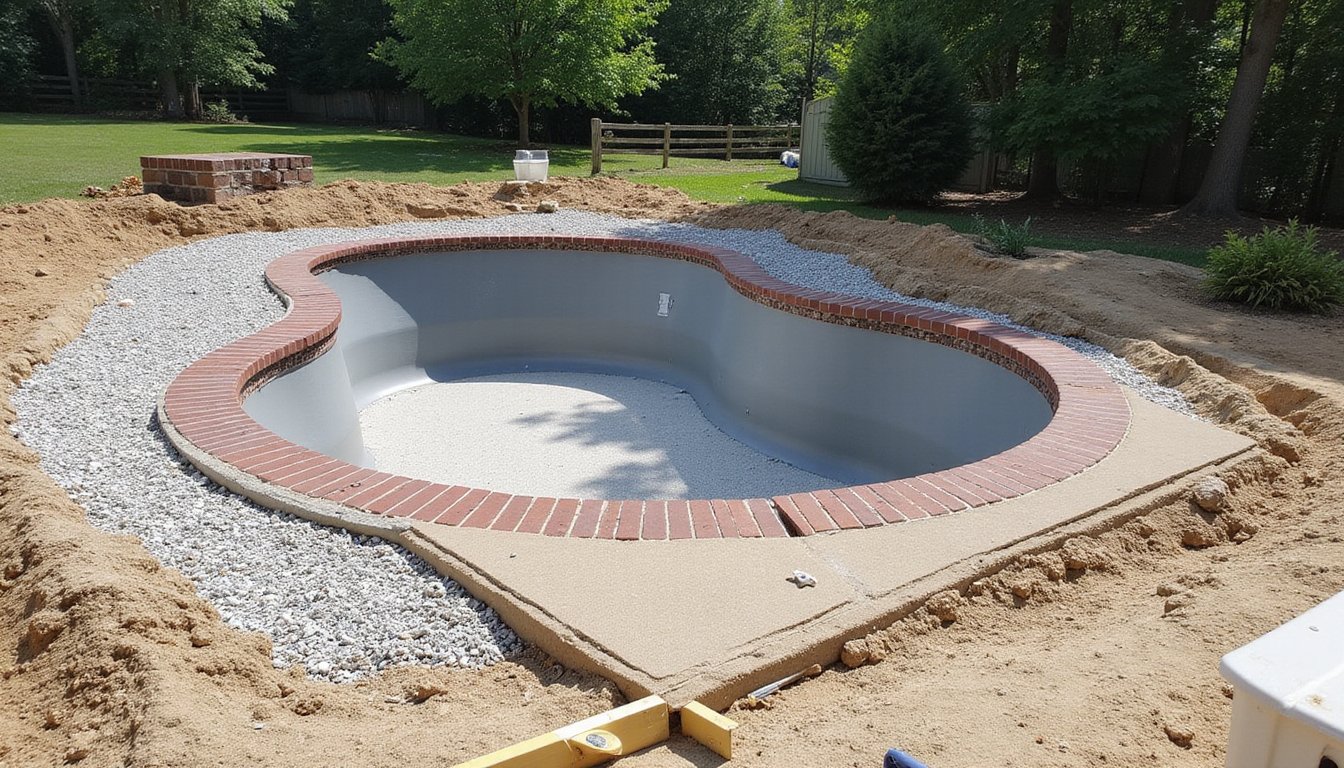
Before your fiberglass shell ever touches the ground, the base beneath it must handle a static load exceeding 125,000 pounds, and that’s water alone, not counting the shell weight or dynamic forces from bathers. Your fiberglass pool structural support base starts with precise excavation matched to pool dimensions.
You’ll need 4 inches of crushed, compacted clear aggregate topped with 2 inches of compacted brick sand. Remove high spots, don’t fill them, to maintain soil compactness. Verify flatness with a transit level.
Build a 4-inch sand cove at the wall junction for load adjustment, reaching 7 inches total height. Install a sump drain at the deep end to counteract hydrostatic uplift. Map all utilities before breaking ground.
When a Retaining Wall Is Required
When your site’s elevation change exceeds 18 inches, you’ll need a retaining wall to limit how much of the fiberglass shell sits exposed above grade, since unsupported sections face lateral forces that the shell alone isn’t engineered to resist. Most local codes require engineered retaining walls once the grade differential surpasses 2 feet, and you should verify your jurisdiction’s specific thresholds before breaking ground. By burying more of the shell behind a properly designed wall, you transfer hydrostatic and soil loads to a structure built to handle them, keeping surcharge pressures within the pool manufacturer’s structural tolerances.
Beyond 18-Inch Elevations
Elevations beyond 18 inches above grade introduce a critical structural threshold, you’ll need a retaining wall to support the fiberglass pool shell. Without backfill or wall support, lateral water pressure exceeds the shell’s unsupported load capacity. Key fiberglass shell durability factors include balanced soil pressure, proper embedment depth, and reinforced perimeter framing.
- A 3-foot elevation requires an 18-inch retaining wall, leaving only 18 inches of exposed shell above grade, the maximum allowable without custom manufacturer reinforcement.
- Walls exceeding 4 feet demand professional engineering per most local building codes, though some jurisdictions enforce this at just 2 feet.
- Terracing multi-level walls reduces material costs while distributing lateral loads across stepped sections, improving structural performance and landscaping integration.
Custom “beefed-up” shells from manufacturers become essential for straight-wall pools exceeding standard elevation limits.
Limiting Shell Exposure
A retaining wall‘s primary job in a fiberglass pool installation isn’t decorative, it’s structural. When your yard’s slope drops faster than standard grading permits, you’ll need a retaining wall to maintain controlled backfill and keep shell exposure at or below 18 inches above grade.
Limiting shell exposure directly reduces lateral stress on unsupported fiberglass surfaces. For a 3-foot elevation change, you’d build an 18-inch retaining wall around the perimeter, burying the remaining depth in compacted backfill. Geogrid reinforcement distributes soil loads across the retained section, requiring setbacks, typically 6 feet for a 6-foot wall.
Modern fiberglass pool construction technology produces strong one-piece shells, but they’re not engineered to resist unbalanced earth pressure without support. You’ll need separate retaining structures, unlike gunite pools that integrate wall function directly.
How Durable Is an Above-Ground Fiberglass Pool?
Your above-ground fiberglass pool’s one-piece molded shell flexes under load rather than cracking, with factory data showing a cracking incidence below 1% when you follow proper installation specs. Integrated structural support ribs distribute the hydrostatic and dead loads across the shell’s perimeter, reinforcing critical stress points where above-ground configurations bear the greatest lateral pressure. The non-porous gelcoat surface requires no resurfacing for 20, 30 years, cutting your annual maintenance costs to $500, $1,000 while resisting algae adhesion and chemical degradation.
Crack-Resistant Flexible Shell
Because fiberglass pool shells are manufactured as single-piece molded structures, they deliver crack resistance that concrete and vinyl alternatives can’t match. Manufacturer data shows cracking incidence below 1% when you follow proper installation protocols. The material flexes under load stress instead of fracturing, which is critical for fiberglass plunge pools above ground where structural forces differ from inground configurations. Regular maintenance is essential to maximize the benefits of fiberglass pool maintenance, ensuring longevity and enjoyment for years to come. Routine checks for any signs of wear and tear can help prevent costly repairs down the line.
- Tensile flexibility: Your shell accommodates ground movement and thermal expansion without surface failure, handling freeze-thaw cycles that would crack concrete.
- Seamless construction: A unified shell eliminates joint vulnerabilities, reducing leak points to near zero.
- Longevity under stress: You’ll get 25, 50 years of service life, with properly maintained installations reaching 60 years, far outlasting vinyl liners’ 7, 12 year replacement cycles.
Extra Structural Support Ribs
These extra structural support ribs function as integrated load paths, distributing force across the shell’s composite layers during fiberglass pool transport and placement and throughout its operational life.
| Load Parameter | Without Ribs | With Ribs |
|---|---|---|
| Lateral deflection | High risk | Minimal |
| Point-load tolerance | Low | Engineered capacity |
| Slope stability | Requires full burial | Above-ground viable |
| Lifespan under stress | Reduced | 25, 50+ years |
| Support compatibility | Limited | Concrete, timber, retained platforms |
You’re fundamentally getting a self-reinforcing structure that maintains dimensional integrity across variable terrain, reducing your dependence on external bracing while handling full hydrostatic loads.
Low-Maintenance Non-Porous Surface
One defining performance feature of above-ground fiberglass pools is the non-porous gelcoat surface, a factory-applied finish that functions as the shell’s primary defense layer against chemical penetration, biological adhesion, and structural water absorption. This surface resists algae attachment, reducing chemical demand and scrubbing frequency compared to concrete alternatives. Clean fiberglass pool maintenance tips are essential for keeping your pool in optimal condition. Regularly checking and balancing the water chemistry ensures the longevity of the gelcoat surface.
- Chemical efficiency: Non-porous gelcoat minimizes chlorine consumption, maintaining clarity with less intervention.
- Structural integrity: Zero water absorption prevents delamination at fiberglass pool deck integration points where load transfer occurs.
- Maintenance reduction: Annual costs run $500, $1,000 versus $1,000, $2,000 for concrete, with no resurfacing cycles required.
Newer gelcoat formulations deliver 10, 20% improved UV resistance, extending surface performance beyond 25 years. You’ll avoid liner replacements and resurfacing entirely, keeping total 10-year maintenance costs around $4,000.
Decking, Fencing, and Permits to Plan For
Once your fiberglass pool shell’s elevation and structural support are locked in, you’ll need to address three interconnected planning elements: decking, fencing, and permits. For semi inground fiberglass pool systems with up to 18 inches exposed, framed decking covers retaining walls and backfill, though costs nearly double compared to concrete decks. Fencing must meet local safety codes, with gate latches positioned at least 54 inches above ground to prevent unauthorized access. Permits require site inspections confirming layout, soil support mandates of at least 50% in mature soil, and design approval for elevations exceeding standard inground specifications. Elevated pools using steel reinforcement and framed supports trigger mandatory permitting. Coordinate all three elements early, each directly impacts structural compliance and your project timeline.
Ready to Transform Your Backyard?
Your dream pool is closer than you think. At Schiller Pools, our experienced team brings over 40 years of expertise to every project, delivering stunning fiberglass pool installations and custom pool construction that turn ordinary backyards into extraordinary outdoor retreats. With flexible financing options and lifetime warranty backing, there has never been a better time to get started. Call (561) 475-5997 today for your free estimate.
Frequently Asked Questions
How Often Should the Water Be Fully Circulated in an Above-Ground Fiberglass Pool?
You should fully circulate your above-ground fiberglass pool’s water every 6 to 8 hours for ideal water quality. That’s your target turnover rate, run your pump to push the entire volume through filtration within that window. If you’re using a variable-speed pump, you’ll want 10, 12 hours at lower RPMs to hit the same throughput. On high-temperature days, don’t drop below 8 hours of runtime to prevent algae buildup.
What Chlorine and pH Levels Should an Above-Ground Fiberglass Pool Maintain?
You should maintain free chlorine between 1 and 3 ppm, targeting 3 ppm as your maximum operational threshold. Keep your pH locked between 7.2 and 7.8, ideally narrowing that to 7.4, 7.6 for peak chemical efficiency. If pH drifts above 7.8 alongside high calcium, you’ll risk damaging your fiberglass gel coat. Test and adjust both parameters weekly, and don’t shock your pool when pH or alkalinity falls out of range.
How Much Does the Water in a Typical Fiberglass Pool Weigh?
Your typical fiberglass pool holding 18,000 gallons carries approximately 149,940 pounds of water weight. You’ll calculate this using the formula: gallons × 8.33 = total water pounds. A mid-range 11,588-gallon pool loads roughly 96,500 pounds, while a smaller 7,594-gallon kidney shape registers around 63,250 pounds. Don’t forget to add the shell weight, typically 2,000 to 3,500 pounds, when you’re engineering your total structural load requirements.
Can Groundwater Pressure Damage an Above-Ground Fiberglass Pool From Underneath?
Yes, groundwater pressure can damage your above-ground fiberglass pool from underneath. Saturated soil generates uplift force that pushes against the shell’s base, potentially causing cracks, wall deflection, or even floating the lightweight structure. You’ll need to install dewatering pipes below the pool’s lowest point, use a 3/4-inch clean stone base for drainage, and maintain a standpipe with sump pump access to actively relieve hydrostatic pressure beneath your pool.
Do Above-Ground Fiberglass Pools Need Different Filtration Systems Than Inground Pools?
You don’t need different filtration types, above-ground fiberglass pools use the same sand, cartridge, and DE filters as inground setups. The difference lies in system sizing and placement. Your above-ground pool’s shorter plumbing runs reduce hydraulic load on the pump, so you’ll typically run smaller-capacity filters matched to lower water volumes. You should still target full-volume turnover every 6 to 8 hours for proper sanitation.